The Odyssey Movie 2026 Review: Is This Still Homer’s Odyssey?
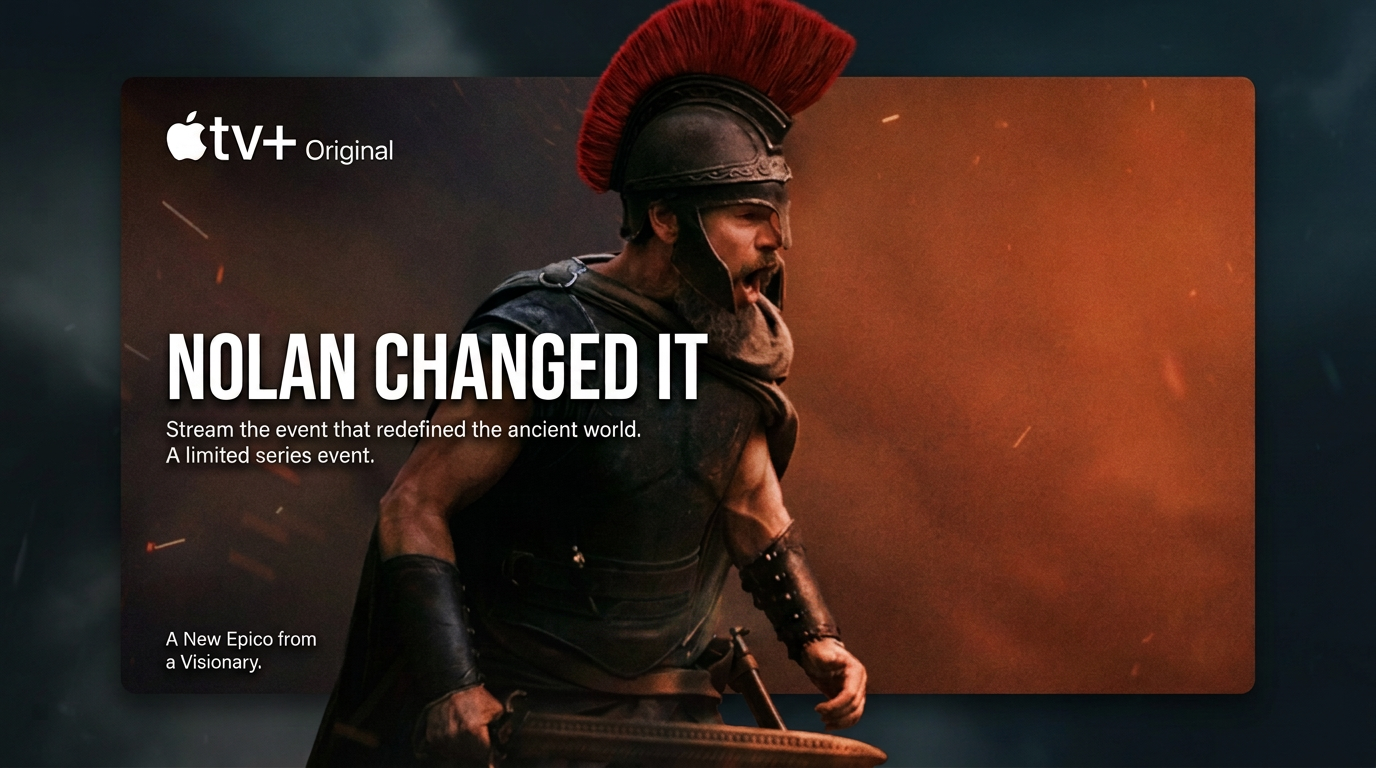
Christopher Nolan’s The Odyssey is finally here, and somehow the biggest debate is not whether the movie is good.
It is whether this is even Homer’s Odyssey anymore.
That might sound dramatic, but it is the argument dominating the conversation around the film. Nolan has taken one of the oldest and most influential adventure stories ever written and filtered it through everything people associate with his movies: guilt, fractured memory, damaged men, the consequences of war and characters who are emotionally trapped long after the main conflict has ended.
So instead of treating Odysseus purely as a legendary hero trying to survive monsters, gods and impossible obstacles, Nolan appears far more interested in what ten years of war would actually do to a man.
And that is where things become interesting.
For some viewers, this is exactly why the adaptation works. Odysseus is not just fighting to return home. He is carrying Troy home with him. Every decision, every loss and every violent encounter feels connected to the person he became during the war.
Other viewers are much less convinced.
They argue that Nolan has taken Homer’s strange, mystical and often surreal world and made it too grounded, too serious and too recognizably Nolan. The joke already circulating online is that this is basically Oppenheimer on a boat, only this time there are Cyclopes.
It is a funny comparison, but it also gets to the heart of the criticism.
Has Nolan adapted The Odyssey, or has he simply absorbed it into his own cinematic universe?
The historical accuracy debate has made things even louder. People have been analyzing the armor, ships, costumes and weapons as though the movie were presenting itself as a Bronze Age documentary. Some historians and mythology fans have criticized details that do not line up perfectly with the period.
Nolan’s defenders have a fairly simple response: this is mythology.
There is no single definitive visual version of these characters. Homer was not writing a production manual for future filmmakers. The story has been retold, translated and reinterpreted for thousands of years.
That argument makes sense, but it has not stopped audiences from debating every helmet, sword and piece of fabric visible in the trailers.
Then there is the dialogue.
Nolan chose modern English instead of forcing the actors to speak in an artificial, overly theatrical style. The intention is obvious. He wants the characters to feel like a family rather than marble statues reciting ancient poetry.
But the moment modern phrases started appearing, parts of the internet immediately rejected them.
A character saying “father” might feel appropriately epic. A character saying “dad” suddenly reminds some viewers that they are watching famous actors in costumes.
It is a small creative decision, but it reveals the impossible problem facing any adaptation of ancient mythology. Make the dialogue too formal and the characters feel distant. Make it too modern and the illusion collapses.
The casting has created another predictable wave of controversy.
Some viewers are debating whether certain actors match traditional interpretations of the characters. Other reactions have moved far beyond serious criticism and into the usual culture-war outrage that surrounds almost every major historical or mythological production.
But the more useful question is not whether these actors resemble paintings created centuries after Homer.
It is whether they make the characters believable.
Mythology has never remained visually fixed. Every generation reshapes these stories in its own image. The Greeks themselves had different versions of the same myths. Demanding one supposedly “correct” interpretation misses how mythology has always worked.
The larger and more important discussion, however, is about the future of movies themselves.
The Odyssey is an enormous production. It was filmed using IMAX cameras, practical locations, large physical sets and the kind of logistical scale that most studios now reserve for superheroes, sequels or established franchises.
That makes the film feel like more than another Nolan release.
It feels like a test.
Can a director still convince audiences to leave their homes for a massive, serious, adult-oriented epic? Can a studio spend hundreds of millions on something that is not built around capes, shared universes or post-credit scenes?
Nolan is one of the few directors who can still get that opportunity.
That is why the film’s performance matters beyond whether audiences like this particular adaptation. If The Odyssey succeeds, it strengthens the argument that spectacle does not have to mean disposable franchise content. Large-scale cinema can still be driven by a director, an idea and a story that has survived for thousands of years.
There is also something strangely appropriate about Nolan using cutting-edge IMAX technology to tell one of humanity’s oldest stories.
The production is technically modern but philosophically ancient. It is built with massive cameras and contemporary filmmaking tools, yet the central questions remain the same.
What does war turn a man into?
Can someone truly return home after becoming a different person?
And what happens when the hero everyone remembers is no longer the man who left?
That is probably the strongest thing about Nolan’s approach.
He may not be giving audiences the version of The Odyssey they imagined in school. He may be giving them something darker: a story about a celebrated warrior slowly realizing that surviving the journey is not the same as escaping it.
So the real argument is not whether the film is perfectly faithful to Homer.
It is whether faithfulness means recreating every monster, island and event exactly as written, or preserving the emotional meaning underneath them.
Nolan’s The Odyssey might be one of the most physically ambitious adaptations of the story ever made while also being one of the most psychologically modern.
That contradiction is exactly why people cannot stop talking about it.