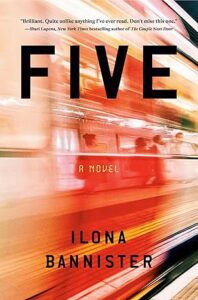
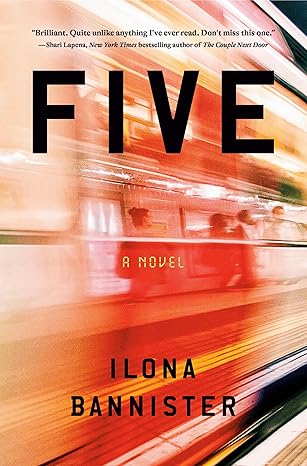
Five: A Novel Book Summary and Review
The Premise That Changes Everything
Most novels give you the luxury of uncertainty. You don’t know who will live, who will suffer, who will walk away changed. Ilona Bannister’s Five strips that comfort away in the very first sentence.
Someone will die here this morning at this suburban train station. It will happen in the next five minutes when the 7:06 to London Victoria arrives.
That’s it. That’s the opening. And from that moment, you are no longer just a reader. You are a participant ; restless, complicit, and deeply uncomfortable in the best possible way. Five is one of the most bracingly original novels of 2026, a book that doesn’t just tell you a story; it uses the story to put you on trial.
What’s It About?
Five introduces readers to five seemingly random people waiting for a train. But these are not just any five people. From the beginning, we know that one of them is going to die soon very soon.
Set against the ticking clock of an approaching train, the novel stretches a matter of minutes across its entire length. Bannister intersperses the present-moment tension with flashback chapters that unpack each character’s history ; the struggling gambler, the abrasive elderly woman, the overwhelmed mother and her volatile child, the polished yet fractured businessman.
Five people. Five stories. Four survivors. The mathematics are simple. The moral calculus is anything but.
The Five Strangers on the Platform
Gideon : the child from hell. He is small, brilliant, and utterly consuming. He has been draining his mother’s energy and resources since birth, and he is balance-walking along the lip of the platform as the train approaches. He is the novel’s most unsettling presence ; a child you cannot look away from, precisely because looking at him forces you to look at yourself.
Emma : Gideon’s mother. Bannister excels at digging out emotional depths many people would prefer to keep hidden, as when a parent momentarily considers whether her life would be easier without her rambunctious child. Emma is the novel’s most quietly devastating character not because she is monstrous, but because she is recognizable. Her darkest thought is one that parents rarely dare to voice, and Bannister makes you sit with it until you understand exactly how someone gets there.
Sonny : the beautiful young man on the verge of gambling his life away. He is 27, magnetic, charming enough to get away with things that would sink others. His addiction is online gambling, but his real problem is the gap between who he appears to be and who he actually is. Readers will find him the easiest to love and, perhaps for that reason, the most dangerous to root for.
Mrs. Worth : the cantankerous old woman who has fallen to the ground yet is refusing help. She is 78, stubborn, prickly, and has come to the platform to visit her grandsons for the first time in years. She resists sympathy on principle, which somehow makes her more sympathetic. There’s a whole lifetime compressed into her refusal to accept assistance from strangers, and Bannister knows exactly when to let that compression speak.
Liam : the businessman. Attractive, wealthy, mid-fifties, and orbiting the others with a curious detachment. He is, as the novel frames him, the successful and damaged businessman orbiting them all. He is the character who takes the longest to understand, and the one whose backstory, when it finally arrives, lands with the most weight.
The Structural Masterstroke
What makes Five genuinely radical isn’t the premise ; it’s what Bannister does with form. The novel breaks the fourth wall, directly addressing the reader, forcing you not just to observe these people but to judge them. The novel asks the reader to be judge, jury, and executioner.
Bannister assumes that readers will pick a favorite character for an early grave and will root for others to survive. She then challenges the reader to ask why one character is “worthy of surviving in the internal universe of your brain” while another is not. The novel’s brilliance lies in that philosophical inquiry.
And she doesn’t let you off the hook cleanly. The novel invites thoughts you might not be entirely proud of. You might find yourself judging harshly, making quick decisions, even justifying them. That’s where Five is at its strongest: not in the mechanics of its premise, but in how it exposes the reader’s own instincts and biases.
Bannister went to extraordinary lengths to make this credible ; timing lines of dialogue, measuring how long it takes to think a particular word, walking and pacing her local train station, counting steps, studying paint, reading signs all to convince the reader that five minutes could contain this much. It does. And she pulls it off.
The Writing: Scalpel-Sharp
Five delivers the tension of a thriller and the deep character development of a literary novel. Bannister’s prose is precise in its depiction of human nature. She is brutal in her honest observation of human failings but compassionate in her understanding of human weaknesses.
It is funnier than you would expect from a book that touches on forced sterilization, baby trafficking, and the casual cruelty of good Christian women ; the kind of book that bites a strip out of the very church ladies it impersonates so well. Wait that last bit was The Calamity Club. But it applies here too, in a different register: Five is darker and more urban, but Bannister shares that quality of writing humor into places it has no right being, and somehow making it work.
Publishers Weekly praised her “compassion and gift for nerve-shredding tension,” while Kirkus Reviews awarded it a starred review, calling it a tense, deftly written page-turner filled with memorable characters, a surprisingly philosophical core, and a plot in which each minute brings a new surprise.
Bannister plays with form, occasionally using her narrative voice to speak directly to the reader as when she explains that surviving characters have metaphorically died in part, and that “metaphors about life and death, or the death of the spirit versus the death of the body, or the death of the past to enable the birth of the future, are always good topics to raise in book club when the conversation lags.”
Because talking about metaphors is easier than talking about why we wanted a particular character to die. It’s a wry, sharp intrusion and it works precisely because Bannister knows exactly what she’s doing.
Review
The pacing is deliberately, sometimes frustratingly, decelerated.
Readers expecting a high-octane, tick-tock thriller may find themselves wanting to slow down to reflect on the storyline or the fates of particular characters. Bannister manages to tell a story that is both fast-paced and perhaps a little slower than expected as her narrative choices prompt introspection. This is, depending on your tolerance, either the book’s greatest strength or its most significant friction point.
The flashback structure can break tension rather than build it.
Some readers have noted that the switches to the lengthy backstories took away the connection and tension felt in the main scene, making the flow feel choppy, and the switching back to the main scene became repetitive instead of tension-filled as time was counting down. It’s a valid criticism. The structural ambition occasionally outpaces the structural execution.
Not everyone will warm to these characters.
Bannister is deliberately writing against the grain of likability. These are not people designed to be adored. She writes a morbidly entertaining story about deeply unlikable characters and the familial trauma that brings them all together. Readers who need to root for someone unreservedly may find the experience alienating by design.
The Bigger Question the Book Asks
Here is what separates Five from the crowded field of psychological thrillers: it doesn’t want to entertain you and send you home. It wants to leave a splinter.
The novel is less about the inevitability of death and more about the uncomfortable calculus we perform, often without realizing it, when we look at other people.
Five offers no easy answers, but rather a nuanced exploration of the human condition in all its messy complexity. And crucially, the novel’s real question isn’t who deserves to die; it’s whether you deserve a better fate than these characters. It doesn’t matter what we think we deserve.
That’s the gut-punch Five saves for last. And it lands.
The Verdict
Five is one of the most formally inventive novels of 2026. It is small in duration ; five minutes on a train platform and enormous in what it asks of its reader. It will make you uncomfortable. It will make you laugh in places you won’t expect. It will make you catch yourself mid-thought and wonder what that thought says about you. Readers will surely find themselves thinking about this book next time they’re standing on a train platform. Kirkus Reviews
Razor-sharp, wickedly funny, and darkly thrilling ; a gripping, chilling story that asks difficult questions about judgment, forgiveness, and the notion of cause and effect.
Ilona Bannister isn’t writing comfort fiction. She’s writing the kind of fiction that changes how you see strangers on platforms, in lifts, at crosswalks ; people with entire histories crammed behind their faces, whose worth you calculate in fractions of a second without ever knowing you’re doing it. Five makes that invisible process visible. And it’s impossible to look away.
At a Glance
- Author: Ilona Bannister
- Published: May 5, 2026 : HQ / HarperCollins
- Best for: Fans of psychological fiction, philosophical thrillers, formally experimental literary fiction, The One, All the Colors of the Dark
- Trigger notes: Includes themes of parental ambivalence, addiction, suicide, and child endangerment handled with precision, not exploitation
- Rating: ★★★★½ : Formally brilliant, morally unflinching, and utterly unforgettable.