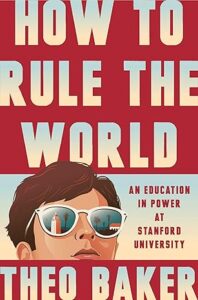
How to Rule the World: An Education in Power at Stanford University Book Summary and Review
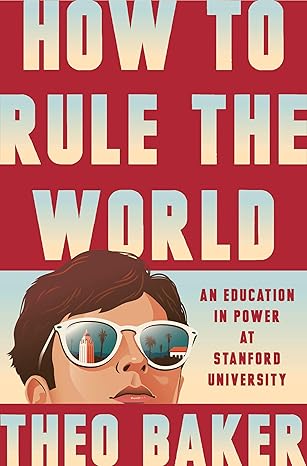
The Kid Who Took Down a President Then Wrote the Book
There is an almost absurd quality to the central fact of Theo Baker’s debut. He arrived at Stanford University at seventeen, a tech-obsessed coder who thought he’d found paradise.
He left, four years later, having toppled the institution’s president, won journalism’s most prestigious young investigator award, and signed a book deal with Penguin Press all before receiving his diploma.
Named a Most Anticipated Book of 2026 by The New York Times, How to Rule the World arrives as a revelatory and gripping account of Silicon Valley hubris from the winner of the George Polk Award.
It is, in equal measure, a first-rate investigative thriller, a mordant campus memoir, and one of the most incisive portraits of institutional rot in American higher education written in years. The only thing more remarkable than the story it tells is the age at which Baker was living it.
Who Is Theo Baker?
Before the book, some context. Baker, the son of political reporters Peter Baker and Susan Glasser, enrolled at Stanford in 2022 planning to study computer science. He joined the student newspaper as a hobby. That detail matters. He wasn’t a crusading young journalist arriving with a manifesto. He was a coder who wandered into the newsroom, presumably looking for something to do between problem sets.
What followed was anything but casual. He had just arrived on campus when he decided to dig into murmurings in scientific forums that the president of his university may have allowed falsified scientific data to be published.
One anonymous tip. One old blog post. One seventeen-year-old with no professional training, no institutional protection, and every incentive to leave well enough alone.
He didn’t leave well enough alone.
The Investigation: A Freshman Takes on a President
At the helm of Stanford’s business was Marc Tessier-Lavigne, a superstar neuroscientist and wealthy biotech executive. He was, by any conventional measure, untouchable ; a celebrated scientist presiding over one of the world’s most powerful universities, insulated by money, reputation, and the reflexive deference institutions extend to their leaders.
Baker reported a series of stories alleging that Tessier-Lavigne was complicit in publishing deceptive and misleading scientific research on multiple occasions.
The university assembled a committee to investigate Baker’s claims, and in 2023, Tessier-Lavigne resigned from his post shortly after Baker became the youngest recipient of a Polk Award.
The mechanics of that investigation, as Baker recounts them, read like a thriller written for people who’ve never trusted institutions.
Only one month into college and thousands of miles from home, Baker began receiving anonymous letters, going on stakeouts, and tracking down confidential sources.
High-powered lawyers and public relations teams were hired to attack his reporting. The full weight of one of the wealthiest universities in the world ; an institution with an annual budget exceeding that of over 150 countries was brought to bear against a teenager with a student press badge.
He won.
Beyond the Scoop: What the Book Is Really About
The Tessier-Lavigne investigation is the book’s spine, but Baker is after something larger. How to Rule the World is not simply a journalist’s victory lap. It is a sustained, clear-eyed examination of what Stanford actually is and what it does to the young people who pass through it.
Stanford, Baker realized, was less a school than a business. Its annual budget was nearly twice that of Harvard or Yale and higher than those of 116 countries.
The product? Students. Especially those special few identified as the next trillion-dollar startup founders. For them, there were secret societies, “pre-idea” funding offers, and social calls from billionaires, all with the expectation that these geniuses would soon join the ruling elite.
The book is based on over 250 interviews with various stakeholders, including students, CEOs, and Nobel laureates, aiming to expose the influence of Silicon Valley’s startup culture.
The picture that emerges is not flattering, but it is recognizable to anyone who has watched Silicon Valley operate up close ; a machine that identifies exceptional young people, performs extraordinary generosity upon them, and extracts loyalty and future value in return.
Steve Blank, who teaches the school’s legendary startup course, tells Baker that “Stanford is an incubator with dorms,” which is not meant as a compliment. What’s striking is not that the pressure exists ; it’s how thoroughly it has been internalized.
There was a time when Stanford students felt the weight of Silicon Valley expectation pressing from the outside. Now, many arrive on campus already expecting, as a matter of course, to launch a startup, raise money, and become rich. The aspiration arrived before the education.
Sam Altman ; OpenAI CEO, former Y Combinator head, precisely the kind of person these students aspire to become , tells Baker that the VC dinner circuit has become an anti-signal to the people who actually know what talent looks like. The students doing the rounds, performing founder-ness for rooms full of investors, tend not to be the real builders.
The performance of ambition and the thing itself have become nearly impossible to tell apart, and the system designed to identify genius has gotten very good at finding people who are good at seeming like geniuses.
The Personal Cost: What the Book Gets Quietly Right
The most emotionally resonant sections of How to Rule the World aren’t the investigative set-pieces ; they’re the quieter passages where Baker reckons with what his reporting cost him personally.
Baker is frank about the toll his reporting took on his social life and his faith in higher education. The book is at its most fascinating when detailing his disillusionment with the “rot” at the heart of academia that prizes the appearance of success over the truth.
He was, lest we forget, a teenager away from home, navigating the social labyrinth of a hyper-competitive campus, and simultaneously conducting an investigation that was generating front-page national news while lawyers tried to dismantle his credibility.
A reviewer noted: “I am a sucker for books that illuminate cultures born of hubris, stories that make you say, ‘I had no idea this world existed.’ Theo Baker achieves this for several such worlds at the same time: Silicon Valley, ‘Nerd Nation’ (as Stanford calls itself), oligarchy, and precocious youth generally.”
That layering ; the personal inside the institutional inside the cultural is what elevates How to Rule the World above a straightforward journalism memoir.
Amy Pascal, the former chairwoman of Sony Pictures, put it neatly: His vulnerability and brilliance leap off the page in equal measure.”
The Writing: Propulsive, Wry, and Disarmingly Self-Aware
Baker writes with a precision and wit that belies his age. Publishers Weekly, in a starred review, called it “a confident testament to the power of independent journalism from an author with a bright future,” and Kirkus described it as “brisk and punctuated with well-explained details.”
For a debut, and from someone who was technically still a student while writing it, the prose control is striking.
William Cohan, the bestselling author of House of Cards, praised the “spare and propulsive prose,” calling the book “a nearly unfathomable accomplishment from someone so young.”
What prevents the book from becoming a self-congratulatory exercise is Baker’s willingness to examine his own naivety, his own seduction by the Stanford machine and the degree to which he, too, arrived as a true believer.
That honesty is the book’s most valuable asset. It would be easy to write this story as a morality play with a clear hero. Baker resists that, and the book is richer for the resistance.
The Bigger Irony the Book Can’t Quite Escape
Here is the uncomfortable truth that hangs over How to Rule the World, acknowledged with some wit by at least one commentator: there’s a certain irony in the strong likelihood that this critically minded book about Stanford’s relationship to power and money will be celebrated by the same class of people it critiques and, if it does well (it has already been optioned for a movie), used as further evidence that Stanford produces remarkable people.
The very features that make Baker’s story compelling ; his age, his pedigree, his precocity, the sheer improbability of what he accomplished are also the features that the Stanford brand would be happy to absorb. He critiques the institution while becoming, almost inescapably, one of its most impressive advertisements. That irony is not a flaw in the book.
It is, in fact, the book’s most sophisticated argument: the machine is good enough at what it does that even its critics emerge as its products.
Finally
How to Rule the World is that rare thing ; a book that earns its hype without feeling like it was written for its hype. It is a genuine investigative account, a campus memoir, a cultural critique, and an unexpected coming-of-age story, all compressed into 336 pages of economical, confident prose.
Jake Tapper called it “essential reading for anyone seeking to understand the culture of money and ambition that has taken hold at one of America’s most storied institutions.”
That’s not blurb inflation. It is an accurate description of what the book delivers.
What Theo Baker has written is, ultimately, a document about the cost of proximity to power what it does to institutions, what it does to the people inside them, and what it does to a teenager who arrives as a true believer and leaves as something more complicated: a journalist.
At a Glance
- Author: Theo Baker
- Published: May 19, 2026 , Penguin Press
- Pages: 336
- Genre: Narrative nonfiction / Investigative memoir
- Best for: Readers of Michael Lewis, Bad Blood by John Carreyrou, Burn Book by Kara Swisher, anyone fascinated by Silicon Valley culture, academic power, and the economics of elite education
- Awards: George Polk Award (youngest-ever recipient); Investigative Reporters and Editors Award
- Rating: ★★★★★ : An extraordinary debut. One of the defining nonfiction books of 2026.