House of the Dragon S3 Episode 7 Explained
Aegon Did Not Become a Good Man, He Finally Became a King
I did not expect to cheer when Sunfyre emerged from those trees.
Aegon remains one of the most morally repellent people in House of the Dragon. One dramatic speech cannot erase his cruelty, entitlement or the suffering he caused before the war stripped away his power.
Yet when he stopped running, drew his sword and declared himself Aegon Targaryen, something changed.
Not his morality.
His identity.
For most of the series, Aegon has lived inside roles other people forced upon him. Alicent wanted him to become the political answer to Rhaenyra. Otto treated him as the legal mechanism through which the Hightowers could control the throne. Criston Cole and Aemond had to locate him and physically return him for his coronation because he did not initially possess the conviction to claim the crown for himself.
Aegon enjoyed the privileges of royalty, but he never understood kingship as an internal identity.
He was wearing someone else’s crown.
Episode 7 changes that.
When Rhaenyra’s soldiers surround him, Aegon has no army, no court and apparently no dragon. The symbols that once made him king have been taken away. He is a damaged man standing in the dirt with two remaining supporters and no reasonable chance of survival.
That is precisely when he finally claims the role.
He does not proclaim himself king from the Iron Throne. He proclaims it when the title offers him nothing except a more memorable death.
That is why the scene works for me.
Aegon is no longer responding to his mother, grandfather, council or brother. He chooses to identify himself even though remaining anonymous might preserve his life. He decides that dying as Aegon Targaryen matters more than surviving as another nameless fugitive.
It is not redemption.
It is agency.
The scene becomes even stronger when Aegon releases Larys and Tyland from their obligations. He does not order them to die beside him. Tyland remains voluntarily, while Larys promises to preserve Aegon’s final moments through history and song. For perhaps the first time, Aegon inspires loyalty without relying entirely upon rank or fear.
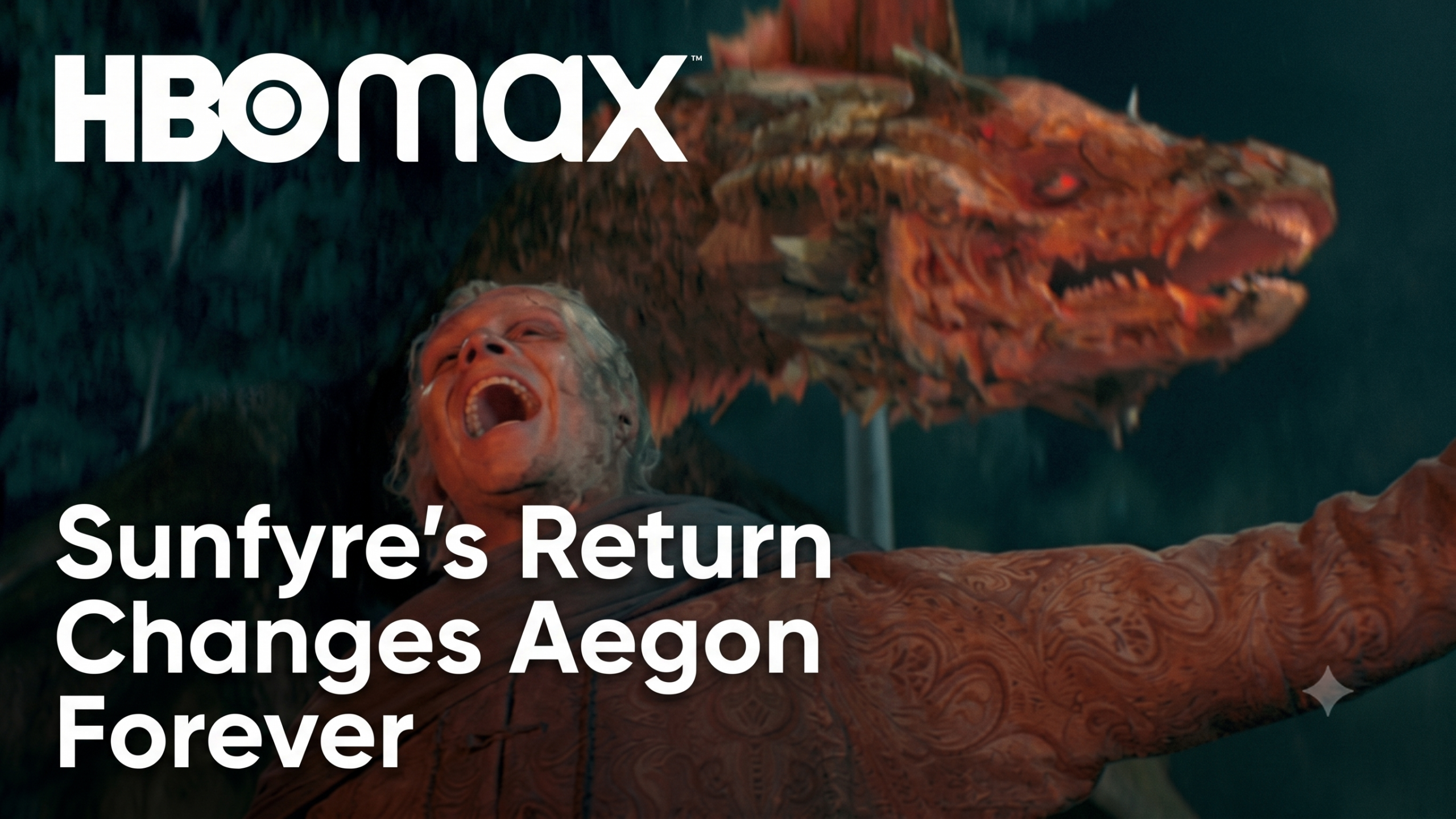
Then Sunfyre appears.
The reunion transforms Aegon’s declaration from the final performance of a doomed claimant into something resembling a coronation.
The visual design is not subtle. Aegon’s face is burned on one side; Sunfyre bears corresponding damage on the opposite side. They look like two halves of the same wounded creature. The episode’s director has explained that their connection is central to Sunfyre’s return, with the dragon seemingly sensing that Aegon was about to die.
That explanation matters because Sunfyre does not merely restore Aegon’s military power.
He validates Aegon’s belief in himself.
Aegon has been rejected by almost everyone who helped place him on the throne. Alicent lost faith in him. Otto regarded him as an embarrassment. Aemond attempted to destroy him. His crown disappeared, his body was broken and his political supporters scattered.
Sunfyre is the one powerful being that still recognizes him.
The dragon does not care whether Aegon is intelligent enough to govern, morally qualified to rule or legally superior to Rhaenyra. Sunfyre responds to the bond.
For Aegon, that response becomes proof.
He declares himself king, and a dragon answers.
I understand why viewers are suddenly rooting for him. The scene uses one of storytelling’s most effective emotional structures: the broken underdog discovers that he was never truly abandoned. The fact that this underdog is Aegon Targaryen makes the response uncomfortable, but it does not make it less effective.
Tom Glynn-Carney also refuses to play the moment as clean heroism.
Aegon begins with something approaching dignity. He appears prepared to accept death. Once Sunfyre starts burning the soldiers, however, his expression shifts into manic delight. The vulnerable man disappears, and the intoxicated prince returns.
He is not horrified by what his restored power can do.
He is ecstatic.
Sunfyre’s sounds even seem to echo Aegon’s laughter, giving the reunion the emotional warmth of two friends finding each other and the visual horror of a king celebrating while men burn alive. Fans immediately noticed both the tenderness and the madness of the moment.
That contradiction is exactly what House of the Dragon needs.
The show becomes weaker whenever it divides the conflict into an enlightened side and a corrupt side. The Dance of the Dragons should not operate like a modern election in which the audience identifies the more acceptable candidate and waits for history to confirm the choice.
It should constantly disrupt our loyalties.
Aegon can be a terrible person and still experience genuine love for his dragon.
Rhaenyra can possess the stronger claim and still become increasingly authoritarian.
Daemon can love his family and remain catastrophically dangerous to it.
Alicent can recognize the consequences of the war while continuing to betray her own children.
These contradictions are not distractions from the story. They are the story.
Episode 7 becomes especially interesting because Aegon’s emotional rise occurs while Rhaenyra’s authority continues to fracture.
Rhaenyra possesses more dragons, more riders and greater visible military power. But the episode repeatedly questions whether those advantages belong to her in any meaningful sense. Ulf is already entertaining Ormund Hightower’s offer of Driftmark. Hugh has personal pressures capable of changing his loyalty. Rhaena’s bond with Sheepstealer produces a confrontation that the riders struggle to control. Helaena directly challenges Rhaenyra by asking whether possessing so many dragons has altered her.
Rhaenyra believes she commands dragons.
Aegon has one dragon that appears to choose him.
That distinction gives Aegon’s relationship with Sunfyre enormous dramatic power.
But I would stop before treating Sunfyre’s arrival as supernatural confirmation that Aegon is the rightful king.
Dragons are not divine judges.
They do not select rulers according to justice, wisdom or legal legitimacy. They form mysterious bonds and then act according to instincts that their riders only partially understand. Sunfyre may have sensed Aegon’s danger, recognized his voice or simply awakened amid the movement and violence. The scene allows Aegon to interpret the return as destiny without confirming that destiny objectively exists.
That uncertainty makes the moment more dangerous.
Aegon now believes the universe has endorsed him.
Before this episode, he was an unwanted king questioning whether the crown had destroyed his life. After Sunfyre’s return, he possesses something far more powerful than political legitimacy: personal conviction.
He has suffered.
He has survived.
His enemies attempted to erase him.
His dragon returned when he called.
Those facts can easily become the foundation of a messianic narrative in Aegon’s mind. He will no longer view himself as the accidental beneficiary of Hightower ambition. He can now see himself as the king who was burned, buried and resurrected alongside his golden dragon.
Aegon has not become better.
He has become coherent.
That may make him far more dangerous than the drunken prince who originally had to be dragged to his coronation.
The smartest part of “The Dragon in Winter” is therefore not the revelation that Sunfyre survived. Book readers largely expected that. The real surprise is how effectively the reunion reorganizes the audience’s emotions.
Viewers who spent years waiting for Aegon’s defeat are now asking whether they are rooting for him. That reaction does not mean the audience has forgotten what he did. It means the series finally placed him inside a story powerful enough to compete with his crimes.
For several minutes, I saw the civil war from Aegon’s perspective.
I saw a betrayed son, a mutilated king and a rider reunited with the only creature that had never judged him inadequate.
Then the fire began.
The scene invited me to celebrate his restoration while forcing me to watch what restored Targaryen power actually means for everyone standing nearby.
That is the moral discomfort this series should produce.
Sunfyre did not prove that Aegon deserves the Iron Throne.
He proved that Aegon is no longer powerless.
Those are not the same thing.