Fallout 4 Just Got a Massive Console Modding Upgrade
Fallout 4 is more than a decade old, but somehow Bethesda has managed to drag it back into one of the most familiar arguments in gaming: are they supporting the modding community, or are they slowly turning mods into another storefront?
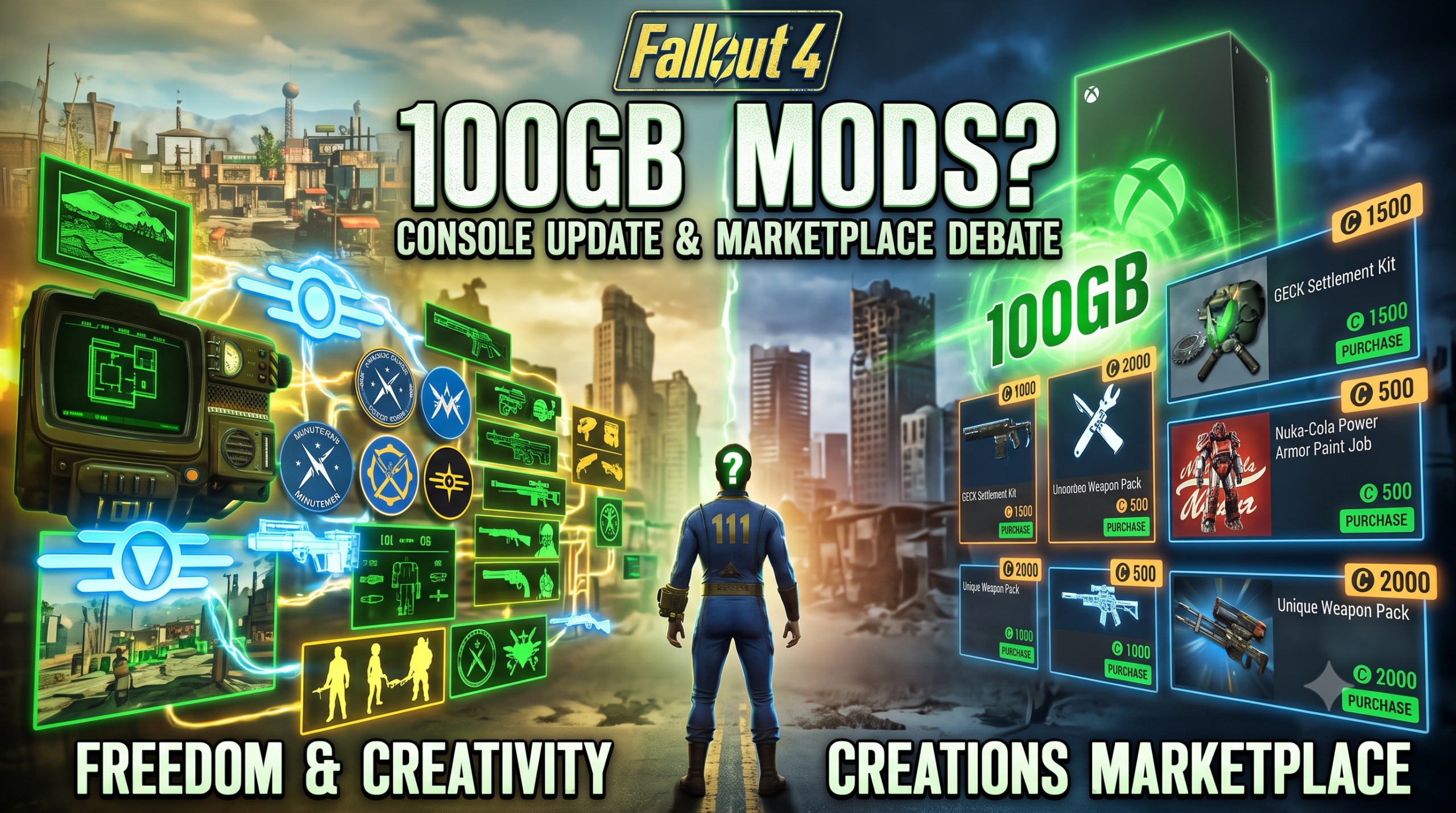
The latest Fallout 4 update dramatically increased mod storage on consoles, especially on Xbox Series X and S. That might sound like a boring technical change, but for console players, it is massive.
For years, Xbox users were stuck with a tiny two-gigabyte mod limit. That meant constantly deleting mods, compressing load orders and choosing between better graphics, new weapons, settlement upgrades or actual quest content. Installing anything close to a fan-made expansion was almost impossible.
Now, Xbox players can potentially use up to 100 gigabytes of mod storage.
That changes Fallout 4 completely.
We are no longer talking about installing a different Pip-Boy color and a few tactical rifles. Players can build enormous load orders filled with new locations, survival systems, questlines, factions, companions and overhauled environments. Fallout 4 on console can finally start resembling the heavily transformed versions PC players have been enjoying for years.
For many fans, this feels like Fallout 4 has been given a second life.
But this is Bethesda, so naturally there is another side to the story.
The update also places more attention on the Creations marketplace, where players can buy officially approved community-made content. Bethesda presents this as a way to support creators and give players access to polished additions. The community is not entirely convinced.
The concern is that Bethesda is using better mod support to push players toward paid Creations.
That immediately brings back the old paid-mod debate. Players are asking why they should pay for small weapons, outfits and quest packs when the Fallout community has produced thousands of free mods for years. Some Creations are genuinely ambitious, but others feel like content that would previously have appeared as a free download on Nexus Mods or Bethesda.net.
There is also the quality-control problem.
Buying a Creation does not always mean receiving something that feels like official downloadable content. Some releases are impressive. Others are short, buggy or poorly integrated into the main game. Without a strong review system, players can struggle to judge whether a Creation is worth the price before buying it.
That is why the current conversation is so divided.
One group sees Bethesda finally removing the chains from console modding. They are excited about larger world expansions, deeper survival experiences and the possibility of turning Fallout 4 into an almost endless role-playing sandbox.
The other group sees Bethesda constructing a better shopping mall.
And then there is the platform argument.
Xbox players receive the biggest benefit because Xbox supports external mod assets and now offers far more storage. PlayStation players still face stricter limitations, meaning they cannot access many of the complex mods available elsewhere. The same game now offers radically different modding experiences depending on which console you own.
So the real question is not simply whether the update is good.
It clearly improves Fallout 4 on console.
The better question is what Bethesda ultimately wants Fallout 4 to become.
Is it an open platform where players and modders keep an old game alive through creativity? Or is it becoming a permanent marketplace where community enthusiasm is slowly converted into paid content?
For now, both things are happening at the same time.
That is what makes this update interesting. Bethesda has genuinely given Fallout 4 players more freedom, especially on Xbox. But it has also created a much larger space in which it can sell them things.
Personally, I see Fallout 4 moving toward becoming a semi-permanent mod platform rather than simply an old single-player game.
Bethesda has now removed the main technical barrier that restricted ambitious console mods. Xbox Series X|S can scale Creation storage up to 100GB, explicitly allowing “larger, more ambitious creations.” That creates room for new regions, quest campaigns, gameplay overhauls and projects approaching unofficial expansion size.
The likely direction has three stages.
1. Console modding starts resembling the PC experience
Xbox players will receive more large ports and curated load-order packages. Fallout 4 will increasingly be presented as something you rebuild rather than merely replay.
Instead of asking, “Should I start another Fallout 4 playthrough?” players will ask:
“Which version of Fallout 4 should I build this time?”
One version might be hardcore survival horror. Another could emphasize tactical combat, settlement management or entirely new quest regions.
PC will remain technically superior because Nexus Mods and external managers offer greater control. But Xbox now has enough storage to become the practical middle ground between unrestricted PC modding and PlayStation’s more limited ecosystem. Community discussion already treats the new storage capacity as a fundamental improvement for console players.
2. Bethesda pushes Creations as unofficial downloadable content
Bethesda cannot produce traditional Fallout releases quickly enough to satisfy current demand. Fallout 5 remains distant, so expanding paid Creations gives the company a comparatively inexpensive way to keep Fallout 4 generating revenue and content.
The model will probably evolve beyond individual weapons and cosmetic packs. Bethesda has a stronger incentive to promote:
- Multi-hour quest campaigns
- New world spaces
- Faction storylines
- Settlement expansions
- Bundled creator projects
- Content marketed like miniature expansions
The featured Fallout 4 marketplace already emphasizes projects containing facilities, enemies, equipment and substantial gameplay additions rather than cosmetics alone.
The commercial goal is clear: make buying a professionally presented Creation feel closer to purchasing a small Far Harbor than purchasing a mod.
3. Quality control becomes the decisive issue
Paid Creations will not fail because players categorically refuse to pay modders. Many players accept creators being compensated.
They will fail if Bethesda allows the marketplace to become crowded with overpriced, poorly tested or shallow content.
The current community concern is not merely “paid mods are bad.” It is that paid content may dominate discovery while lacking the curation, compatibility guarantees and transparent reviews expected from official downloadable content. Recent discussions still question whether available Creations justify their prices and whether free mods will become harder to discover.
Bethesda therefore needs:
- Visible user reviews
- Reliable refund rules
- Strong technical testing
- Clear content-length descriptions
- Better load-order compatibility information
- Separation between free mods and paid Creations
Without those systems, the marketplace will develop the same reputation as low-quality mobile storefronts: large inventory, poor trust and a few genuinely worthwhile products buried underneath.
My prediction
Fallout 4 will become Bethesda’s testing ground for a broader creator economy that eventually carries into Fallout 5 and future Elder Scrolls releases.
The company is effectively studying whether community creators can continuously produce smaller commercial expansions between Bethesda’s major releases. This reduces the pressure created by decade-long development cycles while keeping older games active.
For players, the result will be mixed.
Fallout 4 will probably receive some of the most ambitious console-accessible community content in its history. A few projects may become good enough to feel like legitimate expansions. At the same time, the boundary between community creativity, official content and monetized mods will become increasingly blurred.
The endpoint is not Fallout 4 becoming a live-service game in the conventional sense.
It is becoming a live-service storefront built around a single-player RPG: Bethesda maintains the platform, creators provide the content, and Fallout remains commercially active while everyone waits for the next main game.