The Hawk Series 2026 Review
I went into The Hawk expecting one very specific thing: Will Ferrell playing another loud, delusional sportsman who behaves as though confidence can overpower reality.
That is exactly what the series gives me at first.
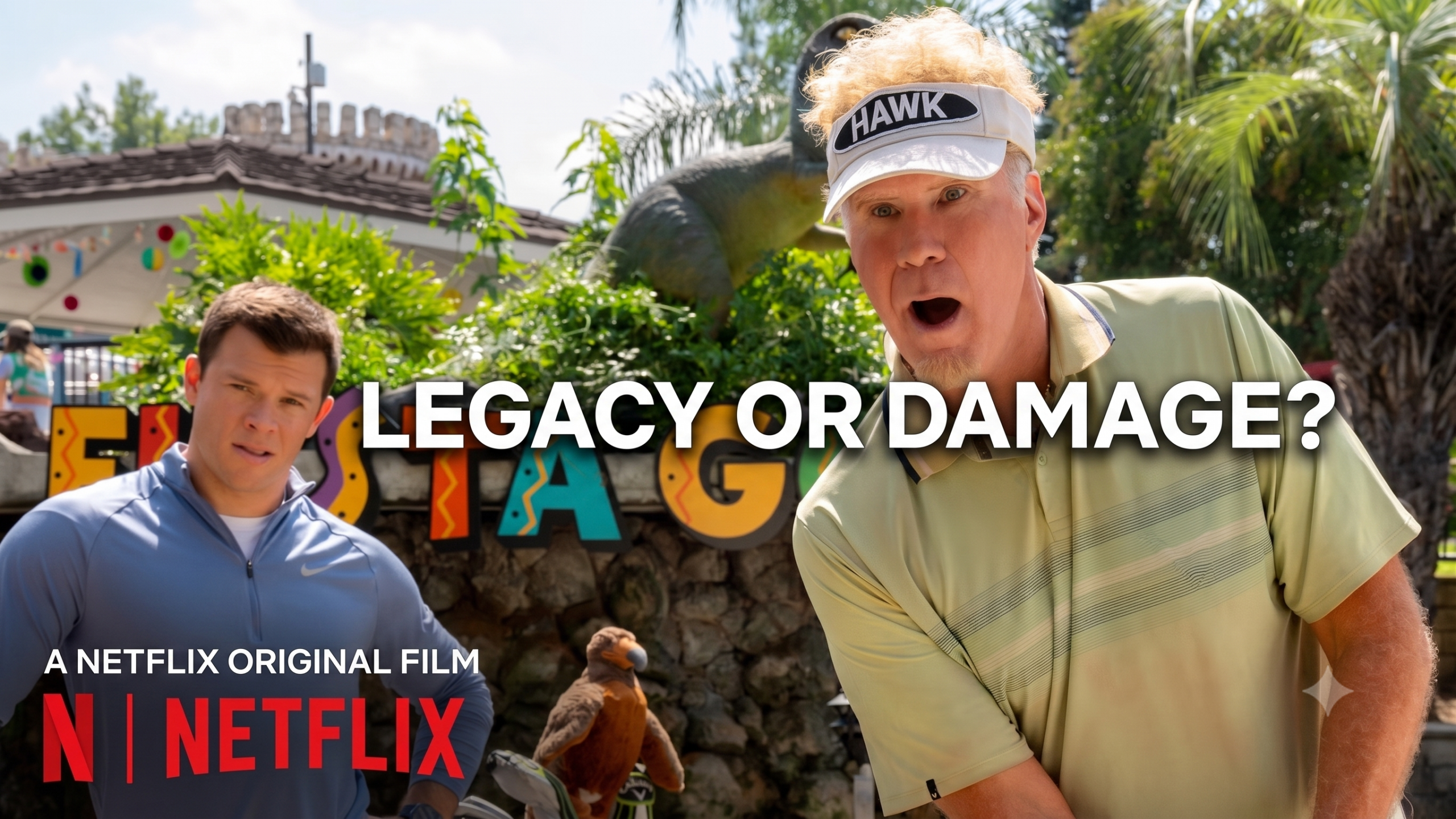
Lonnie “The Hawk” Hawkins arrives as a familiar Ferrell creation. He is arrogant, emotionally underdeveloped, visually ridiculous and almost completely incapable of recognizing how exhausting he is to everyone around him. The comparisons to Talladega Nights, Blades of Glory and Semi-Pro are impossible to avoid. Critics have understandably attacked the show for recycling a comedy persona that was already fully formed twenty years ago.
But I also think that criticism explains only half of what The Hawk is trying to do.
The show becomes more interesting when I stop treating Lonnie as another lovable idiot and start seeing him as a man whose entire identity has become a form of addiction.
Lonnie is not simply addicted to golf. He is addicted to being watched, admired and remembered. He needs the comeback because accepting retirement would force him to confront everything he neglected while building the Hawk mythology.
That includes his son.
The father-and-son conflict between Lonnie and Lance is the real series. The golf tournaments, rivalries and absurd promotional spectacles are mostly decoration around two men competing over the same emotional wound. Lonnie wants Lance’s admiration without earning it. Lance wants to defeat his father while still desperately needing acknowledgment from him.
Neither man knows how to ask for what he actually wants, so they turn the golf course into a battlefield.
This is where the split between critics and viewers starts to make sense to me. As pure comedy, The Hawk is inconsistent. Some jokes feel stretched beyond their natural lifespan, while others rely on Ferrell shouting or behaving inappropriately and expecting the sheer commitment of the performance to produce laughter. Several reviews have argued that the ten-episode format turns what might have worked as a compact film into an overextended series.
But viewers defending the show are responding to something else. They are responding to the chemistry, the relaxed watchability and the increasingly emotional relationship beneath the stupidity. Online discussion has repeatedly highlighted Ferrell’s partnership with Fortune Feimster and the central father-son storyline, even among viewers who admit that the writing and tone are uneven.
The finale is where those two versions of the series finally collide.
Lonnie reaches the decisive putt believing his son’s life is in danger. He misses, Lance wins, and Lonnie claims that he deliberately sacrificed his own victory. Then the show reveals that Lance fabricated the threat and manipulated his father using the same psychological tactics Lonnie had spent years using on everyone else.
The obvious question is whether Lonnie really missed intentionally.
I do not think he did.
Ferrell himself has suggested that Lonnie genuinely tried to make the shot and later claimed otherwise because admitting another failure would be unbearable. That interpretation makes the ending much better.
Had Lonnie deliberately missed, the series would give him a clean redemption. He would finally place his son above his ego, sacrifice the Grand Slam and prove that he had changed.
But a real miss leaves him in a far more revealing position.
For one moment, Lonnie believes he can become both things at once: the victorious legend and the father who saves his son. He still tries to win because the Hawk identity remains stronger than his moral awakening. When he fails, he rewrites the failure as sacrifice.
That is vintage Lonnie.
Yet the moment still contains genuine progress. Whether he misses deliberately or not, his first concern afterward is Lance. His instinct may remain corrupted by ego, but the emotional priority has shifted. He has not become a good father. He has merely reached the point where becoming one is finally imaginable.
Lance’s deception complicates that progress further. He does not simply defeat his father at golf. He proves that he has inherited Lonnie’s worst talent: the ability to manipulate people while convincing himself that victory justifies the method.
Lonnie looks proud because Lance has finally become recognizably his son.
That pride is both touching and disturbing.
This is why I cannot dismiss The Hawk as merely another failed attempt to revive old Will Ferrell comedy. The criticism that it feels dated is valid. The jokes are uneven, the tone keeps shifting, and the series often resembles a two-hour sports comedy stretched across five hours.
But buried inside that bloated structure is a sharper story about inheritance.
Lonnie spends the season trying to reclaim his legacy. By the end, he discovers that his real legacy is Lance—not because Lance wins the U.S. Open, but because he has learned how to weaponize charm, insecurity and deception exactly as his father did.
The Hawk does not simply return.
He reproduces.