House of the Dragon S3 Finale Explained
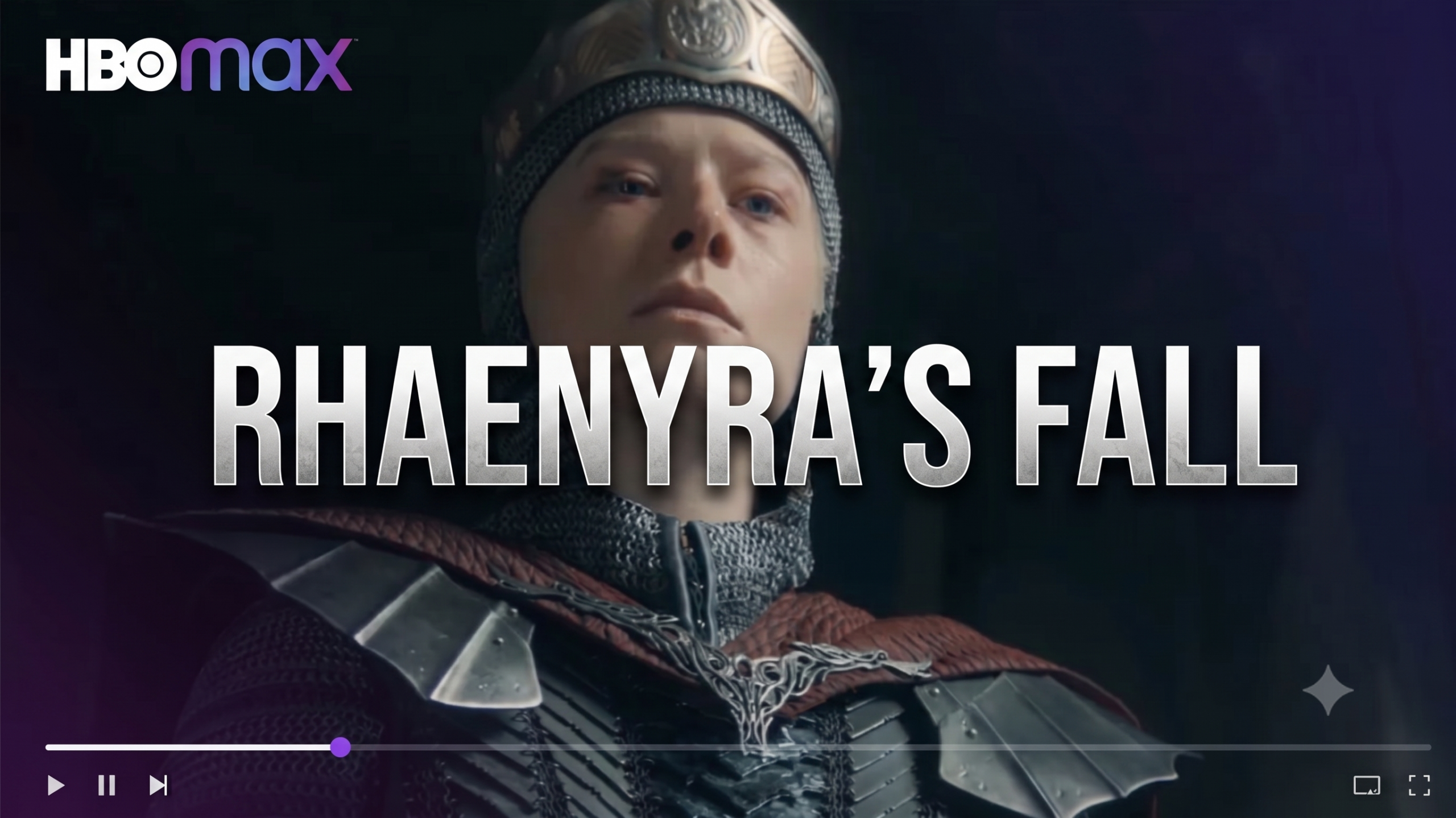
Rhaenyra Didn’t Suddenly Go Mad, She Finally Found a Reason to Believe She Can Never Be Wrong
The moment that disturbed me most in the Season 3 finale wasn’t Tumbleton.
It wasn’t Ulf turning Silverwing against Rhaenyra’s forces.
It wasn’t Ormund’s death.
It wasn’t even Helaena falling from the Red Keep.
It was Rhaenyra standing in front of the people of King’s Landing and effectively telling them:
I am the person history needs.
Because once a ruler genuinely believes that, almost anything becomes permissible.
And I think House of the Dragon has finally arrived at the version of Rhaenyra this story has been circling for three seasons.
Not Rhaenyra the rightful heir.
Not Rhaenyra the woman denied her inheritance.
Not Rhaenyra the grieving mother.
Not even Rhaenyra the Black Queen.
Rhaenyra the chosen one.
That difference matters.
For most of the series, Rhaenyra’s claim has been political.
Viserys named her heir.
The lords swore oaths to her.
Aegon’s faction usurped her throne.
However complicated the succession becomes, Rhaenyra can therefore look at the war and tell herself that she is restoring something that was stolen.
Episode 8 gives her something much more dangerous.
A sacred justification.
She no longer merely believes that she deserves the throne.
She believes Westeros needs her to have it.
That is how morality starts disappearing.
The prophecy has become Rhaenyra’s most dangerous weapon
I have had mixed feelings about House of the Dragon making Aegon the Conqueror’s prophecy such an important part of the story.
Sometimes it has felt like an unnecessary attempt to keep pointing toward Game of Thrones: remember the White Walkers, remember Daenerys, remember that this is all connected.
But after this finale, I think I finally understand what the show may actually be doing with it.
The prophecy isn’t important because Rhaenyra is going to fulfill it.
She won’t.
Condal has explicitly acknowledged that Rhaenyra and Daemon are interpreting something whose possible fulfillment lies roughly two centuries in their future. They simply do not know that.
That means the prophecy isn’t validating Rhaenyra.
It is corrupting her.
And that is much more interesting.
Rhaenyra has spent this entire war searching for evidence that suffering has meaning.
Her son dies.
Her kingdom fractures.
Her family turns against itself.
Dragons kill dragons.
Thousands of people die because two branches of one dynasty cannot agree over a chair.
If Rhaenyra accepts that reality at face value, then she has to confront a horrifying possibility:
Maybe all of this suffering is simply the consequence of people wanting power.
The prophecy gives her an escape from that conclusion.
Suddenly the war isn’t merely about succession.
It is about saving humanity.
Every corpse becomes part of some greater necessity.
Every compromise begins looking like weakness.
Every person opposing Rhaenyra becomes not merely a political enemy, but an obstacle standing between humanity and its salvation.
That is how somebody can murder religious leaders and still believe they are the righteous person in the room.
The finale makes that transformation explicit. Rhaenyra rejects the religious institution that refuses to sanction her rule and then substitutes her own sacred legitimacy: she is Targaryen, she possesses dragons, she knows the prophecy, therefore she answers to something greater. Condal described the moment as a fundamental change in Rhaenyra’s relationship with the people she governs.
That is not madness.
It is worse.
It is logic built on an unquestionable premise.
This is where the Daenerys comparison becomes unavoidable
The similarities are obvious enough that Condal has now acknowledged them directly.
Daenerys also gradually stops describing herself merely as someone seeking a throne and starts describing herself as someone uniquely capable of creating a better world.
Her violence becomes easier to justify because she believes the destination sanctifies the methods.
Rhaenyra is beginning to speak the same language.
But I think there is one enormous difference.
With Daenerys, Game of Thrones eventually asked viewers to accept a massive psychological acceleration.
We certainly had warning signs. Daenerys had threatened cities, burned enemies and increasingly embraced absolutist rhetoric.
But the transition from ruthless conqueror to someone willing to burn King’s Landing after surrender remains controversial because the final seasons compressed so much character development into so little time.
House of the Dragon is doing something different with Rhaenyra.
It has been slowly removing every alternative explanation she has for herself.
That is what makes this version more convincing to me.
Rhaenyra once wanted Viserys’ approval.
He’s gone.
She wanted her sons secure.
Lucerys and Jacaerys are gone.
She wanted the lords to recognize her lawful inheritance.
Their loyalty keeps shifting.
She wanted the smallfolk to recognize her as their queen.
They increasingly distrust her.
She believed dragons would settle the legitimacy question.
Then Aegon returned with Sunfyre.
One by one, the external sources that could validate Rhaenyra have failed.
So she creates an internal one.
The gods chose me.
That belief cannot be taken away.
And therefore it cannot be corrected.
Aegon’s return may have broken the last restraint
This is why Sunfyre’s return in Episode 7 matters so much more after watching the finale.
Aegon was supposed to be finished.
Burned.
Broken.
Politically irrelevant.
Rhaenyra finally possessed King’s Landing, the throne and the numerical dragon advantage.
Then word arrives:
Aegon lives.
Sunfyre lives.
And people are celebrating.
The finale begins with that revelation triggering enormous fear in Rhaenyra. Daemon essentially tells her this is the moment that will test what kind of ruler she actually is.
She responds by becoming harder.
That makes psychological sense.
Because if surviving assassination, capturing King’s Landing, gathering dragonriders and sitting the Iron Throne still aren’t enough to establish legitimacy, Rhaenyra faces two possibilities.
One:
Maybe legitimacy cannot be imposed.
Two:
Everyone else is wrong.
She chooses the second.
From there, almost every relationship begins collapsing.
The frightening thing is how isolated she becomes
Baela confronts her.
Rhaenyra responds by asserting rank and eventually confining her.
Mysaria has become politically inconvenient.
Rhaenyra sends her away.
Ulf feels disrespected and eventually defects.
Corlys has already become increasingly alienated.
Hugh’s position becomes unstable.
Even Helaena—possibly the least politically ambitious adult Targaryen in the entire conflict—eventually becomes another object within Rhaenyra’s strategy.
That pattern is more important than any single cruel act.
A tyrant does not necessarily begin by waking up one morning and deciding to become evil.
Sometimes tyranny emerges because every dissenting voice gradually gets reclassified.
An adviser becomes disloyal.
A relative becomes insolent.
A religious authority becomes illegitimate.
A hostage becomes necessary.
A civilian becomes collateral damage.
Eventually the ruler is surrounded only by people who agree—or people too frightened to disagree.
And Rhaenyra is moving rapidly toward that condition.
Helaena’s death is where the transformation becomes tragic rather than merely political
Helaena has always existed strangely outside the Dance.
Everybody else is trying to obtain something.
Aegon wants recognition.
Aemond wants power.
Daemon wants significance.
Alicent wants control over consequences she helped create.
Rhaenyra wants her inheritance.
Otto wants his dynasty.
Helaena mostly wants to be left alone.
That makes her almost incompatible with the political world surrounding her.
Emma D’Arcy described Helaena as essentially the moral heart of the story: someone close to power who somehow remained relatively uncontaminated by it.
Which makes her death devastating for Rhaenyra’s arc.
Because Helaena cannot easily be transformed into an enemy.
She is not Criston Cole marching an army against her.
She is not Aemond riding Vhagar.
She is not Aegon contesting the throne.
She is a traumatized pregnant woman being held because her existence has political usefulness.
The finale puts her in a position where she understands that her unborn child can become another piece on the board. She ultimately takes her own life, leaving behind the prophetic tapestry she has been constructing throughout the season.
Rhaenyra does not directly murder Helaena.
That distinction matters.
But the political machine Rhaenyra now commands helped create the cage around her.
And I think Helaena’s death removes one of the final ways Rhaenyra could tell herself that her methods only harm guilty people.
Then comes the tapestry
This might be my favorite symbolic choice in the finale.
Helaena leaves behind knowledge.
Rhaenyra receives something that might challenge, expand or complicate her understanding of destiny.
And she discards it.
D’Arcy specifically highlighted the simplicity of Rhaenyra looking at something potentially illuminating and throwing it away.
That tells me everything about where Rhaenyra is psychologically.
She doesn’t actually want prophecy.
She wants confirmation.
There is an enormous difference.
A person genuinely searching for truth is capable of discovering that they were wrong.
A person searching for confirmation only accepts information that strengthens the conclusion they already possess.
Rhaenyra has crossed into the second category.
She believes prophecy validates her.
Therefore prophecy that complicates her interpretation becomes irrelevant.
That is the god complex.
Not believing that gods exist.
Believing that the gods happen to agree with you.
And this is why the High Septon scene works
Rhaenyra has spent years fighting the argument that a woman cannot legitimately sit the Iron Throne.
The Faith’s refusal therefore hits the oldest wound in her identity.
Again, she receives two possible interpretations.
Maybe Westerosi institutions do not recognize her authority.
Or:
Those institutions possess no authority worth recognizing.
So she eliminates the problem.
She rejects the Faith and elevates Old Valyria instead. She effectively constructs a theology in which Targaryen blood itself becomes evidence of superior legitimacy.
That is a terrifying idea when the person promoting it owns dragons.
Because dragons make delusion unusually difficult to challenge.
If an ordinary monarch claims divine authority, people can laugh.
If a Targaryen claims divine authority and then a sixty-ton flying predator lands behind them, theology suddenly becomes harder to debate.
This has always been the hidden sickness inside House Targaryen.
They possess enough supernatural power to mistake biological advantage for cosmic importance.
And Rhaenyra is now doing exactly that.
Ironically, this makes her more interesting than when the show protected her
One criticism that has followed House of the Dragon is that the adaptation sometimes seemed reluctant to allow Rhaenyra to become genuinely morally ugly.
Her worst choices could feel softened, transferred to other characters or surrounded by enough justification that audiences were encouraged to remain comfortably Team Black.
Episode 8 destroys that comfort.
The finale’s major reviews are explicitly describing this as Rhaenyra’s full descent toward tyranny, and Condal says that she ultimately embraces Daemon’s harder philosophy of ruling through uncompromising Targaryen power.
Good.
Because I don’t want House of the Dragon to tell me which colored banner contains the heroes.
I want it to show me why intelligent people chose those banners and then make me increasingly uncomfortable about defending either one.
Rhaenyra having a legitimate grievance does not guarantee she becomes a legitimate ruler.
Those are completely different questions.
She can have been wronged.
She can have been usurped.
She can have experienced misogyny.
She can love her children.
She can genuinely believe she is protecting Westeros.
And she can still become dangerous.
In fact, those things make her more dangerous because they give her an endless supply of arguments proving that whatever she does next is justified.
That’s the real tragedy of Rhaenyra Targaryen
I don’t think the finale is saying:
“Rhaenyra was secretly evil all along.”
That would be boring.
I think it is saying something much nastier.
Rhaenyra has accumulated enough legitimate suffering that she can now use that suffering to excuse illegitimate behavior.
Every betrayal proves she should trust fewer people.
Every challenge proves she must demonstrate greater strength.
Every defeat proves she wasn’t ruthless enough.
Every prophecy proves her destiny.
Every victory proves the gods favor her.
There is no possible outcome left that contradicts her worldview.
That is when a ruler becomes extraordinarily dangerous.
And it makes the inevitable comparison with Daenerys more interesting than simple visual foreshadowing.
Both women begin with grievances that I understand.
Both encounter institutions that treat them unjustly.
Both possess extraordinary power capable of overturning those institutions.
And eventually both face the same temptation:
If the world refuses to recognize that I am right, maybe the world itself is wrong.
Once you reach that conclusion while sitting on a dragon, there are very few limits left.
The Battle of Tumbleton gives Episode 8 its spectacle.
Helaena gives it its tragedy.
But Rhaenyra gives it its real horror.
Because by the end of Season 3, I don’t think she believes she is becoming a tyrant.
I think she believes she has finally become exactly what history requires.
And that is much more frightening.