Fallout 5 Needs to Learn From Fallout 76
I think Fallout 76 has accidentally become one of the most important games Bethesda has ever made.
Not because it launched well.
It absolutely did not.
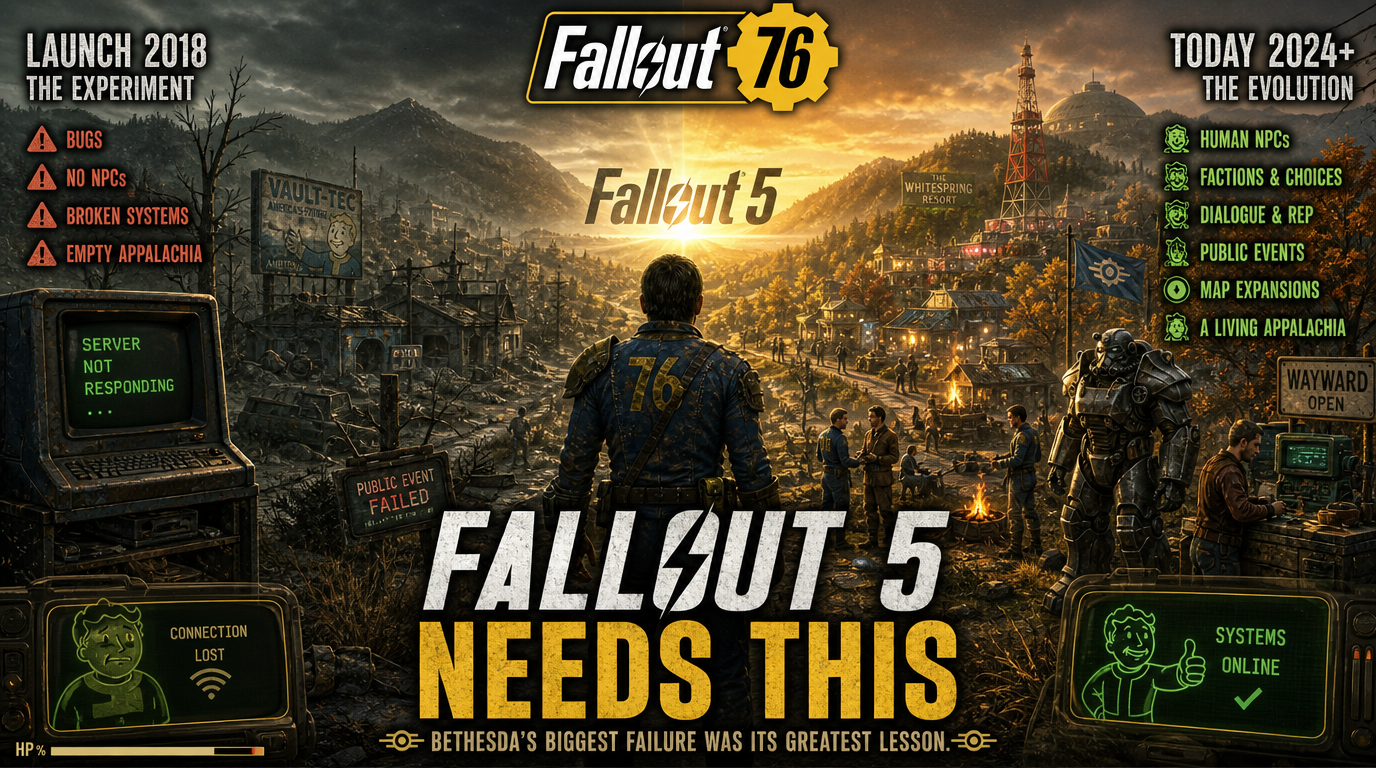
Fallout 76 came out as the game everyone pointed at when they wanted to explain how badly Bethesda had lost the plot. No human NPCs. Broken systems. Technical chaos. A world that looked interesting but felt strangely hollow. For a lot of Fallout fans, it was not just a bad launch. It felt like Bethesda had misunderstood what Fallout was supposed to be.
But that is exactly why the current conversation is so interesting.
Because now, years later, players are looking at Fallout 76 and asking something that would have sounded insane at launch:
Is this actually the blueprint for Fallout 5?
And honestly, I think the answer might be yes.
Not in the multiplayer sense.
I do not think Fallout 5 should become Fallout 76 with a new map. I do not want forced online systems, live-service structure or public events replacing traditional quest design. Fallout 5 needs to be a proper single-player RPG first.
But when I look at what Fallout 76 became after years of updates, I can see a lot of lessons Bethesda should absolutely carry forward.
The biggest one is the map.
Appalachia might be one of Bethesda’s best open worlds. It has variety, verticality, weird regional identity and a real sense of discovery. You move from forests to toxic industrial zones, creepy towns, military sites, underground facilities, mountain regions and strange little environmental stories that reward wandering.
That is classic Bethesda at its best.
Fallout 76 proved that Bethesda can still build a wasteland that makes you want to walk in a random direction just because something on the horizon looks suspicious.
That matters for Fallout 5.
The next Fallout does not just need a big map. It needs a map with personality. Appalachia works because it does not feel like one repeated wasteland texture stretched across a huge space. It feels regional. It has cultural memory. You can sense what the place was before the bombs and what it became after.
That is the kind of world design Fallout 5 should study carefully.
Then there is the dialogue comeback.
Fallout 76 launched without human NPCs, which was one of the most controversial decisions Bethesda ever made. But Wastelanders changed the game completely. Suddenly there were characters, factions, dialogue checks and actual conversations again.
And here is the important part: those systems felt closer to older Fallout than Fallout 4’s simplified dialogue wheel.
That is why people keep bringing Fallout 76 into Fallout 5 discussions.
Bethesda already corrected one of Fallout 4’s biggest mistakes inside Fallout 76.
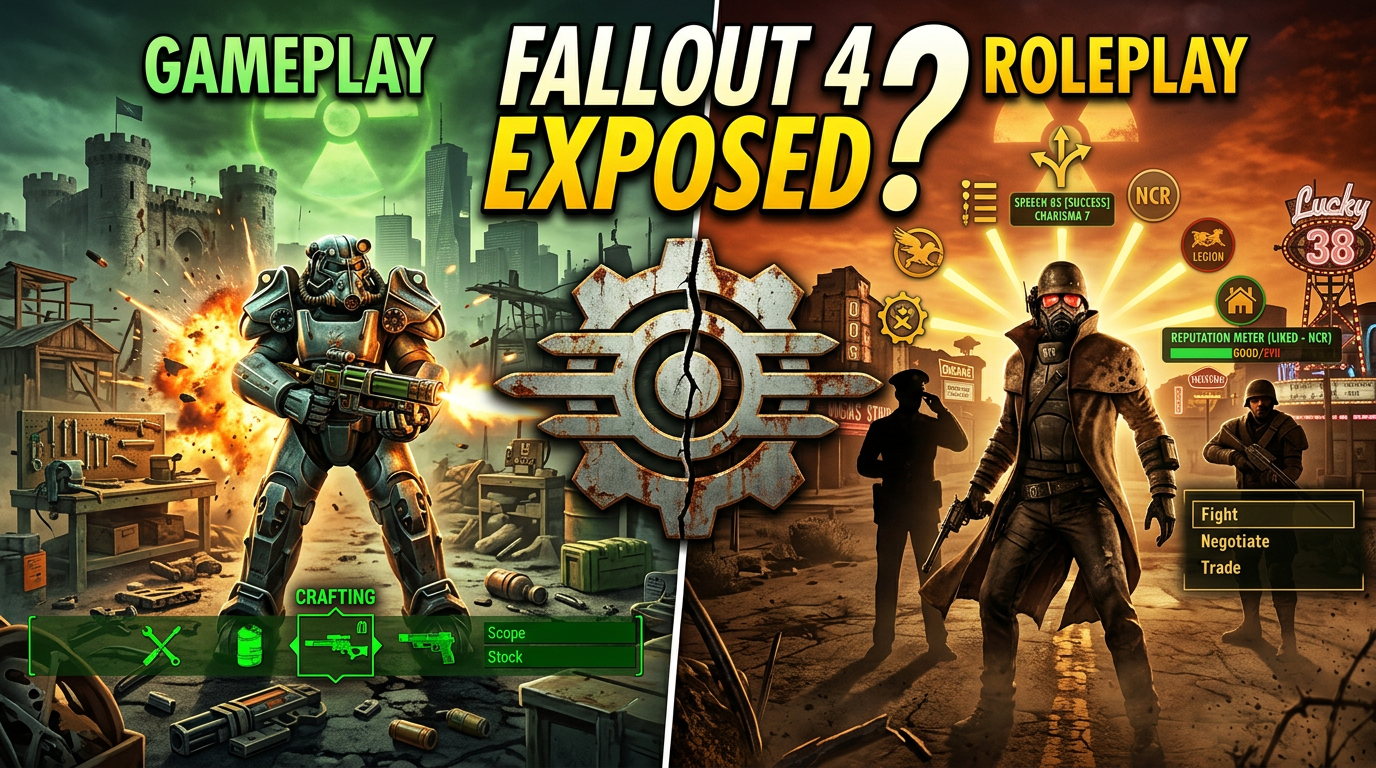
Fallout 4 had better gunplay, better exploration flow and better moment-to-moment accessibility, but its dialogue system made role-playing feel thinner. Fallout 76, ironically, started as the least traditional Fallout and slowly rebuilt itself by moving back toward Fallout 3 and New Vegas-style conversation design.
That is the lesson.
Fallout 5 should not repeat Fallout 4’s dialogue structure. It should take the better version Bethesda already tested in Fallout 76: visible dialogue options, skill checks, faction context and choices that feel tied to your build.
The same goes for RPG systems.
Fallout 76’s perk card system is not perfect, and I would not want it copied directly into Fallout 5. But the flexibility behind it is interesting. The game lets players reshape builds, experiment with different playstyles and adjust their character without restarting the entire game.
That kind of build freedom is useful.
Fallout 5 should bring back deeper character identity, but it should also learn from how Fallout 76 made experimentation easier. Players should be able to specialize without feeling trapped. They should be able to role-play without needing a spreadsheet. They should be able to change direction, but not so freely that choices stop mattering.
That balance is hard.
But Fallout 76 has spent years testing versions of it in public.
The other major lesson is exploration as a long-term system.
Fallout 76 had to keep players returning to the same world for years, so Bethesda learned how to make existing spaces stay useful. Public events, seasonal objectives, new encounters, map expansions and repeatable activities all gave players reasons to revisit old areas.
Fallout 5 does not need live-service grinding, but it should learn from that structure.
A single-player Fallout world should not become dead after you clear a location once.
Settlements should evolve. Factions should move. Roads should become more dangerous or safer depending on your choices. Old buildings should gain new meaning later in the story. The wasteland should react over time instead of freezing after the first visit.
That is where Fallout 76 points toward something valuable.
It shows that a Fallout map can be more dynamic.
The danger is that Bethesda learns the wrong lesson.
The lesson should not be “make Fallout 5 online.”
The lesson should not be “turn every system into a repeatable grind.”
The lesson should not be “replace handcrafted quests with seasonal loops.”
That would be a disaster.
The real lesson is that Fallout works best when the world feels alive, reactive and worth returning to.
Fallout 76 got there the hard way. It had to fail, rebuild itself, listen to players and slowly add back the things people missed. NPCs. Dialogue. factions. Better events. Bigger map additions. More reasons to explore. More ways to define your character.
In a strange way, Fallout 76 became a public prototype for Bethesda’s future.
It showed what players rejected.
It showed what they missed.
It showed what they were willing to forgive.
And it showed which parts of Bethesda’s design still work when given enough time and support.
That is why Fallout 5 should pay attention to Fallout 76.
Not because Fallout 76 is the perfect Fallout game.
It is not.
But because it contains a record of Bethesda correcting itself.
If Fallout 5 combines Fallout 4’s accessibility and gunplay with Fallout 76’s improved dialogue direction, Appalachia-style map design and stronger long-term world systems, Bethesda could finally get close to the Fallout people keep imagining.
A game that feels good to play.
A game that gives you real choices.
A game with a world worth exploring for hundreds of hours.
A game where your build matters, your dialogue matters and your presence changes the wasteland.
That is the version of Fallout 5 I want.
Not Fallout 76 as a sequel.
Fallout 76 as a lesson.