Fallout 4 vs New Vegas: The Debate Is Back
I think the Fallout 3 and New Vegas remasters are about to make Fallout 4 look better and worse at the same time.
That sounds contradictory, but it is exactly where the Fallout community is heading.
For years, Fallout 4 has lived in this strange position where almost everyone agrees it is fun to play, but not everyone agrees it is a great Fallout RPG. Now that Fallout 3 and New Vegas are coming back in remastered form, that old argument is waking up again with full power.
Because the moment players return to Fallout 3 and New Vegas with cleaner visuals, smoother performance and hopefully better shooting, Fallout 4’s biggest advantage becomes less automatic.
That advantage was always feel.
Fallout 4 is simply easier to pick up and play. The shooting feels stronger. The movement feels smoother. The world is more readable. Looting is faster. Crafting gives every junk item a purpose. Settlement building gives the wasteland a sense of ownership. Power armor finally feels like a walking tank instead of just another outfit with better stats.
When I go back to Fallout 4, I immediately understand why so many people still play it.
It has momentum.
You leave Vault 111, walk into the Commonwealth, pick up junk, modify weapons, build a base, fight raiders, upgrade armor, explore a ruined factory, find a magazine, get distracted by a settlement, then suddenly realize three hours disappeared.
Fallout 4 is very good at keeping the player moving.
That is not a small thing.
Older Fallout fans sometimes dismiss that as casualization, but accessibility is part of why Fallout 4 reached so many players. It made the wasteland more immediate. You did not need to fight the interface, the gunplay or the older RPG jank as much. The game got out of your way more often.
But then the conversation shifts to role-playing.
And that is where Fallout 4 starts bleeding.
The voiced protagonist was ambitious, but it narrowed the character in people’s heads. Instead of imagining your own tone, your own personality and your own moral texture, you were pushed through a very specific performance. The dialogue wheel made it worse because many choices felt like four flavours of the same response: yes, sarcastic yes, angry yes, and maybe later.
That is the criticism that never really died.
In Fallout 3 and especially New Vegas, dialogue felt more like a system. Your skills, reputation, faction choices and character build could reshape conversations. You could talk your way through problems, expose someone, lie convincingly, threaten people, role-play as a scientist, brute, coward, idealist or complete wasteland parasite.
New Vegas in particular made the world feel responsive.
Your decisions followed you. Factions judged you. Companions reacted to ideology, not just whether you were nice enough. Quests often had political consequences, not just emotional ones.
That is the thing Fallout 4 struggled with.
It gave me a better wasteland to shoot through, but not always a better wasteland to argue with.
And Fallout needs both.
This is why the remasters are such a dangerous comparison point. If Bethesda updates Fallout 3 and New Vegas with Fallout 4-style gunplay while preserving their older RPG structure, the community is going to ask a brutal question:
Was Fallout 4 really the future of Fallout, or was it just the version that improved the controls while weakening the role-playing?
That is the nightmare comparison for Bethesda.
Imagine New Vegas with better visuals, smoother shooting, improved UI, less crashing and more modern quality-of-life systems. Suddenly, one of Fallout 4’s biggest defenses gets weaker. Players can no longer say, “Sure, New Vegas has better writing, but it is painful to play now.”
If the remaster solves enough of that pain, the role-playing gap becomes impossible to ignore.
But I also think the argument can become too simplistic.
Fallout 4 is not a bad game because it is less reactive than New Vegas. It is a different kind of Fallout. It is more interested in exploration, scavenging, combat loops, settlement ownership and environmental storytelling. It is less interested in letting you define your character through complex dialogue trees.
That tradeoff created one of Bethesda’s most replayable worlds.
The Commonwealth may not be the strongest role-playing setting in the franchise, but it is incredibly sticky. It gives players reasons to wander. It makes junk valuable. It turns ruined homes and broken machines into resources. It makes the player feel like they are physically rebuilding small pieces of the wasteland.
That matters.
Fallout 4 understood something the older games did not fully emphasize: survival is not only about choosing dialogue options. Sometimes it is about building a generator, wiring lights, defending a settlement and turning trash into ammunition.
That is role-playing too, just expressed through systems instead of conversations.
The problem is that Fallout 4 leaned too far in that direction.
It let me build a life in the wasteland, but it did not always let me define who I was with enough precision. I could customize my weapons, armor, settlements and companions, but my actual character often felt strangely prewritten.
That is why this debate refuses to die.
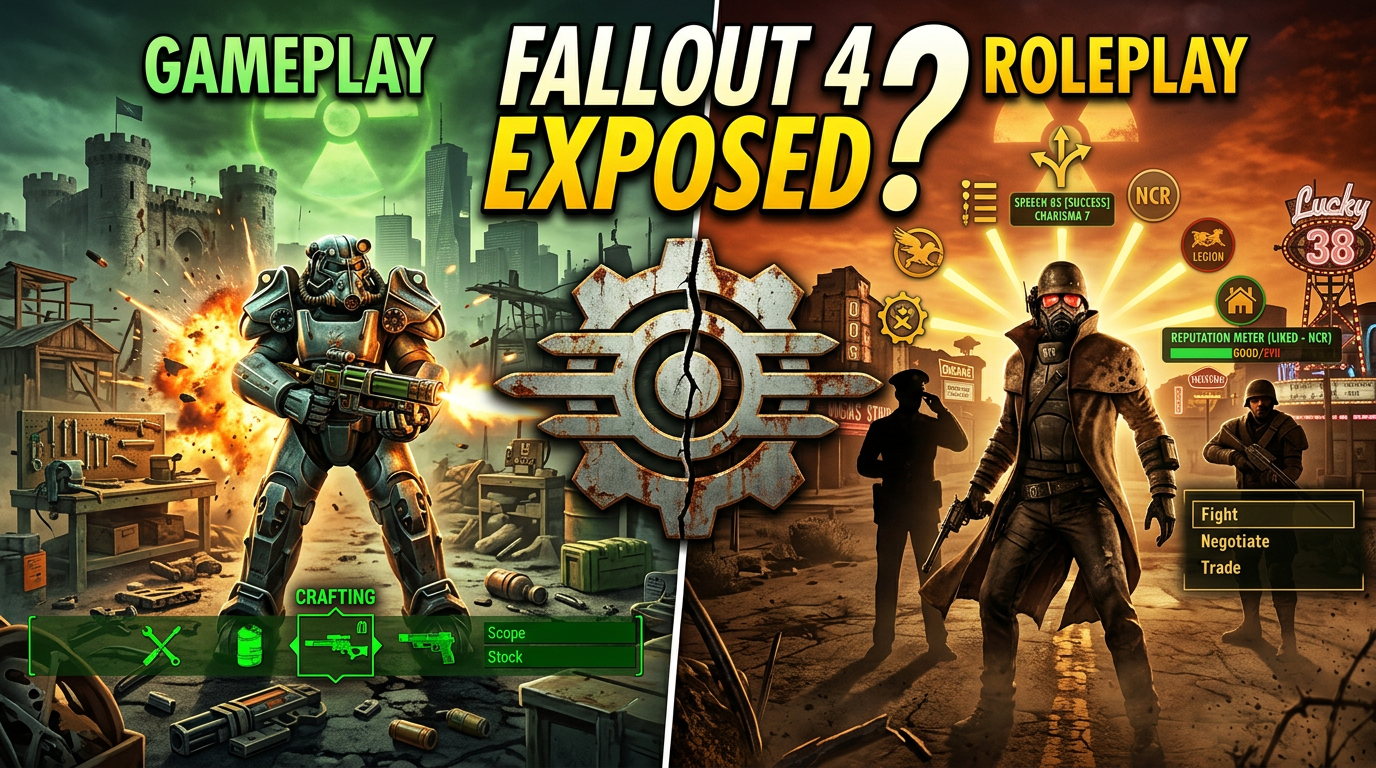
Fallout 4 is superior as a modern open-world action sandbox.
Fallout 3 and New Vegas are stronger as role-playing frameworks.
The ideal Fallout is not one side winning. It is Fallout 4’s physical gameplay fused with New Vegas-style choice, consequence and dialogue depth.
That is what fans are really asking for.
They do not want clunky old combat back. They do not want every classic inconvenience preserved like a museum artifact. They want the older games’ agency with the newer games’ playability.
They want guns that feel good and conversations that matter.
They want settlements and faction consequences.
They want exploration and character freedom.
They want the wasteland to be fun to move through and meaningful to shape.
That is why these remasters are bigger than nostalgia.
They are going to reopen the question of what Fallout should become next.
If Fallout 3 and New Vegas return with modern improvements but keep their RPG soul intact, Fallout 4 may start looking like the transitional game in the series: the one that fixed the hands but weakened the voice.
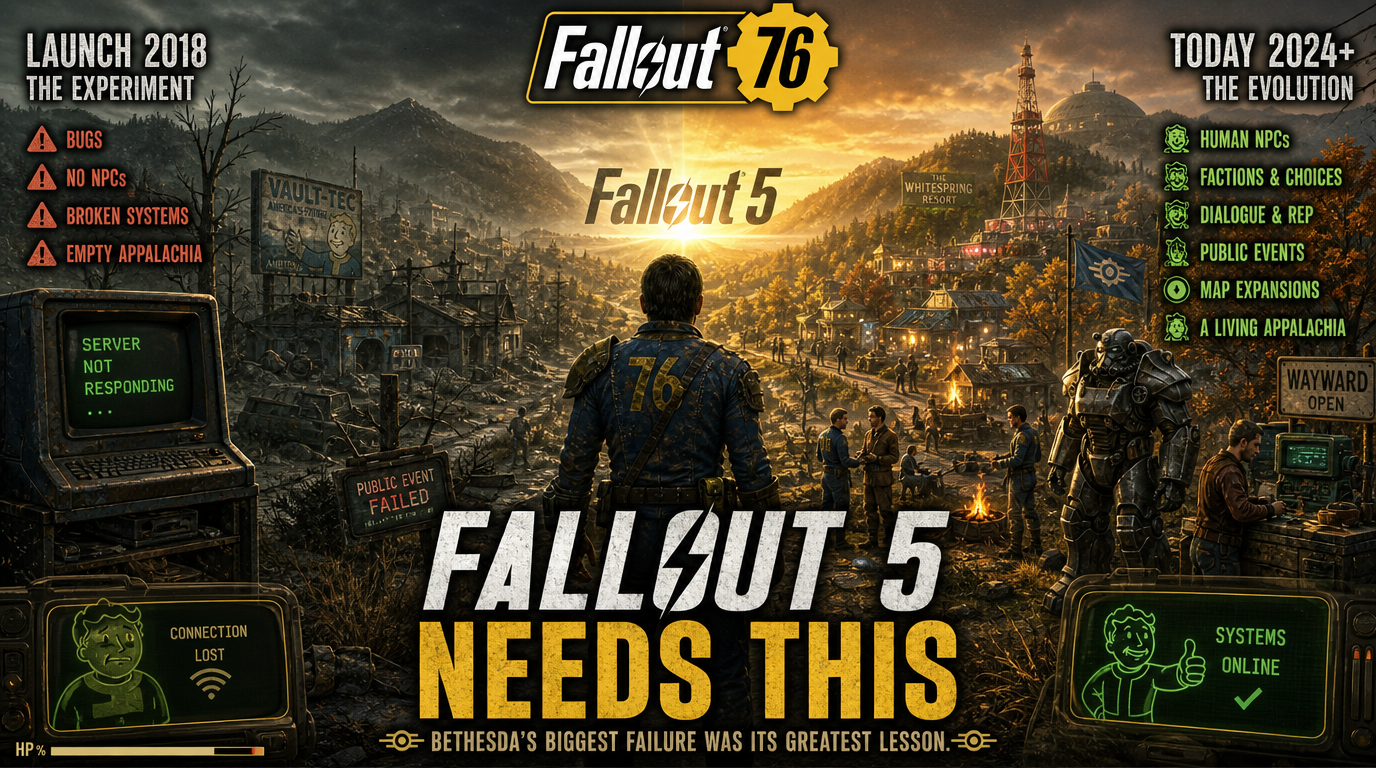
And honestly, that may be the most useful lesson Bethesda can take into Fallout 5.
Do not throw away what Fallout 4 got right. Keep the gunplay. Keep the world density. Keep the crafting depth. Keep the accessibility. Keep the sense that every ruined building might contain something worth finding.
But bring back the role-playing bite.
Bring back dialogue that lets me be someone specific.
Bring back factions that remember what I did.
Bring back quests where the best solution is not always shooting, looting or following the marked objective.
Because Fallout 4 proved the wasteland can feel great to play.
Fallout 3 and New Vegas proved it can feel great to inhabit.
The next great Fallout needs both.