Dutton Ranch (2026), Episodes 1–3 : Complete Recap & Ending Explained
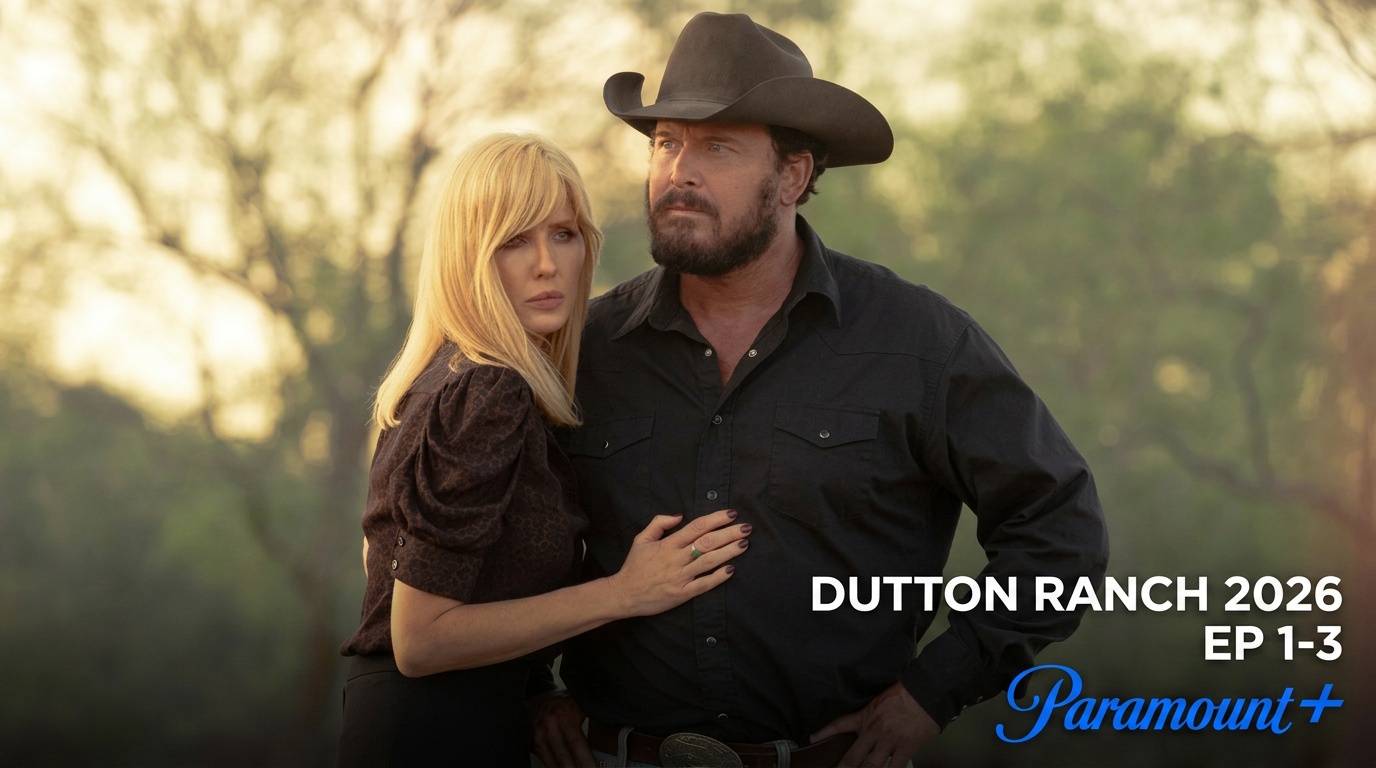
Creator: Chad Feehan | Executive Producer: Taylor Sheridan | Network: Paramount+ / Paramount Network | Episodes: 9 (May 15 – July 3, 2026) | Stars: Kelly Reilly, Cole Hauser, Finn Little, Annette Bening, Ed Harris, Jai Courtney
There’s a line in Dutton Ranch‘s first trailer that tells you everything you need to know about the show’s ambitions and its self-awareness: “A legacy is a beautiful thing,” Beth Dutton says, staring into the middle distance with the particular expression of someone who has buried more of other people’s business than most undertakers, “but only if it survives.”
That is the question Dutton Ranch is asking not just about the Dutton name, which is now attached to a 7,000-acre parcel of South Texas land that nobody in Rio Paloma asked them to buy, but about what Beth and Rip Wheeler actually are when stripped of Montana, the Yellowstone Ranch, John Dutton’s political gravity, and every institutional advantage they spent five seasons of television wielding.
In Texas, the Dutton name is not currency. It is not protection. It is not the shadow of a dead patriarch falling across everyone else’s property line. It is a word on a mailbox that the Jackson family has not yet decided whether to respect or ignore.
Dutton Ranch is a direct sequel to Yellowstone, continuing the present-day timeline. It follows Beth and Rip after the events of Yellowstone Season 5 as they leave Montana to start a new life in South Texas.
The spinoff is, at its core, the Beth and Rip show — the couple whose fiery chemistry became the emotional backbone of Yellowstone — relocated to unfamiliar territory and forced to earn what they once inherited. It is also, three episodes in, considerably better than it had any right to be.
The World Before Rio Paloma: How They Lost Everything (Again)
The series premiere kicks off by doing what this franchise does best: destroying everything with fire. A devastating wildfire tears through Montana, forcing Beth and Rip to abandon their beloved home.
At the end of Yellowstone, the lovebirds, along with their adoptive son Carter, moved to a small ranch near Dillon, Montana, where they could focus on the land and not have the responsibilities of the Dutton name. Yet within just a few minutes of Dutton Ranch, their property has burned down, displacing them to the fictional town of Rio Paloma six months later.
While Rip gets to work cutting fences and getting the cattle out, he tasks Beth with grabbing Carter. The trio scramble, grabbing everything they can, before heading out to safety. With their home lost, and the land a smoldering mess of shattered dreams, they drive out to parts unknown. We then cut forward to Rio Paloma in Texas, six months later.
The Montana fire is narratively efficient to a fault — it dispenses with any lingering obligation to the Yellowstone geography in approximately four minutes — but it does something symbolically important. Beth and Rip did not choose Texas because it was the best option. They chose it because everything behind them was ash. This is not a fresh start born of optimism. It is a fresh start born of necessity, which means they arrive in Rio Paloma carrying the specific desperation of people who have already lost once and cannot afford to lose again.
Rip quickly secures a legacy property from an aging rancher named Jeanie, who wants to sell to genuine cowboys rather than massive corporations. Rip immediately renames it Dutton Ranch.
The renaming is both a statement of intent and an act of defiance. He has no Yellowstone to inherit, no Dutton patriarch to operate under. So he builds the name into a new piece of land and dares the world to take it from him.
The Jackson Empire
Before exploring the episodes themselves, the antagonist architecture of Dutton Ranch demands its own introduction — because the Jackson family is the show’s most important creative achievement and the element that will determine whether this series outlasts the novelty of watching Beth and Rip in a new geography.
Annette Bening plays Beulah Jackson, a powerful and cunning Texas ranch matriarch who serves as the series’ primary antagonist. Ed Harris stars as Everett McKinney, a weathered veteran and veterinarian with a dry sense of humor.
Jai Courtney is on board as Rob-Will, a ranch foreman who is a misogynistic, racist, and homophobic brute with a drug problem. Juan Pablo Raba plays Joaquin Jackson, the family’s adopted son and problem solver — which basically translates to hiding the family’s dirty laundry. Natalie Alyn Lind plays Oreana, Beulah’s rebellious granddaughter and Rob-Will’s daughter.
Beulah Jackson is the show’s most immediately compelling creation. She runs the neighboring 10 Petal Ranch, having spent decades trying to buy the exact plot of land that Rip and Beth just purchased from Jeanie, treating the local cattle market like her own personal monopoly.
Annette Bening, Oscar nominated five times and one of the most precise character actors working in any medium, plays Beulah with a particular Texas aristocratic register — all surface warmth and structural menace, the kind of woman who controls a room by making everyone in it feel slightly indebted to her before she’s said anything threatening. She is nothing like John Dutton. She is everything like John Dutton. The show understands this irony completely.
Ed Harris plays Everett McKinney, and the show teases that if Everett was once married to Beulah, he is likely only Rob-Will’s father, as Joaquin is clearly Hispanic — making Everett potentially Oreana’s grandfather and Carter’s love interest’s grandfather by extension, setting up a family web that will become dramatically consequential as the season progresses.
Episode 1: “The Untold Want”
At the beginning of Episode 1, Rob-Will Jackson awakens a man called Wes Ayers in the middle of the night. What follows is the series’ first act of violence — swiftly executed, immediately buried (quite literally), and detonated onto the Dutton Ranch’s newly acquired acreage as a power move by a man who is, from his first scene, established as someone whose impulse control is clinical in its absence.
Rob-Will kills Wes and buries the body on the Dutton Ranch. Not because the Duttons are involved. Because the Dutton Ranch is the most convenient nearby location for a problem he needs to make disappear, and because the new neighbors are nobody yet. The arrogance of that choice — disposing of a murder on someone else’s land without a second thought — tells you everything about what 10 Petal Ranch has been to Rio Paloma for decades. Everyone else’s land is, in some sense, still theirs.
Meanwhile, Beth and Beulah circle each other like hungry wolves. Their first meeting at the slaughterhouse is the episode’s best scene — two women who have both spent their careers being underestimated by men and who recognize each other immediately as the actual power centers of their respective operations.
Beulah stonewalls Beth at the slaughterhouse when Beth needs to schedule her steer in. Beth is not best pleased. When the pair butt heads over logistics, Beth realizes the game is rigged in their favour and leaves. The Jackson family seem to hold all the keys to the locks and control the doors in Rio Paloma.
It is a perfectly constructed first encounter: Beulah wins the tactical exchange without raising her voice, which is the specific kind of defeat that someone like Beth Dutton metabolizes into campaign strategy rather than retreat.
While Beth clashes with Beulah, she unexpectedly finds an ally in Everett McKinney, a veterinarian who helps her navigate the people, politics, and realities of ranch life in South Texas. Meanwhile, Rip focuses on rebuilding operations with the help of Azul, a longtime hand who stayed on after the sale, and ex-convict Zachariah.
There’s also an altercation at the gas station between Rip and Rob-Will, which preludes drama that could spill over into something far worse. The gas station exchange is brief and calibrated — two men who immediately recognize each other as exactly the type of threat the other represents, conducting the social ritual of mutual warning dressed as pleasantry. Cole Hauser plays it with the particular stillness of someone who has learned to be very quiet just before something terrible happens.
Carter at the Rodeo
Carter, now 19 years old and still in high school, struggles to adapt to life in Texas and quickly finds himself pulled into trouble after defending a mysterious girl named Oreana, unaware that she’s a member of the powerful Jackson family.
He’s only been in Rio Paloma for a few minutes, but Carter is already teetering into trouble. Not making any friends at school, he’s cajoled into going to the local rodeo by a girl who seems interested in him, but actually only invites him to buy alcohol for her friends because he looks old enough. While there, he finds Oreana in a fight with her boyfriend in the parking lot, with Carter punching him when he starts to get physically violent with her. Carter winds up in jail until Oreana bails him out.
Finn Little’s Carter has grown considerably since his introduction in Yellowstone as a feral, parentless kid who showed up on Rip’s doorstep and refused to leave.
He is, at 19, recognizably the product of Rip Wheeler’s particular parenting philosophy — which is to say, he is principled about violence and absolutely willing to use it in the right circumstances, has not fully learned to pick his moments, and is now romantically entangled with the granddaughter of the woman trying to destroy his family’s new beginning. The Romeo and Juliet framing is obvious and deliberately invoked; the show earns the right to it by making Oreana genuinely interesting rather than a passive love interest.
The Body
The episode ends with Rip discovering Wes Ayers’ corpse on his property. The weight of that discovery — not just the horror of it, but the instant, experienced calculus of a man who has spent his entire adult life knowing which problems get reported and which problems get managed — is all over Cole Hauser’s face in the episode’s final minutes.
Episode 2: “Earn Another Day”
Episode 2 forces Rip to decide what to do with Wes’ corpse. Meanwhile, Beth and Carter have their own run-ins with 10 Petal’s owner Beulah Jackson and her family. IMDb
Rip’s decision — to move the body rather than report it — is the episode’s defining moral beat, and it is handled with the psychological honesty that has always distinguished the Yellowstone universe’s treatment of its morally compromised protagonists. He does not report it. He does not confront the Jacksons. He moves it, taking on the burden of someone else’s crime and converting it into leverage he hasn’t decided how to use yet.
This is Rip Wheeler in his purest form: a man who understands that the law is a tool other people wield against people like him, who has spent his entire life operating in the spaces between what is legal and what is necessary, who defaults to the calculated management of dangerous information over the uncertain outcomes of official processes. It is also, objectively, the decision most likely to make the next seven episodes significantly more complicated. Which is, of course, precisely why he makes it.
Rob-Will and Joaquin are meanwhile trying to deal with their own problem — they can’t find the body. The police will be looking for it after Wes’s partner, Whitney, filed him as a missing person. Sheriff Wade begins investigating the missing cowboy. IMDb
The missing body investigation is the season’s pressure valve: every episode that passes without the body being found or the truth surfacing is another episode of accumulated tension. The show is clearly building toward a moment when Rip’s knowledge of Wes’s murder becomes the most dangerous card on the board.
Beth Builds an Alternative Empire
While Rip deals with the physical problem, Beth addresses the structural one.
Everett points her toward an independent meatpacking facility near San Antonio run by a man named Claudio. Beth drives down, talks tough, and secures an alternative supply chain, completely bypassing Beulah’s corporate stranglehold.
This is the most satisfying Beth scene of the first two episodes — not because of its dramatic intensity, which is calibrated rather than explosive, but because it illustrates the specific way Beth Dutton operates.
She does not fight the system directly. She builds a parallel system and then uses it to make the existing system irrelevant. The slaughterhouse monopoly that Beulah used to stonewall her is now simply not the only option. Beth did not break the lock. She found a different door.
Knowing they are outnumbered, Rip begins building an army.
He speaks with Zachariah, the ex-convict ranch hand that Azul vouched for, about recruitment. Zachariah, played by Marc Menchaca, is the season’s most intriguing wild card — a man with a documented past that nobody has fully explained yet, vouched for by Azul with the specific credibility of someone who has earned the right to vouch for people. His loyalty will be tested before this season concludes.
Carter and Oreana: The Morning After
Carter skips school to hang out with Oreana the next day. There’s clearly romantic tension between the two, but Oreana’s boyfriend is clearly not going anywhere without another fight. Oreana and Carter will likely become the Romeo and Juliet of Rio Paloma — the rivalry between the Dutton Ranch and 10 Petals is bound to escalate, and Carter and Oreana will find themselves in the middle of two warring families.
Rip, who shared John Dutton’s wisdom about the opposite sex, has a man-to-man talk about girls with Carter — a relieved Rip realizing his adopted son is navigating something relatively normal for once.
It is the show’s warmest moment in two episodes, and it works precisely because it arrives in the middle of so much accumulated darkness. Rip talking about girls, after moving a murder victim’s body, is the show’s most effective tonal contrast — the domestic warmth that these two people are still somehow maintaining inside a life that keeps generating catastrophe.
The Episode 2 Closer: Jackson Internal Chaos
Oreana is revealed to be a Jackson — she is Beulah’s rebellious granddaughter and Rob-Will’s daughter. The fact that Carter is now entangled with her means the ranch war between Dutton Ranch and 10 Petal is no longer merely commercial and territorial. It is now personal, generational, and romantic simultaneously.
Episode 3: “Act of God Business”
Episode 3 is where Dutton Ranch shifts register. The first two episodes were establishment — geography, alliances, power structures, the specific topography of Rio Paloma’s social hierarchy. Episode 3 is the moment the show stops surveying the battlefield and starts the actual fighting.
As Beth fights to secure their business, Rip confronts a deadly threat. Tensions increase throughout Rio Paloma. The episode title — “Act of God Business” — is a piece of deliberate irony: nothing that happens in Rio Paloma is an act of God. Everything is deliberate. Everything is chosen. But the people responsible for the worst of it will, when confronted, always invoke forces beyond their control. Villains Wiki
Rip’s Deadly Threat
The threat Rip faces this episode is not abstract or bureaucratic. It is physical and immediate — a direct confrontation that tests whether the quiet menace he has been projecting since arriving in Texas is backed by the actual capacity for violence that his Montana history suggests. Plot Explained
Cole Hauser, who has spent three episodes playing Rip’s arrival in Texas as a man conserving energy — observing, filing information, declining unnecessary confrontations — finally lets the conservation break. The result is the episode’s most viscerally satisfying sequence and the clearest statement yet of who Rip Wheeler is outside of Montana’s protective mythology. He is not a man whose danger was borrowed from John Dutton’s institutional power. He is dangerous on his own terms, in any geography, against any opponent.
Beth and Joaquin
Beth’s meeting with Joaquin Jackson is one of the episode’s most carefully staged diplomatic exchanges — two people who are not enemies yet and are both trying to determine whether they have to be. Joaquin, as 10 Petal’s problem solver, is the family member most capable of pragmatic calculation. He sees Beth clearly.
The exchange between Kelly Reilly and Juan Pablo Raba is the episode’s best-written scene — two people who understand each other’s intelligence and are still trying to establish whether understanding leads to mutual respect or simply a more informed antagonism. Joaquin is not Rob-Will. He did not kill Wes.
He is cleaning up Rob-Will’s mess because that is what he has always done, and the question the show is beginning to ask is whether there is a version of this conflict that Joaquin would prefer to avoid.
Beth does not give him the answer he is looking for. She gives him a better question.
Carter and the Sheriff (Again)
Carter finds himself at the mercy of the local sheriff for the second time in three episodes and the pattern is beginning to establish itself as something the show intends to develop rather than resolve. Carter’s instinct toward protective violence, modeled on Rip’s example, is both his most admirable quality and his most immediate liability in a town where the sheriff’s relationship with the Jackson family is not yet fully understood.
Sheriff Wade, played by Josh Stewart, is investigating Wes’s disappearance with the specific energy of someone who knows more about how this town operates than he is publicly admitting. Whether he is a genuine investigator or a Jackson-aligned instrument of the local power structure is one of the season’s most important unresolved questions.
Everett McKinney: Friend or Liability?
Episode 3 introduces genuine ambiguity around Everett McKinney that the first two episodes carefully avoided. His helpfulness to Beth and his warmth toward Rip have positioned him as the show’s moral ballast — the old, weathered good man who can navigate between the warring parties.
But this episode begins asking whether his position between the Duttons and the Jacksons is geographical or strategic.
The show’s speculation that Everett may be Rob-Will’s father — and therefore Oreana’s grandfather — would make his relationship with the Duttons considerably more complicated. He would be the grandfather of Carter’s love interest, the father of the man who committed the murder Rip is covering up, and the chosen confidant of the woman who wants to destroy 10 Petal’s monopoly. That is not a neutral position. It is the most surveilled position on the board.
Ed Harris plays all of this with a veteran’s economy. He reveals nothing. He conceals nothing visible. He simply exists in the scene with the weight of someone who has been carrying information about these people for longer than the Duttons have been in Rio Paloma.
The Relationships Driving the Season
Beth and Rip: The Same Fire, New Fuel
The consistent critical consensus on Dutton Ranch is that Kelly Reilly and Cole Hauser’s chemistry carries everything around it, and three episodes in, that consensus is correct. Unlike the political land wars of Yellowstone, Dutton Ranch promises a more intimate exploration of Beth and Rip’s relationship against the backdrop of a Texas range war, featuring themes of loyalty, survival, and the high cost of maintaining a legacy in unforgiving territory.
What the show does well — better than the later seasons of Yellowstone managed — is give Beth and Rip problems that cannot be solved by institutional power, because they no longer have institutional power. The Wes Ayers situation is entirely Rip’s to manage; he cannot call a brand, cannot leverage a senator, cannot use John Dutton’s network.
He is a rancher with a body on his land and a neighbor who put it there, and the only instrument he has is the specific intelligence of a man who has been making hard decisions in dark places his entire life.
Beth’s commercial campaign against Beulah’s monopoly is similarly resource-constrained in a way that makes it more interesting than her Yellowstone boardroom wars. She has one ally in Everett, one supply chain in Claudio, and the conviction that every monopoly has a structural weakness if you look for it hard enough. Three episodes in, she is looking.
Beulah vs. Beth: Annette Bening’s Scene-Stealing Precision
The main antagonist of the show is Beulah Jackson, and Annette Bening makes her the kind of villain you simultaneously despise and find yourself watching with slightly more attention than the protagonists in every scene they share.
Bening’s performance is built around a specific understanding of how power works in small communities — not through overt dominance, but through the accumulated weight of years of controlled generosity.
Beulah has done favors for everyone in Rio Paloma. She controls the slaughterhouse, the cattle auction, the social calendar, and the sheriff’s professional context. She does not need to threaten anyone because the threat is structural and everyone already knows it.
What unsettles her about Beth is not Beth’s power — she has more of it. What unsettles her is Beth’s complete indifference to the social architecture Beulah has spent decades constructing.
Beth does not need to be liked in Rio Paloma. She does not need to be respected. She needs land, cattle, and a supply chain. The things Beulah offers everyone else in exchange for loyalty are things Beth simply does not want.
That indifference, in Beulah’s world, is more threatening than any direct challenge. You cannot control someone who does not want what you’re offering.
What Dutton Ranch Is Really About
The show’s deepest thematic argument, visible across three episodes, is about the specific cost of beginning again after catastrophic loss — not the logistical cost but the psychological one.
Beth and Rip left Montana because Montana burned.
They arrived in Texas with the intention of building something that was theirs in a different way than the Yellowstone Ranch ever was — not inherited, not protected by someone else’s name, but earned from scratch by people who know how to earn things.
The problem is that the violence follows them. Not because they cause it — the Wes Ayers murder happened before they arrived — but because the kind of people they are, the choices they are constitutionally incapable of not making, attract it. Rip moves the body because he cannot do anything else and remain who he is. Beth fights the slaughterhouse monopoly because she cannot coexist with a structure designed to control her. Carter punches abusive boyfriends in parking lots because he was raised by people for whom protective violence is a moral reflex.
The series establishes Texas as every bit as dangerous and complicated as Montana ever was. This is not the show’s failure. It is its honest thesis: you cannot outrun who you are.
You can move 2,000 miles south, rename a ranch, buy a new bull at auction, and drive through country that looks nothing like where you started. The fire still finds you. The bodies still appear on your land. The powerful neighbor still decides you’re a problem.
The only difference is that this time, the name on the gate is theirs. They built it. Nobody gave it to them. And that, the show argues in Beth’s trailer line and in every choice Rip makes in the dark, is the thing that might actually make it worth saving.
Episode 4 Preview: “Earn It or Take It”
Episode 4 has not yet aired as of the publication of this article. Based on the narrative threads left open after Episode 3:
The Body investigation is reaching a critical point. Sheriff Wade has been looking for Wes Ayers long enough that the absence of a body is no longer reassuring — it is suspicious. Rip’s decision to move rather than report is going to require active maintenance in Episode 4.
The Rob-Will/Rip confrontation that was building across the gas station exchange in Episode 1 and the threat in Episode 3 is due for escalation. Rob-Will is not smart enough to know when to stop pushing, and Rip is now fully operational.
Carter and Oreana are moving toward the Romeo-and-Juliet complication that the show has been architecting since the rodeo. With the ranch war between their respective families intensifying, their relationship is about to become a liability for both sides.
Beulah’s counter-move to Beth’s Claudio supply chain is overdue. Beulah does not ignore problems; she absorbs them into her institutional framework. Beth’s alternative meatpacking arrangement removed one of her leverage points, and Beulah will not leave that unremedied.
Everett McKinney’s loyalties will continue to be tested. Three episodes of perfect neutrality is the maximum the show will permit before forcing a choice.
Three Episodes In, Where Does This Stand?
Dutton Ranch is, against some reasonable pre-air skepticism, a genuinely strong piece of franchise television. The show has wisely traded the exhausting political baggage of Montana for a localized Texas turf war, and Beth is still delivering venomous lines with total precision while Rip brings his familiar quiet menace.
The casting of Bening and Harris was the season’s most important creative decision, and it has paid immediate dividends.
They provide the two things the Yellowstone spinoffs have consistently struggled to provide: antagonists with enough complexity to sustain a full season, and supporting characters with enough independent weight to make the world feel three-dimensional rather than constructed around the protagonists.
Three episodes in, Dutton Ranch is the best-reviewed Sheridan spinoff since the original Yellowstone and the most dramatically coherent thing to carry the Dutton name.
Whether it sustains that across six more episodes — whether the body stays buried, the war stays interesting, and Carter and Oreana survive the collision of their families — is what Friday mornings on Paramount+ are for.
The legacy is beautiful so far. Now it has to survive.