Resident Evil (2026): The Terrifying Science Behind Bryan’s Mutation
The Infection That Rewrites the Human Body
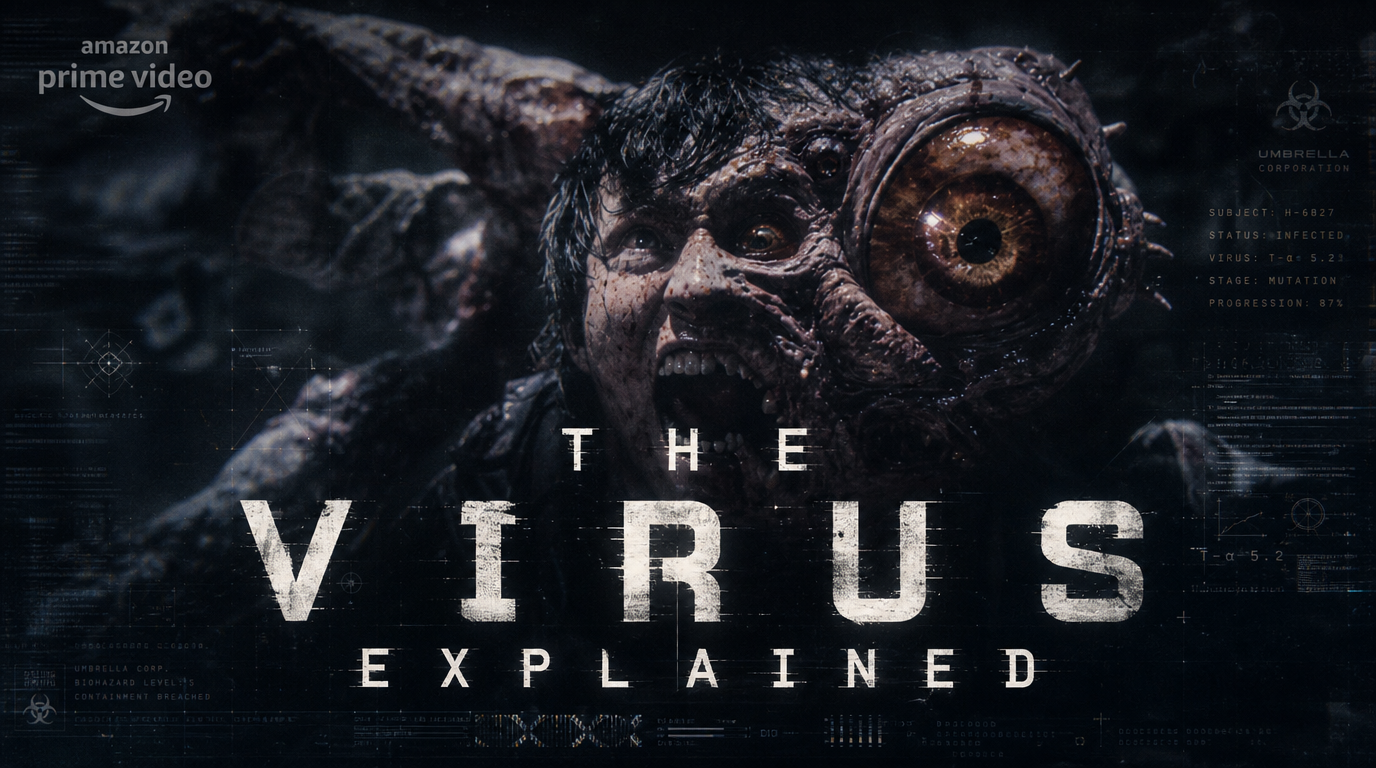
What fascinated me most about Bryan’s transformation in Resident Evil (2026) wasn’t necessarily the grotesque creature he eventually becomes, but the biological implications of a virus capable of reorganizing a living human body into something completely unrecognizable. Unlike conventional zombie infections that primarily destroy brain function and turn their victims into mindless predators, Umbrella’s experimental pathogen appears capable of fundamentally altering the structure and behavior of human tissues, creating organisms that develop entirely new anatomical features. This raises an interesting question about whether Bryan’s mutation represents uncontrolled cellular growth, an accelerated form of biological adaptation, or something considerably more complicated.
How Umbrella’s Virus Accelerates Biological Transformation
According to the explanation provided by Umbrella employee Paul, the experimental serum was originally developed for the American government and designed to accelerate the evolution of living organisms, although the resulting outbreak demonstrates just how catastrophically that objective failed. I find this concept especially interesting because biological evolution normally occurs through inherited genetic changes across generations, whereas Bryan’s transformation resembles an extreme form of cellular reprogramming occurring within a single individual. If we attempt to explain the process scientifically, the closest fictional interpretation would involve the virus hijacking the mechanisms responsible for cell division, differentiation, and tissue development, effectively forcing mature cells to behave as though their biological instructions had been rewritten.
The Connection to Cancer and Uncontrolled Cell Growth
One real-world phenomenon that comes surprisingly close to certain aspects of Bryan’s mutation is cancer, particularly the way genetic alterations can disrupt the mechanisms that normally regulate cellular division and survival. Cancer cells can continue multiplying when they should stop, invade surrounding tissues, and develop characteristics that differ substantially from those of healthy cells, which makes them an interesting comparison for a fictional virus producing abnormal biological growth. However, I think the distinction is important because cancer doesn’t generate functional tentacles, additional mouths, or coordinated organs, and its progression generally occurs over much longer periods. Bryan’s transformation would require not only uncontrolled cell multiplication but also an extraordinary ability to organize that growth into completely new anatomical structures.
Could Regenerative Biology Explain His New Limbs?
Another fascinating scientific connection involves regenerative animals such as axolotls, which possess the remarkable ability to regrow complex structures, including limbs containing bones, muscles, nerves, and blood vessels. Researchers have discovered that this process depends on specialized cellular signaling and positional information, allowing regenerating tissues to reconstruct the correct anatomical structures rather than simply producing disorganized masses of cells. When I look at Bryan’s tentacles and additional appendages, I can’t help wondering whether Umbrella’s fictional virus somehow activates and corrupts developmental mechanisms that ordinarily remain inactive in adult humans. The problem, of course, is that real regeneration requires tightly coordinated biological processes, and no known pathogen can force an adult human body to construct functional new limbs within minutes.
Why Bryan’s Body Begins Absorbing Other People
One of the most disturbing characteristics of the infection is its ability to merge biological material from different individuals, something we witness repeatedly through the monstrous amalgamation pursuing Bryan before his own transformation develops similar capabilities. I interpret this behavior as the virus prioritizing the acquisition of additional biological mass, potentially allowing infected organisms to expand their physical structures by incorporating tissues from other victims rather than relying exclusively on their original bodies. Although biological systems can exchange genetic material and certain cells can fuse under specific conditions, there is no known mechanism through which a human body could rapidly absorb another person and reorganize the resulting tissues into a functioning creature. Nevertheless, the concept gives the film’s monsters a disturbing internal logic, because their increasingly grotesque appearances reflect the accumulation of biological material rather than conventional human growth.
Why Bryan Loses Control of His Own Body
What I find particularly horrifying about Bryan’s mutation is that his body begins attacking people while he remains conscious enough to understand what is happening and desperately plead for treatment. This suggests that the infection isn’t immediately destroying his awareness, but is instead interfering with the neurological mechanisms responsible for controlling his newly formed anatomical structures. From a biological perspective, voluntary movement requires communication between the nervous system and muscles, so the emergence of appendages operating independently of Bryan’s intentions would imply an entirely new system of motor control. The film doesn’t establish how such a system works, but I think the separation between Bryan’s conscious desires and his body’s violent behavior is what makes his transformation significantly more disturbing than an ordinary zombie infection.
The Connection to William Birkin and the G-Virus
For longtime Resident Evil fans, Bryan’s final appearance immediately brings to mind William Birkin, whose infection with the G-virus in Resident Evil 2 produces an increasingly grotesque series of mutations involving abnormal growth, oversized limbs, and additional eyes. I find the resemblance compelling because both transformations suggest that the infected body has abandoned its original anatomical organization in favor of aggressive tissue proliferation and adaptation. However, I wouldn’t interpret the similarities as proof that Bryan contracted the G-virus, especially since the film’s creators have discussed the T-virus as the basis for its infected creatures. The connection is therefore more useful as a comparison between the franchise’s approaches to biological horror than as confirmation that the two characters share exactly the same infection.
Could Something Like Bryan’s Mutation Actually Happen?
When I compare Bryan’s transformation with contemporary scientific research, I think the most interesting conclusion is that the movie combines several genuine biological phenomena into a process that remains impossible under our current understanding of human physiology. Viruses can alter cellular activity, mutations can disrupt growth regulation, and certain animals can regenerate complex tissues, but none of these mechanisms allows a fully developed human being to produce enormous new organs, absorb other individuals, and reorganize the nervous system almost instantaneously. There is also the unavoidable problem of energy and mass, because constructing additional tissues requires substantial biological material and metabolic resources that cannot simply appear through genetic changes. For me, this is what makes the fictional science behind Bryan’s mutation so effective: it takes recognizable features of living biology, removes the natural limitations that normally keep them under control, and imagines what might happen if an experimental pathogen could manipulate the human body without any regard for its original structure or survival.
The Sewer Monster That Defies Human Biology
One of the most disturbing creatures in Resident Evil (2026) isn’t necessarily Bryan’s final mutation, but the enormous, pale humanoid sitting motionless inside Raccoon City’s sewers, whose grotesquely swollen abdomen eventually bursts open and releases an entire swarm of mutated rats. What fascinates me about this creature is that its transformation appears fundamentally different from the other infected individuals we encounter, because instead of developing additional limbs or becoming an aggressive predator, its body seems to function as some kind of biological container for an entirely different species. That raises an unsettling question about whether Umbrella’s experimental virus is capable of transforming humans into living incubators, effectively exploiting their bodies to sustain and potentially spread other infected organisms.
Could the Rat Man Be a Living Incubator?
The first scientific concept that comes to mind is biological parasitism, particularly the way certain organisms exploit another living creature as a host for development, nourishment, or reproduction. In nature, parasitic organisms can survive inside animal tissues, manipulate host physiology, and sometimes produce severe anatomical changes, although the relationship between the Rat Man and the creatures inside him appears considerably more extreme. I find it interesting to consider whether the virus has altered his internal organs to accommodate the rats, potentially creating an environment where infected animals can remain alive while the host’s original biological functions gradually deteriorate. However, the movie never confirms that the rats were actually growing inside him, meaning this interpretation remains a theoretical explanation rather than established Resident Evil lore.
The Biological Problem With Hundreds of Rats Living Inside a Human
What makes the Rat Man particularly fascinating from a scientific perspective is the enormous physiological challenge associated with keeping hundreds of living animals inside a single human body, because each rat would require oxygen, nutrients, sufficient physical space, and a way to eliminate metabolic waste. Even if Umbrella’s virus somehow expanded the man’s abdominal cavity and modified his internal organs, the resulting pressure on his respiratory and cardiovascular systems would ordinarily be fatal. This is where I think the creature moves beyond conventional parasitism into something resembling an entirely new biological arrangement, potentially involving extensive tissue restructuring and an abnormal exchange of nutrients between the human host and the infected animals. No known virus can create such a system, but the concept offers an interesting fictional explanation for why the creature’s body has become so grotesquely enlarged.
Why the Rats Might Be More Important Than the Human Host
Another interpretation I find compelling is that the Rat Man may no longer function as an independent organism, but instead represents a temporary biological shelter that allows the infected rats to survive until they encounter another potential victim. This would explain why the creature remains relatively motionless when Bryan approaches, only becoming dangerous once its abdomen ruptures and the swarm escapes. If the virus is capable of altering different species through a shared biological mechanism, the human body could theoretically serve as a protective structure while the rats act as mobile carriers responsible for spreading the infection. The distinction matters because it would suggest that the Rat Man isn’t necessarily a failed mutation, but a potentially effective disease-spreading organism whose grotesque anatomy serves a specific purpose.
The Connection to the Real Rat King Phenomenon
One particularly interesting comparison involves the historical phenomenon known as a rat king, in which multiple rats become physically entangled through their tails and remain trapped together in a tightly connected group. Documented specimens exist, although the phenomenon is extremely rare and has nothing to do with animals merging into a single biological organism. What makes this comparison relevant is that the mutated rats in Resident Evil appear capable of combining their damaged bodies after Bryan attacks them, suggesting that the virus may interfere with the normal biological boundaries separating individual organisms. I find this considerably more disturbing than ordinary infection because it introduces the possibility of multiple creatures becoming components of a larger biological structure, although the actual mechanism behind their fusion remains unexplained.
Could Viral Infection Make Different Bodies Fuse Together?
There is an interesting scientific parallel involving viruses that induce cellular fusion, a process through which infected cells can merge their membranes and form unusually large structures containing multiple nuclei, sometimes referred to as syncytia. Certain viruses are capable of triggering this behavior, demonstrating that infections can interfere with the mechanisms that normally maintain the physical separation between individual cells. However, extending that process to entire animals would require extraordinarily complex changes, because functioning organisms contain multiple specialized tissues, immune defenses, circulatory systems, and nervous networks that cannot simply merge into one coordinated body. I think Resident Evil exaggerates this genuine biological phenomenon to imagine what might happen if a pathogen could eliminate those barriers entirely, allowing infected organisms to combine into increasingly grotesque masses of living tissue.
Why the Sewers Make the Perfect Environment for This Mutation
I also find the creature’s location important because Raccoon City’s sewer system has an established connection to viral transmission throughout Resident Evil mythology, particularly through infected rodents associated with the original outbreak. Rats are especially effective at moving through densely populated environments, navigating concealed spaces, and encountering contaminated water or biological waste, making them a useful narrative vehicle for explaining how an infection might spread beyond its initial source. If Umbrella’s experimental pathogen can infect both humans and rodents, then the sewers could become an environment where different infected species interact and develop unpredictable mutations. The Rat Man’s enormous body and the swarm emerging from his abdomen might therefore represent a localized example of the virus adapting to an environment where human and animal populations overlap, although the film provides no definitive explanation for why this particular mutation occurred.
What the Rat Man Reveals About Umbrella’s Experimental Virus
Ultimately, what fascinates me about the Rat Man is that he challenges the conventional idea that a viral infection must simply transform its host into a stronger or more aggressive version of itself, because his mutation seems to involve an entirely different biological relationship between organisms. While Bryan’s body develops extraordinary anatomical structures and regenerative capabilities, the Rat Man appears to have become a vessel for other infected creatures, suggesting that Umbrella’s pathogen can produce dramatically different outcomes depending on the host and its environment. I don’t think real-world biology offers a plausible mechanism for hundreds of rats living inside a human abdomen or merging into a coordinated monster, but parasitism, cellular fusion, and infectious disease transmission provide recognizable scientific concepts that make the fictional mutation more interesting to examine. For me, the most disturbing possibility isn’t that the Rat Man represents a particularly unfortunate infected individual, but that his body has become a biological tool whose original human identity no longer matters to the infection controlling it.