Musallat Movie Explained | Review & Recap

Musallat 1 Review
A young couple, Suat and Nurcan, are torn apart by economic necessity when Suat moves to Germany for work. However, their separation invites a third party into their relationship, an obsessive, shapeshifting Jinn that will stop at nothing to possess Nurcan.
Where to Watch Musallat 1 Movie
For viewers in Turkey, “Musallat” (2007) is widely available and often free to watch on local digital platforms.
You can currently watch it on:
PuhuTV: The movie is available for free (with ads) on PuhuTV. This is usually the most reliable official source for older Turkish films.
YouTube: The full movie has been officially uploaded by production channels (look for channels like Fanatik Film or Avşar Film). Searching for “Musallat 2007 Full İzle” will typically yield the official high-quality upload.
Netflix (Check Availability): It rotates on and off the Turkish Netflix catalog. It is worth a quick search if you have a subscription, as the license is frequently renewed.
A Quick Tip: If you search on YouTube, ensure the runtime is approximately 1 hour 35 minutes to avoid clicking on clickbait clips or reaction videos.
Recap
The story is set in a rural Turkish village where Suat and Nurcan are deeply in love. They are the picture of innocent, idyllic romance. However, facing financial pressure, Suat makes the difficult decision to leave the village and work in Berlin, Germany, to save money for their wedding. He leaves Nurcan behind in the care of his family, promising to return.
In Germany, Suat’s life becomes a psychological hell. He begins to experience terrifying, unexplainable phenomena. He sees grotesque visions, hears voices, and feels a suffocating presence. His mental state deteriorates rapidly, leading him to attempt suicide.
Doctors and psychiatrists in Germany are baffled; physically, he appears fine, but his mind is shattering. His childhood friend, Metin, realizes this isn’t a medical issue but a spiritual one. They decide Suat must return to Turkey to seek help from a Hacı (a spiritual healer/exorcist) named Burhan Kasavi.
The Mystery in the Village
Here is where the narrative fractures brilliantly. While we watch Suat suffering in Germany, we are simultaneously shown scenes in the village where Suat appears to have already returned.
To the villagers and Nurcan, Suat came back from Germany some time ago. He seems slightly different, colder, more intense, perhaps a bit strange but he is there. He marries Nurcan. They begin a life together. Nurcan becomes pregnant. However, her pregnancy is plagued by pain, nightmares, and a sense of dread. She is physically tormented by the fetus growing inside her, and the “Suat” she is living with exhibits erratic, sometimes frightening behavior.
The film reveals that the “Suat” in the village is not the real Suat. It is a Jinn, a supernatural entity made of smokeless fire that has been obsessed with Nurcan since her childhood. This Jinn has shapeshifted into Suat’s exact likeness to deceive Nurcan and the villagers.
Meanwhile, the real Suat is still struggling to return home, constantly blocked and attacked by the Jinn’s influence, which is trying to kill him or drive him mad to keep him away from the village.
The Ending Explained
The climax of Musallat is a tragic collision of these two realities.
1. The Exorcism: The real Suat (the one who was in Germany) finally reaches the Hacı, Burhan Kasavi. The Hacı realizes that a powerful Jinn has fallen in love with Nurcan and has taken Suat’s place to conceive a child with her—a hybrid abomination forbidden by spiritual law. To break the haunting (Musallat), they must confront the entity.
2. The Birth and the Death: Back in the village, Nurcan goes into a violent labor. The Jinn (wearing Suat’s face) is with her. The birth is not natural; the creature clawing its way out is destroying her from the inside.
3. The Twist: The Hacı performs a ritual to kill the Jinn. As the ritual reaches its peak, the Jinn—currently in the form of Suat in the village begins to die. However, because the Jinn has tied its existence so closely to the perception of those around it, the lines of reality blur.
In a heartbreaking twist, the real Suat arrives too late. Nurcan gives birth to the baby but dies in the process, her body unable to withstand the trauma of birthing a half-demon entity.
The entity that was posing as Suat “dies” or dissipates, but the damage is absolute. Nurcan is dead. The real Suat is left with nothing but grief and the horrific realization that while he was suffering in Germany, a monster was living his life, sleeping in his bed, and impregnating the woman he loved.
The Final Scene: The movie closes on a somber note, often interpreted as the baby surviving—a permanent reminder of the violation. The real Suat is left alive but spiritually destroyed, haunting the village like a ghost himself.
Critical Analysis and Review
As a commentator on the genre, I believe Musallat stands out for three specific reasons:
1. The “Islamic Gothic” Aesthetic
Unlike Western horror, which often relies on Christian iconography (crucifixes, holy water), Musallat leans heavily into Islamic theology regarding the Jinn. The horror here isn’t about a random monster; it is about a parallel intelligent species (Jinn) that can fall in love, feel jealousy, and trick humans. The Jinn in Musallat isn’t just a beast; it is a character with a motivation (twisted love).
2. The Doppelganger Horror
The most terrifying aspect of the film is not the jump scares, but the violation of identity. The idea that your loved one could come home, sleep beside you, and father your child, only for you to never realize it wasn’t actually them, is deeply unsettling. It taps into the primal fear of intimacy never truly knowing the person next to you.
3. The Sympathetic Villain
In a strange way, the Jinn is the most tragic character. It loved Nurcan so much that it defied the laws of its own dimension to be with her. It didn’t want to kill her; it wanted to be her husband. The destruction it caused was a byproduct of its selfish, impossible love. This elevates the movie from a simple creature feature to a dark, supernatural romance tragedy.
Musallat 2 Review
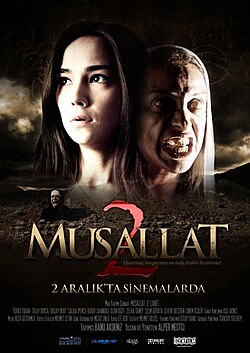
Unlike the first film, which was a love story destroyed by a Jinn, this sequel acts as a standalone story (anthology style). It explores the concept of ancestral sin, how the desperate, forbidden choices of parents can damn their children before they are even born.
Detailed Movie Recap
A Life Built on Lies
The story centers on Elif, a beautiful, wealthy, and seemingly happy young woman working as an art teacher. However, her perfect life is plagued by a specific, suffocating physical ailment. She suffers from severe asthma attacks that doctors cannot explain, hears voices that aren’t there, and has nightmares of a dark, shadowy figure claiming her.
Her psychological state deteriorates until her family is forced to reveal a devastating secret: Elif is adopted. Her biological parents died in a rural village under mysterious circumstances when she was an infant.
Determined to cure her “illness” (which she intuitively feels is spiritual, not physical), Elif travels to her birth village to find answers. The village is bleak, impoverished, and steeped in superstition.
There, she meets a terrifying, bedraggled older woman, a local sorceress (a büyücü) named Ümmü. Ümmü knows exactly who Elif is. Through Ümmü, the horrific truth of Elif’s conception is revealed.
The 41 Stitches
Elif learns that her biological mother was barren and desperate for a child. Her father, unwilling to accept a childless life, forced Ümmü to perform a forbidden dark ritual known as the “41 Stitches Spell” (41 Dikiş Büyüsü).
This is the core lore of the movie. To create life where God did not intend it, they summoned a powerful Jinn tribe. The deal was transactional: The Jinn would help conceive the child, but in return, the child would belong to them.
Elif was never “meant” to be born. Her very existence is a magical debt. Her parents died trying to protect her or escape the deal, leading to her adoption by a wealthy family in the city, which temporarily hid her from the Jinn’s influence.
The Ending Explained
The climax of Musallat 2 is grim and rejects the “triumph of good” trope common in Western horror.
Elif realizes that her asthma and suffocating attacks were not a disease; they were the Jinn trying to “collect” what belongs to them. The protection that kept her safe (her distance from the village and her ignorance of the truth) has been shattered by her return.
The Failed Exorcism
Elif attempts to break the curse, hoping that knowing the truth will set her free. However, the film establishes a cruel rule of magic here: You cannot break a deal if you are the product of that deal. If the spell is broken, Elif’s life ends because the spell is the only thing keeping her alive.
The Debt is Paid
In the terrifying final moments, Elif is cornered. The Jinn do not want to kill her; they want to take her. The ending implies that Elif is dragged into the Jinn’s dimension (or fully possessed/taken over), fulfilling the pact her father made decades ago.
Review
As a follow-up to the first Musallat, this film shifts the thematic focus significantly. Here is why it resonates:
1. The Horror of Biology
While Musallat 1 was about a lover being replaced, Musallat 2 is about body horror and origin. Elif discovers that she is essentially “counterfeit” life. She was purchased from demons. This creates a deep existential horror, how do you fight a monster when the monster is the reason you exist?
2. The Critique of Superstition
Director Alper Mestçi uses this film to criticize the dangerous reliance on sorcery in rural folklore. The “41 Stitches” spell serves as a metaphor for greed. Elif’s father wanted a child so badly he was willing to make a deal with the devil, but he wasn’t the one who paid the price—his innocent daughter was.
3. The Inescapable Fate
Turkish horror often leans into fatalism (Kismet/Fate). Unlike Hollywood movies where the hero finds an ancient dagger to kill the beast, Musallat 2 posits that some spiritual contracts are absolute. It leaves the viewer with a sense of hopelessness that is disturbing but effective.
Where to Watch “Musallat 2: Lanet” (2011)
Is it streaming on Netflix, YouTube, or Apple TV? Here is your complete guide.
If you are looking to watch Alper Mestçi’s psychological horror sequel “Musallat 2: Lanet”, finding a high-quality stream can be tricky due to licensing changes. Unlike the first movie, which is widely available for free, the sequel often sits behind digital rental counters.
Here are the best current options to watch the movie in 2026:
1. Best for Quality: Digital Rental & Purchase
The most reliable way to watch Musallat 2 in High Definition (1080p) without ads is through digital marketplaces. This is recommended if you want to catch the subtle visual details of the “41 stitches” ritual scenes.
Apple TV / iTunes Store: Often available for rent (approx. 48-hour window) or permanent purchase.
Google Play Movies: Check the Turkish catalog for availability.
2. Subscription Streaming (Check Availability)
Netflix (Turkey): The Musallat franchise rotates in and out of the Netflix library frequently. If you have an active subscription, search for “Musallat 2: Lanet” directly.
Tip: If it is not currently listed, it may have moved to a local competitor like BluTV or Exxen.
3. Free Options (with Ads)
PuhuTV: As one of the largest archives for Turkish cinema, PuhuTV often hosts the Musallat series. It is free to watch but requires you to disable ad-blockers.
YouTube: While the full movie is occasionally uploaded by production companies (like Mia Yapım or Fanatik Film), it is often taken down for copyright.
Warning: Avoid “Part 1/Part 2” uploads from unofficial channels, as they often have pitched audio or zoomed-in screens to evade copyright detection.
Important Note: Don’t Confuse the Titles!
When searching, ensure you are clicking on “Musallat 2: Lanet” (2011) directed by Alper Mestçi. There is a similar low-budget horror series called Mühr-ü Musallat 2 released recently. These are not the same movie. Look for the poster featuring the character Elif or the release year 2011.
For International Viewers
If you are watching from outside Turkey (e.g., USA, UK, Germany):
You may need a VPN set to a Turkish server to access the movie on PuhuTV or local Netflix.
English subtitles are rarely included on local Turkish platforms. We recommend using Apple TV or YouTube (if official), as they are most likely to support external caption files (.SRT).












Post Comment