Zeta (Agent Zeta) 2026 : Full Movie Recap & Ending Explained
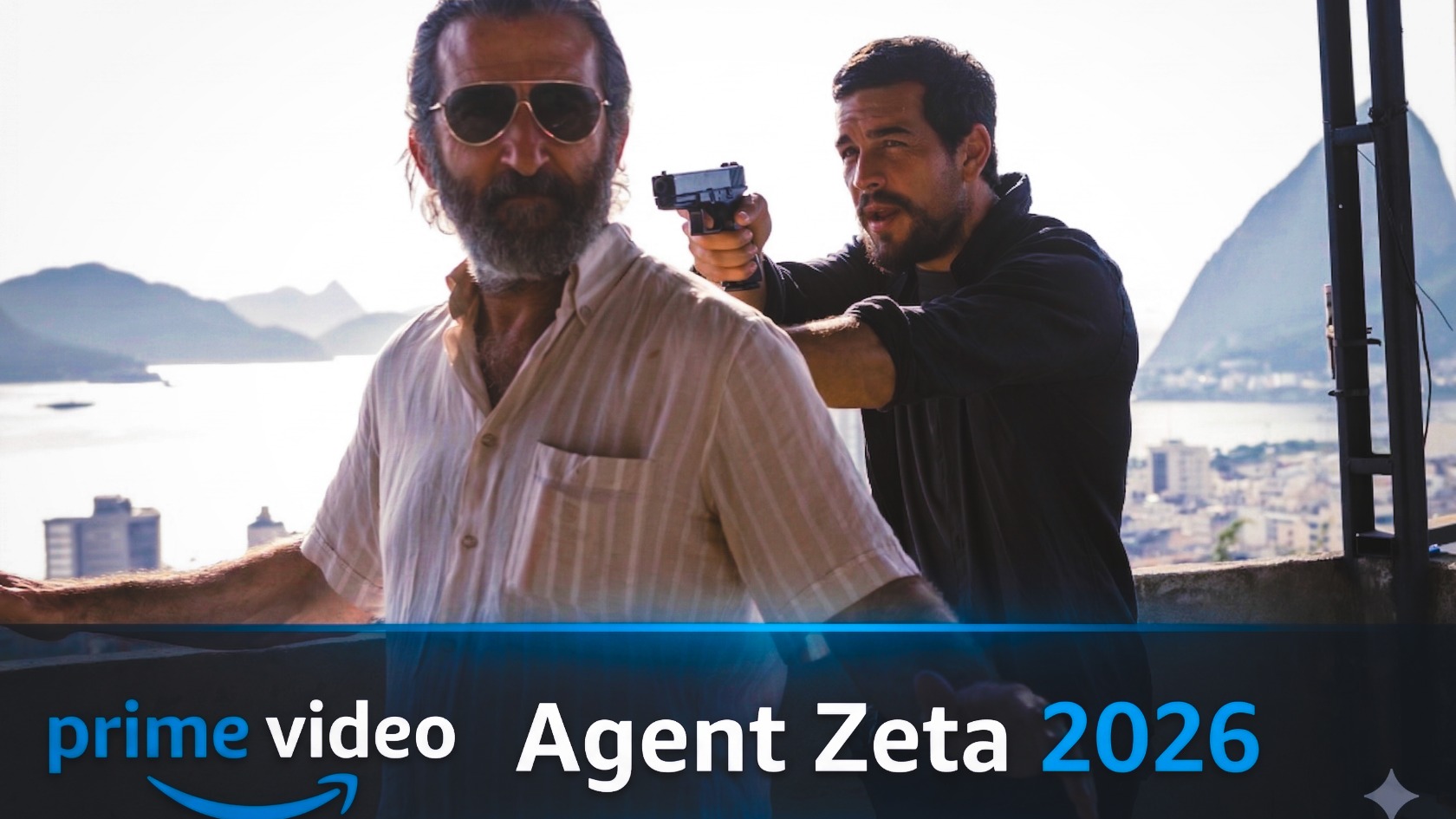
The Film at a Glance: Spain’s Answer to the Spy Thriller
Amazon Prime Video has been building a formidable catalogue of European genre cinema, and Zeta released internationally under the title Agent Zeta , arrives as the most ambitious Spanish spy thriller in recent memory. It announces itself with the swagger of a franchise opener and the intimacy of a family drama, wrapped inside a globe-trotting action film that spans Tallinn, Rio de Janeiro, Medellín, and the rain-soaked streets of Galicia.
Agent Zeta is a 2026 Spanish action spy film directed by Dani de la Torre and written by De la Torre, Oriol Paulo, and Jordi Vallejo.
Led by Mario Casas, the cast also features Mariela Garriga, Nora Navas, and Luis Zahera. After the simultaneous killing of four former Spanish intelligence agents involved in the so-called ‘Operación Ciénaga’, Zeta is tasked by the CNI with tracking a surviving missing agent, joining forces with Colombian intelligence agent Alfa, going on to deal with a mysterious sixth member of the operation, who is codenamed Casiel.
Directed by Dani de la Torre ; a Galician filmmaker who made his name in action cinema with titles such as Retribution and Gun City, as well as the series La Unidad and Marbella , the film arrived on Prime Video on 20 March 2026.
What makes Zeta worth examining closely is not simply the action though it delivers that in abundance but the architecture of its mystery: a 37-year-old covert operation in Colombia whose buried truth turns out to be simultaneously a geopolitical time bomb and one man’s entire personal history.
Four Corpses and One Missing Man
The film opens with a display of ruthless operational precision. Mysterious deaths are occurring all across the world. An unknown assassin is selectively killing off former agents of the Spanish organisation CESID who once went on Mission Ciénaga at the Ciénaga Ranch. Nobody knows what happened there except the agents, and the rising death toll worries Elena, the current Spanish National Intelligence (CNI) chief.
Four former agents. Four deaths. Four different locations. All executed simultaneously ; a signature that signals not opportunistic revenge, but a meticulously orchestrated campaign with institutional-grade planning behind it.
Elena discovers that one CESID member, Salvador Ancares, is still alive and missing. She flies to Spain and meets Iago, a CNI agent who is currently on leave, looking after his sick mother, Sara. Initially, Iago who works under the code name Zeta disagrees to take the mission, but later gets ready thinking that Ancares is his estranged father.
This is the hook that transforms what could be a conventional espionage procedural into something far more personal. Zeta is not simply hunting a target. He is, or believes he is, hunting his own father ; a man he was told died on a classified mission when Iago was a child. The mission and the family wound are the same wound.
Mario Casas plays Zeta with a studied, cool-burning intensity ; the kind of controlled performance that knows when to let the mask slip just enough to remind you there is a human being underneath the operative. Iago was raised by his mother and has always lived under the conviction that his father died when he was a child, specifically during a mission for the Spanish secret services.
However, through his dialogue with Elena, Iago/Zeta discovers the first fragment of the truth about his own existence: his father did not die but was forced to change his identity after the dark outcome of Operation Ciénaga.
Colombia, a Cemetery, and a Woman Called Alfa
Zeta arrives in Colombia to find Salvador Ancares ; the last surviving agent from the Ciénaga operation before whoever is running this assassination campaign does.
Zeta recovers a video of Ancares and some GPS coordinates, but soon, Alfa, an agent of the Colombian Intelligence Service, drives away with his bag. After Zeta chases her down, Alfa promises that she will be able to say more about Operation Ciénaga and its location if the CNI allows her and Zeta to work together.
The introduction of Alfa (Mariela Garriga) is a masterclass in misdirection. She is presented as the film’s most dynamic supporting player technically brilliant, wryly competitive with Zeta, and apparently motivated by Colombia’s own institutional interest in closing the Ciénaga file. The film leans into the pleasures of their odd-couple partnership, playing the two agents’ friction for both action spectacle and understated chemistry.
As Zeta and Alfa walk into a cemetery following the GPS coordinates, they notice strange men in the vicinity. They try to confront them, but soon, a group of thugs surrounds them from all sides. The goons take Zeta to a secret hideout where he finds Ancares, and Alfa keeps an eye on the situation. Together, they fight the goons, extract Ancares, and bring him to the CNI Headquarters.
Salvador Ancares played with weathered, quietly devastating authority by Luis Zahera is finally face to face with the young man who may be his son. Throughout the film, he keeps Zeta at a distance, even feigning ignorance at times about his connection to him. However, Salvador’s actions consistently point toward protecting him like a father would for a son.
Zahera, as multiple critics have noted, is the film’s secret weapon ; a performer of such lived-in physical and emotional presence that every scene he inhabits takes on additional gravity. He is the mystery’s anchor, and watching him navigate the tension between Salvador’s paternal instincts and his survival imperative is one of Zeta‘s most quietly compelling pleasures.
What Was Operation Ciénaga?
The film’s second act is devoted to excavating the past and it is here that Zeta earns its most substantial dramatic material.
Thirty-seven years ago, Ancares was investigating drug dealers and came to know about two big names in the market: Sito Baltar and Esteban Furiase. They dealt with cocaine and all kinds of firearms. However, the CNI came to know that apart from Baltar and Furiase, Spain had a much bigger threat: a local mob boss named Tirapu was making moves with a guerrilla terrorist organisation named the ETA, who wanted to rule Spain. Tirapu had direct links with Baltar and Furiase, who had been funding the militia with their drug money.
The ETA ; the Basque separatist organisation responsible for decades of bombings, assassinations, and political violence in Spain provides the film with its sharpest historical edge. The connection between South American narco-trafficking and European domestic terrorism is not a fictional invention but an echo of documented real-world relationships that made this particular era of Spanish security particularly harrowing.
Spanish intelligence had been tracking Tirapu for years, following him to Colombia, where he had established a steady arms traffic toward the ETA in Spain.
That day at the festival represented the final opportunity to eliminate him, but the circumstances made the mission nearly impossible: the three targets were surrounded by thousands of civilians in the streets of Medellín. Logic dictated that the mission should be aborted.
The CNI got a lead that all three of them would be present at the Flower Festival, and it would be a perfect chance to neutralise them.
During the Flower Festival at Ciénaga Ranch, they spotted all three of them, but the situation drastically changed when the area got flooded with many civilians. Furiase got to know that something was not right, and soon, a firefight started between their goons and the agents. The CNI agents could ultimately neutralise their targets, but Mission Ciénaga saw a bloodbath where bystanders got caught in the crossfire and died.
The first shots rang out. The three criminals died, but it was also a slaughter of civilians. The Spanish secret services were forced to fake the deaths of the five agents involved in the mission, while Colombian government agencies searched for those responsible for the carnage.
The operation was buried and left no trace. The crucial question the film holds in reserve: the operation had been aborted. So who fired the first shot?
Casiel and the Secret at the Centre of Everything
The film’s most consequential revelation arrives in measured, controlled doses. There were not five agents on Operation Ciénaga. There were six. The sixth agent ; unrecorded, off the books, unknown even to Elena and the current CNI leadership was operating under the codename Casiel.
Casiel was the codename for Sara Varela, a National Police agent who had dedicated herself with absolute abnegation to the fight against the terrorist group ETA.
The root of her determination was deeply buried in her family history: Sara’s father was a Civil Guard who had been killed years earlier by the command led by Tirapu. Sara joined the agents of Operation Ciénaga, assuming the role of an infiltrator at the very heart of the Furiase family. Taking the name Ana Vázquez, she was dubbed “Casiel” by the other five spies.
Under this identity, Ana managed to attract the attention of Teo Furiase in Medellín and soon became his lover. From that privileged position, Casiel discovered crucial information about the arms traffic destined for the ETA in Spain.
She was motivated by something more than professional obligation.
Casiel’s father was murdered by the very man she was now infiltrating the inner circle of. She was a spy driven by grief and that grief, as the film will eventually reveal, was what pulled the trigger that was never supposed to be pulled.
The revelation of Casiel’s identity is the film’s most devastating beat, because by this point in the story, the audience has already met her. Casiel is not a figure from the past.
She is present. She is alive. She is, in fact, the woman who has been closest to Zeta this entire time because Casiel is Sara, the sick mother Iago left behind in Spain at the very beginning of the film, the woman whose illness set the entire narrative in motion.
Iago’s mother is Casiel. The sixth agent. The woman who fired the first shot. The mystery he has been investigating is his own origin story.
Alfa Is Ainara
The film’s second major twist arrives in its final act, and it recontextualises every scene Alfa has shared with Zeta.
At the start of the movie, Alfa is initially introduced as a top Colombian agent assisting Zeta. However, it turns out she is the journalist who previously contacted Celia (Salvador Ancares’ wife), and the mole inside the operation.
She is the one who has been orchestrating the assassinations all this time, and her motive is deeply personal. As we learn during the final confrontation, Ainara‘s parents were killed during the Ciénaga massacre by Casiel.
Seeing their deaths, and how the agents ran away, caused her to spiral into a rage-inducing vengeance mission. She spent years meticulously tracking down everyone involved, manipulating events from the shadows and even using Esteban Furiase’s cartel to carry out the killings.
The symmetry is almost unbearable in its elegance. Casiel became a spy because her father was murdered by Tirapu. Ainara became an assassin because her parents were murdered by Casiel. Both women were forged from grief. Both chose violence as the instrument of justice.
The film draws a direct, unbroken line between the massacre 37 years ago and the blood-soaked present not as coincidence, but as causality.
This is Zeta‘s most intellectually ambitious gesture: the suggestion that violence of this kind does not conclude with its perpetrators.
It transmits. It propagates through generations with the precision of inheritance, finding new carriers, new causes, new justifications until someone makes a different choice.
The Climax: An Airfield, a Father, and a Final Confrontation
Salvador is shot at the airfield by Alfa’s assassin, who is desperate to prevent the truth from getting out. By this point, Zeta has figured out what is going on and he lies in wait for Alfa at his place.
The final confrontation between Zeta and Ainara is the film at its most stripped back and emotionally direct. No gadgets, no chase sequences, no operational choreography just two people in a room, one of whom has spent her entire adult life hunting the people who made her an orphan.
The two square off, where Ainara reveals her past and connection to Casiel. The pair end up face to face after she initially shoots Zeta, before our protagonist returns and shoots her down.
Zeta wins the fight. But the word “wins” feels inadequate here. He has just shot the woman whose parents were killed by his mother. He has just protected the woman who pulled the trigger that started the whole catastrophic chain. There is no clean victory available to anyone standing in this room.
The Ending Explained
Zeta closes on a sequence of careful, layered revelations that the film has been earning since its opening frame.
Salvador Ancares : still alive. Salvador Ancares is still alive. He dupes the authorities, claiming he has passed away to avoid suspicion, while the doctor covers for him.
The man who spent 37 years living under a false identity, who carried the weight of Operation Ciénaga’s buried truth across decades, chooses , one final time , to disappear. It is not cowardice. It is the logic of a man who has learned that visibility is a death sentence.
Ainara : patched up, not finished. Zeta scoops up Ainara and takes her outside to the ambulance, where the CNI arrive to play damage control. With the drama finally over and Ainara getting patched up, before she potentially goes back after Casiel. The operative word there is “potentially.” Ainara is alive. Casiel is alive. The cycle is not closed it is merely paused.
The letter : Casiel’s confession. The film’s most emotionally resonant moment is its quietest. Zeta finds the postcards Salvador mentioned beforehand in the photo frames back home. There is a letter here from Casiel, explaining what happened in the past, and how Salvador was still alive. She made the decision to leave as she could not face her past choices. Casiel wanted to protect Zeta from herself and bury the woman she once was. She regrets not giving Salvador the chance to be a father to Zeta.
Sara , Casiel , wrote the letter. She knew, at some level, that this would all eventually surface. She left the postcards in the frames like a time-delayed confession, embedded in the most domestic of objects, waiting for the son who was also the spy to come home and find it.
The letter is, in its way, a mirror of the film’s entire emotional logic. The lies that parents tell children to protect them from history are not erasures. They are delays. And the delay, in this case, cost 37 years, four lives, and one child’s entire understanding of who they are.
What the Ending Actually Means: The Kill Bill Echo
Agent Zeta (2026) will have recalled the iconic Kill Bill scene where Beatrix Kiddo breaks into Vernita Green’s house and is witnessed by Vernita’s young daughter. The story of this Spanish thriller is also a chronicle of revenge spanning two generations.
Thirty-seven years ago, the massacre at the flower festival in Colombia originated with Casiel, a woman who became a spy driven by the thirst for vengeance following her father’s death. In the present, the deaths of the Spanish agents involved in Operation Ciénaga are driven by that same sentiment this time executed by the shadow of Agent Alfa.
The thematic architecture of Zeta is built around this repeating pattern: a person loses someone to violence, becomes a weapon, deploys that weapon, and in doing so, creates the next generation of grieving children who will, in turn, become weapons. Casiel’s father was murdered. Casiel murdered Ainara’s parents. Ainara murdered the Ciénaga agents. Somewhere in another timeline, Ainara’s violence would have created the next Casiel.
The film does not offer a solution to this cycle. What it offers instead is the figure of Iago , Zeta , a man who has now been given the full truth about the violence that produced him, and who must decide what to do with it. He chose, in the final confrontation, to shoot Ainara rather than let her complete her mission. But he also chose to leave her alive. And he found his father’s letter. And he is standing in the ruins of the lie that was his entire childhood, holding a piece of paper that his mother hoped would explain everything.
The film ends before he decides what to feel about any of it. That ambiguity is not a weakness , it is a design.















Post Comment