The Mortuary Assistant (2026) Full Movie Recap & Ending Explained
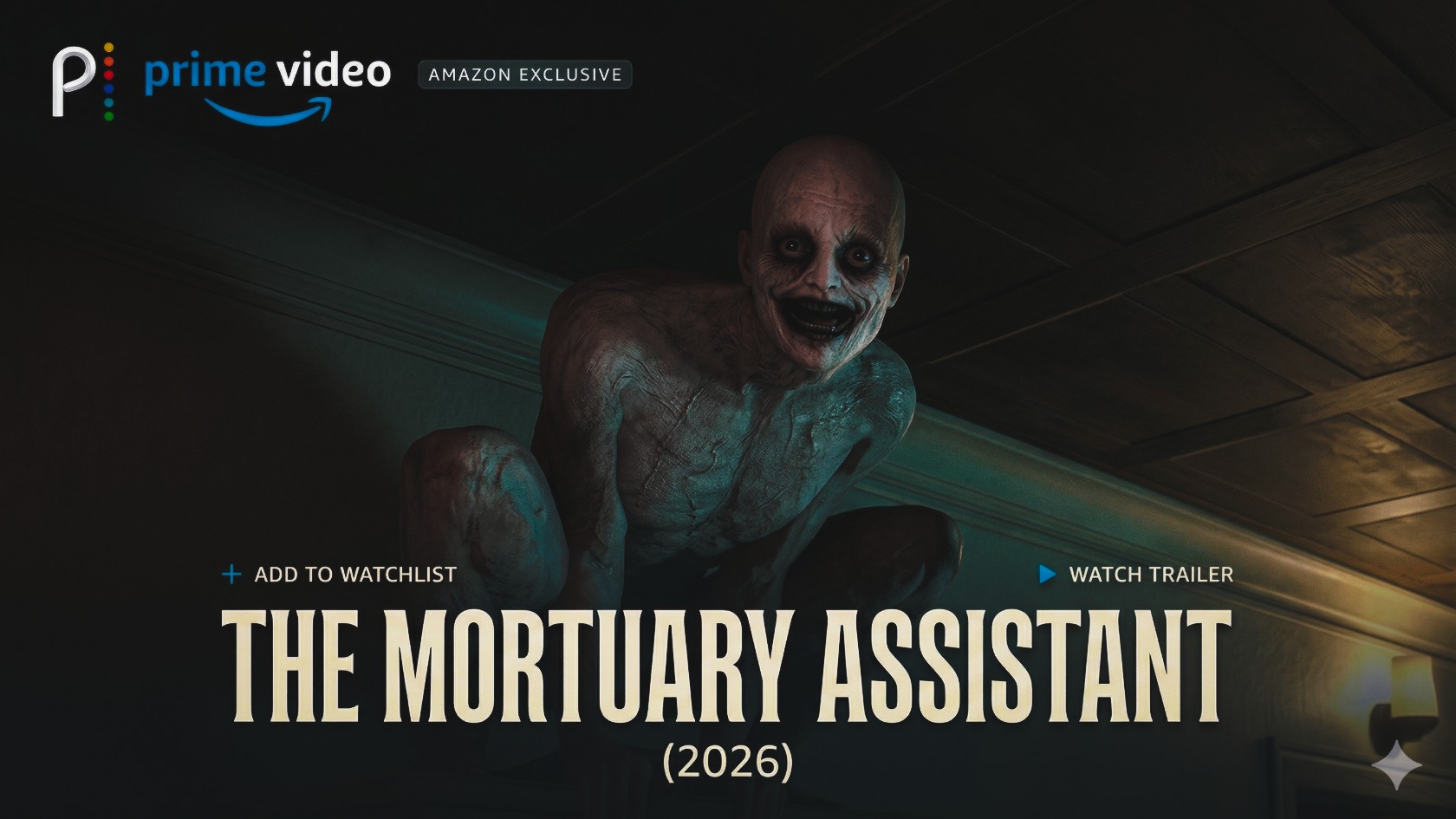
A Demon Named The Mimic, a Body in a Box, and the Trauma That Has Always Been Waiting
The Mortuary Assistant is a 2026 American supernatural horror film directed by Jeremiah Kipp from a screenplay by Tracee Beebe and Brian Clarke. Based on the 2022 video game by DreadXP, it stars Willa Holland and Paul Sparks. The film was released on February 13, 2026 in limited theater release, with a Shudder streaming release following on March 26, 2026.
The Mortuary Assistant is a flawed but genuinely interesting horror film that attempts something more ambitious than its budget and its source material might suggest. It is trying to be a story about trauma, addiction, guilt, and the particular courage of choosing to keep going in the face of things that will never fully go away and it tells that story with sincerity, even when the screenplay occasionally buries it under lore and exposition.
The film’s ending is its best argument for itself. Rebecca walking back through the door of the mortuary not because the demon is defeated, but because she has accepted that this is the ongoing work of her life is a genuinely earned moment that the game’s interactive endings could gesture toward but never quite achieve. The Mimic is still watching from the treeline. The sobriety chip is still in her pocket. And Rebecca Owens, having survived one night, makes the choice to survive the next one.
That choice, quiet as it is, is the most honest thing in the film.
Review: 5.5/10 ; A horror film with more thematic ambition than it can consistently execute, elevated significantly by Willa Holland’s committed lead performance and the genuinely unsettling atmosphere of its central location. Recommended for horror fans who are willing to meet it on its own terms; less so for those seeking conventional scares. The game it is based on remains, on balance, the superior version of this story but the film’s emotional core is real, and its ending earns what the rest of the runtime spends too much time explaining.
The Film at a Glance: A Game Adaptation That Reaches for More Than It Finds
The Mortuary Assistant is a 2026 American supernatural horror film directed by Jeremiah Kipp from a screenplay by Tracee Beebe and Brian Clarke. Based on the 2022 video game by DreadXP, it stars Willa Holland and Paul Sparks. The film was released on February 13, 2026 in limited theater release, with a Shudder streaming release following on March 26, 2026.
The 2022 video game it adapts was a cult phenomenon in the horror gaming community ; a procedurally generated, first-person mortuary simulator that confronted players with demonic possession, ritual procedure, and the particular dread of being locked inside a building full of bodies that are not necessarily as inert as they appear.
It worked because games work through participation. Fear builds when you are the one making the mistake, missing the clue, choosing the wrong body to burn. The film's challenge ; one that it meets with mixed results is translating that interactive dread into a cinematic experience that can generate the same anxiety without giving the audience any agency at all.
The Mortuary Assistant attempts to follow in the footsteps of Five Nights at Freddy's and more recently Iron Lung by adapting a small indie horror video game to the big screen. Keith & the Movies The results are uneven but not unworthy ; a film that is better than its troubled production and limited marketing budget suggest, carrying a genuine emotional undercurrent beneath the supernatural mechanics.
One Year Clean, One Night Shift Too Many
The film opens not in the mortuary but in a church basement. Rebecca Owens (Willa Holland) is at a Narcotics Anonymous meeting, and she is about to receive her one-year sobriety chip. It is an opening that tells you everything about what the film wants to be: this is not a haunted house movie. This is a story about a woman carrying something heavy, and the haunted house is simply where that weight becomes visible.
Rebecca is a young woman whose life has been marked by trauma. Yet she has found victory in her struggles. She's a recovering alcoholic celebrating one year of sobriety. And she's nearing the end of an internship for a job she's surprisingly enthusiastic about a mortuary assistant.
After successfully embalming her final supervised procedure, her boss Raymond Delver (Paul Sparks) welcomes Rebecca to a full-time position at River Fields Mortuary. The peculiarly adamant Raymond assigns her the day shift while he insists on handling nights.
Raymond Delver is an interesting piece of casting. Paul Sparks plays him with a quality that reads initially as flatness but accumulates into something more deliberately calibrated ; a case to be made that he's intentionally portraying a man worn down by years of surviving the same nightmare. A guy who's no longer scared, just exhausted.
A man for whom every interaction with Rebecca is shadowed by the knowledge of what is coming, and the guilt of knowing he is, to some degree, responsible for it.
Rebecca comes in to work and proceeds embalming and burning a body, which she initially finds strange that the chart states to do both ; this would be a waste of time but she proceeds anyway. Strange things start happening. She sees a shadowy figure and various hallucinations.
The film's first act is genuinely effective in its slow accumulation of wrongness. The set design is near perfect. Fans of the game will instantly recognize the embalming room, the narrow hallways, the dim fluorescent lighting. It feels like stepping directly into the source material. The mortuary is a space where the clinical and the uncanny coexist ; stainless steel instruments beside ancient shadows, fluorescent lights against a darkness that refuses to be fully dispelled.
The Kelly Incident
The first genuine eruption of supernatural violence arrives not in the mortuary but at Rebecca's home and it arrives with the particular brutality of something that knows exactly where to find you.
She wakes up back at home and her sponsor Kelly is banging on the door. Rebecca reluctantly answers and Kelly states Rebecca had called her and told her to come over which Rebecca does not recall.
Kelly, her mentor, had assumed that she'd done drugs again, and urged Rebecca to just admit that she'd slipped. Rebecca tried to make her understand that she wasn't high, but Kelly refused to believe her.
Rebecca then loses control, her eyes go yellow and she begins violently attacking and eventually kills Kelly with a corkscrew through the temple.
The murder of Kelly is the film's first major tonal commitment. It is not a jump scare. It is not a dream sequence. Rebecca, with yellow eyes and a corkscrew, kills the person responsible for keeping her sober. The demon has used her body to destroy the relationship that was holding her recovery together.
Claiming she received a phone call requesting her to come over because Rebecca relapsed, Kelly arrives at the door. Rebecca suddenly becomes possessed, bites off one of Kelly's fingers, then stabs her in the head with a corkscrew. Unable to understand what just happened once she returns to normal, Rebecca calls Raymond for help.
While Rebecca is on the phone, the body of Kelly stands up and moves towards her before falling over when Rebecca turns to look at her. Rebecca runs towards the door to leave and when she opens it, Kelly is standing there having only just arrived, indicating she has hallucinated the whole thing.
The reality-loop here ; did she kill Kelly or not? is the film's most disorienting sequence and establishes the demon's central tactic: it does not just attack physically. It attacks the protagonist's ability to trust her own perception of reality. The demon, as the film will later reveal, is called
Raymond Explains the Rules: The Mimic and Its Method
Rebecca drove back to the mortuary, and Raymond told her that the entity would go to any length to take possession of her body. It will try to weaken her and exploit her worst fears to gain control.
The entity could easily inhabit the dead, but it was only a temporary solution to merely enter the mortal world. To truly thrive it needed a living body strong enough to withstand possession. And currently, the entity had bound itself to Rebecca like it once did to Raymond. While most humans usually collapsed within a few hours, the fact that Rebecca was still alive and in control suggested that she was strong enough to fight it. Raymond explains that The Mimic is an entity that will exploit the worst parts of one's self in order to weaken a living host it wants to possess.
The Mimic is a precise and terrible name for this thing. It does not simply scare ; it imitates. It takes the shape of your fears, the voice of the people you love, the texture of your worst memories, and deploys them as weapons. Against Rebecca, it has an almost unfair arsenal: a history of addiction, a year of sobriety that could be unmade at any moment, and a father's death that she has never fully processed.
It's established early in The Mortuary Assistant that Rebecca had previously tried to take her own life, as evidenced by the scars on her arms and by the demon's attempts to convince her to do so again. The demon serves as a living metaphor for those dark thoughts, always plaguing Rebecca throughout the film.
Raymond's explanation also reveals why he called Rebecca in on that particular night shift: he did not know The Mimic would target her. He did not anticipate that the entity would bind itself to a new host while she was working. His guilt is not theatrical ; it is the guilt of a man who made a mistake that has catastrophic consequences for someone who trusted him.
The Night Alone
Raymond disappears by design, or by circumstance, the film deliberately keeps this ambiguous and Rebecca is left alone in the mortuary with the demon, the dead, and her own disintegrating sense of what is real.
Raymond calls Rebecca and tells her to cut her wrist on a body and burn it, which she does. Rebecca continues to hallucinate as the burning of the body hasn't worked.
Raymond calls again and Rebecca tries to explain that it didn't work, before Raymond says he hasn't spoken to her since he left and tells her to find the tapes in the basement and to hang up the phone. Raymond's voice changes from helpful to telling her to burn herself and inject herself with embalming fluid and she hangs up the phone.
This sequence in which the voice claiming to be Raymond turns out to be the demon imitating him is the film's central horror game: you cannot trust the guidance you are receiving. Every instruction might be genuine, or it might be a demonic attempt to make you harm yourself. The phone is a vector of manipulation just as much as the dark hallways and the flickering lights.
Rebecca goes to the basement and finds tapes which she plays. They are of Raymond explaining that to stop demons they need to be embalmed with reagent, and burned. Reagent is shown in the tape to be blood from a woman he has locked in a box.
Rebecca goes on to follow Raymond's instructions and finds symbols written on the walls using burning paper to make them appear. She then hallucinates some more and finds the woman in the box in the storage room.
The woman in the box is Valery and her existence is the film's most morally complex element.
Valery and the Ethics of Captivity
Audiences get a taste of what kind of fate could be awaiting Rebecca through Valery, a woman Raymond keeps trapped in the building's basement. Implied to be one of the other former employees of the mortuary who wasn't able to escape the demon's grasp, Raymond repeatedly tells Rebecca that it is no longer Valery. The demon possessing Valery is able to hide itself beneath the woman's humanity and take advantage of Rebecca's kindness, almost escaping after briefly tricking her.
In the end, when Rebecca opened Valery's coffin, the frail woman embraced Rebecca, but it soon became evident to Rebecca as well as the audience that she was still possessed, and the helpless cries were the demon's way of freeing itself. Thankfully, Raymond stormed in at the right time. He showed the demon the symbolic tattoos on his chest and commanded it to go back into the coffin.
The moral horror of Valery is that she is being kept alive in a box, used as a blood source for the rituals that protect others, because Raymond cannot find another way. She is both victim and resource. The film does not resolve this ethical contradiction ; it presents it, lets it sit uncomfortably, and allows Rebecca to interrogate it.
Rebecca was terrified, and it had become evident to her that Raymond had been keeping a lot of secrets from her. During The Mortuary Assistant's ending, when Rebecca saw the demon in the basement, she was reminded of the night she'd lost her father.
The Father's Death
Throughout the film, Rebecca is haunted by fragmented visions of her father. The full truth arrives in the film's most emotionally resonant sequence.
A flashback shows The Mimic causing Ben to fall and break his neck after rescuing Rebecca from drowning when she was a teen. While unconscious, Rebecca greets her father in the afterlife. Ben tells his daughter she needs to stop reliving his death because that moment only brings her pain.
The demon begins taunting Rebecca by forcing her to relive memories of her past, where her mother died of a drug overdose and she subsequently became a drug addict, nearly dying of an overdose herself, resulting in her father's death when he tried to save her. Realising the demon is trying to use her guilt over her father's death against her, Rebecca can finally come to terms with his death.
Ben Owens did not die because of anything Rebecca did. He died because The Mimic — the same entity now targeting his daughter caused him to fall while saving her. Rebecca has spent years carrying the weight of a death she did not cause, and her addiction, her recovery, her sobriety chip ; all of it has been built on the foundation of misplaced guilt.
This is the demon's cruelest knowledge: it knows that if it can make Rebecca feel responsible for her father's death one more time, it can break her. It knows the exact shape of her wound because it made the wound.
The Ritual: Finding the Name, Burning the Body
Rebecca places the tablet with the name of the demon which she has found around the mortuary on a cadaver. While it begins to question her, she then burns it.
Following Raymond's steps, Rebecca gets another body from the morgue, performs a ritual to supernaturally mark it with the demon's name, and burns the corpse in the crematorium.
The ritual procedure ; identifying the demon's name, marking the body, burning it is lifted directly from the game's core mechanic. The film translates it with reasonable fidelity, though the absence of the game's ticking clock (the post-it notes tracking the demon's progress toward full possession) means the sequence lacks the mechanical tension of the source material. What it retains is the thematic logic: to defeat the demon, you must name it. You must identify what specific thing is trying to possess you.
The Ending Explained
Rebecca awakens in the morning in the mortuary. She goes back to the storage room and releases the woman in the box with bolt cutters. The woman begins to berate Rebecca and Raymond comes into the room showing a tattoo on his chest which makes the woman back up back into the box.
Raymond tells Rebecca he will explain upstairs. He explains to Rebecca that the woman locked up isn't alive and died long ago. He tells her that he needs her blood to prevent others' deaths and that Rebecca used it too.
Raymond suggested that he and Rebecca could look for another way to combat the demon together. Rebecca turns away to walk outside.
This is the film's decisive moment. Rebecca has survived the night. She has performed the ritual. She has confronted her father's ghost and been released from the misplaced guilt that has driven her addiction and her self-destruction. She could walk out of the door and never come back.
While she's initially tempted to flee, Rebecca can see the demon watching her from the nearby woods and reluctantly returns to the building.
The Mimic is still out there. It has not been destroyed ; it has been temporarily displaced. And the demon, standing in the treeline in broad daylight, watching her from across the street, makes clear that running is not an option. You cannot flee a thing that is bound to you.
This plays into the film's interpretation of Raymond's call to action, telling her that she can't just run from her problems but must be prepared to face them again whenever they resurface. The ending of the film, which sees her decide to continue working with Raymond, highlights the importance of persevering in the face of darkness.
Rebecca turns around and walks back into the mortuary. Not because she has been defeated. Not because the demon has won. But because she has recognised that this is her life now ; the same way that sobriety is her life now. She will not be free of The Mimic. She will not be free of the grief or the guilt or the craving. But she can face it, night after night, with the tools and the knowledge and the company of someone who has been doing the same thing for longer than she has.
What the Ending Actually Means
The Mortuary Assistant's finale is reflective of the source material's "good" ending, using the turn to put emphasis on the film's themes of confronting lingering trauma over outright defeating it. The original game includes multiple potential endings, including ones where Rebecca is fully possessed by the demon or turned into another source of contaminated blood for Raymond to use in the rituals against the demon. However, the film ultimately goes with one of the Good endings from the game, specifically the Closure ending.
The Closure ending is the correct choice for a film. The game's darker outcomes ; Rebecca fully possessed, Rebecca locked in a box like Valery are appropriate for an interactive medium where the player's failures have narrative consequences. A film cannot ask an audience to earn a good ending. It must make the case for why this particular ending is the honest one.
And the case The Mortuary Assistant makes is quietly coherent: trauma does not end. The demon does not die. Raymond sadly acknowledges that Rebecca will never be able to fully escape that trauma. She will always have to deal with the demon now that it has latched onto her, a metaphor for people who must deal with trauma that won't simply go away.
Rebecca's year of sobriety chip ; the one she received in the opening scene, the one the demon tried to destroy by using her hands to attack Kelly is still in her pocket. She survived the night. She named the demon. She faced her father's death and was told, by the man she lost, that his death was not her fault.
Rebecca turns around and reenters the mortuary. This is not triumph. It is commitment. It is the choice to do the difficult thing again tomorrow, and the day after, and the day after that because the alternative is the darkness standing in the treeline, waiting for you to stop.
The Demon as Metaphor: What The Mimic Actually Represents
At various points, the demon represents Rebecca's struggles with sobriety, her guilt over her father's death, and the very concept of trauma. At the core of The Mortuary Assistant is a story about trauma. The demon haunting both Rebecca and Raymond tries to use their personal histories to its advantage, drawing on the worst memories either of them has to try and break their spirits. It serves as a visual stand-in for the weight of that grief and regret.
The Mimic's name is its most precise piece of characterisation. Trauma mimics. It reproduces the original wound endlessly, in new contexts and new bodies and new relationships, until the original event and its echoes become indistinguishable. Rebecca cannot tell, at various points in the film, whether she is remembering her father's death, experiencing a demonic hallucination, or simply feeling the ordinary weight of grief. The Mimic has made all of these things feel the same. Which is, of course, exactly what trauma does.
The film's most interesting formal decision is to present Rebecca's psychological state and her supernatural experience on the same visual plane neither is more real than the other, because for a person living inside untreated trauma, there is no meaningful difference. The demon is not a metaphor bolted onto a horror movie. The demon is the horror movie, and the metaphor is its engine.
Critical Reception
On Rotten Tomatoes, critics note that "The Mortuary Assistant squanders its chilling premise in a scare-starved story that buries the game's atmosphere beneath bloated lore and a muddled narrative. Others acknowledge that "a strong lead performance from Willa Holland saves the film." The consensus describes sluggish pacing alongside a hellish mystery that drives the narrative.
On the review aggregator website Rotten Tomatoes, 40% of 30 critics' reviews are positive.
The division is largely between critics who came for conventional horror and found the film too slow and exposition-heavy, and viewers who engaged with the thematic material and found it surprisingly thoughtful. The game's fanbase is equally divided ; those who appreciate the fidelity to the source material's atmosphere and those who find the absence of interactive agency fundamentally incompatible with cinematic storytelling.
The Mortuary Assistant starts off with a lot of promise, and you can see all the ingredients for a wickedly entertaining chiller. It certainly has the commitment in its star Willa Holland and the technical know-how from director Jeremiah Kipp. But the too frequent "Let me explain" moments bog things down while the 'dream versus reality' aspect grows more repetitive than revelatory.
Willa Holland
The consensus on one point is nearly unanimous: Willa Holland is better than the film that contains her.
Performance-wise, Willa Holland carries the film. She's believable, grounded, and emotionally accessible as Rebecca. You're invested in her survival.
The escalating nightmare genuinely feels inescapable at times, despite the resolve and smarts of its main protagonist, and it's only at the climax where the difficulty level takes a drop. That's not to take anything away from the emotional and physical wringer the excellent Holland is put through, and her survival quest in this evocatively designed house of horrors is played with an admirable seriousness.
Holland grounds the film's more overtly metaphorical elements with physical and emotional specificity. When Rebecca grips her sobriety chip, it is not a prop ; it is the object that anchors her to the version of herself she has been building for a year. When The Mimic tries to take that from her, the stakes feel genuinely personal rather than generically supernatural.
Final Verdict
The Mortuary Assistant is a flawed but genuinely interesting horror film that attempts something more ambitious than its budget and its source material might suggest. It is trying to be a story about trauma, addiction, guilt, and the particular courage of choosing to keep going in the face of things that will never fully go away and it tells that story with sincerity, even when the screenplay occasionally buries it under lore and exposition.
The film's ending is its best argument for itself. Rebecca walking back through the door of the mortuary not because the demon is defeated, but because she has accepted that this is the ongoing work of her life is a genuinely earned moment that the game's interactive endings could gesture toward but never quite achieve. The Mimic is still watching from the treeline. The sobriety chip is still in her pocket. And Rebecca Owens, having survived one night, makes the choice to survive the next one.
That choice, quiet as it is, is the most honest thing in the film.
Review: 5.5/10 ; A horror film with more thematic ambition than it can consistently execute, elevated significantly by Willa Holland's committed lead performance and the genuinely unsettling atmosphere of its central location. Recommended for horror fans who are willing to meet it on its own terms; less so for those seeking conventional scares. The game it is based on remains, on balance, the superior version of this story but the film's emotional core is real, and its ending earns what the rest of the runtime spends too much time explaining.












Post Comment