The Bride! (2026) : Complete Recap, Review & Ending Explained
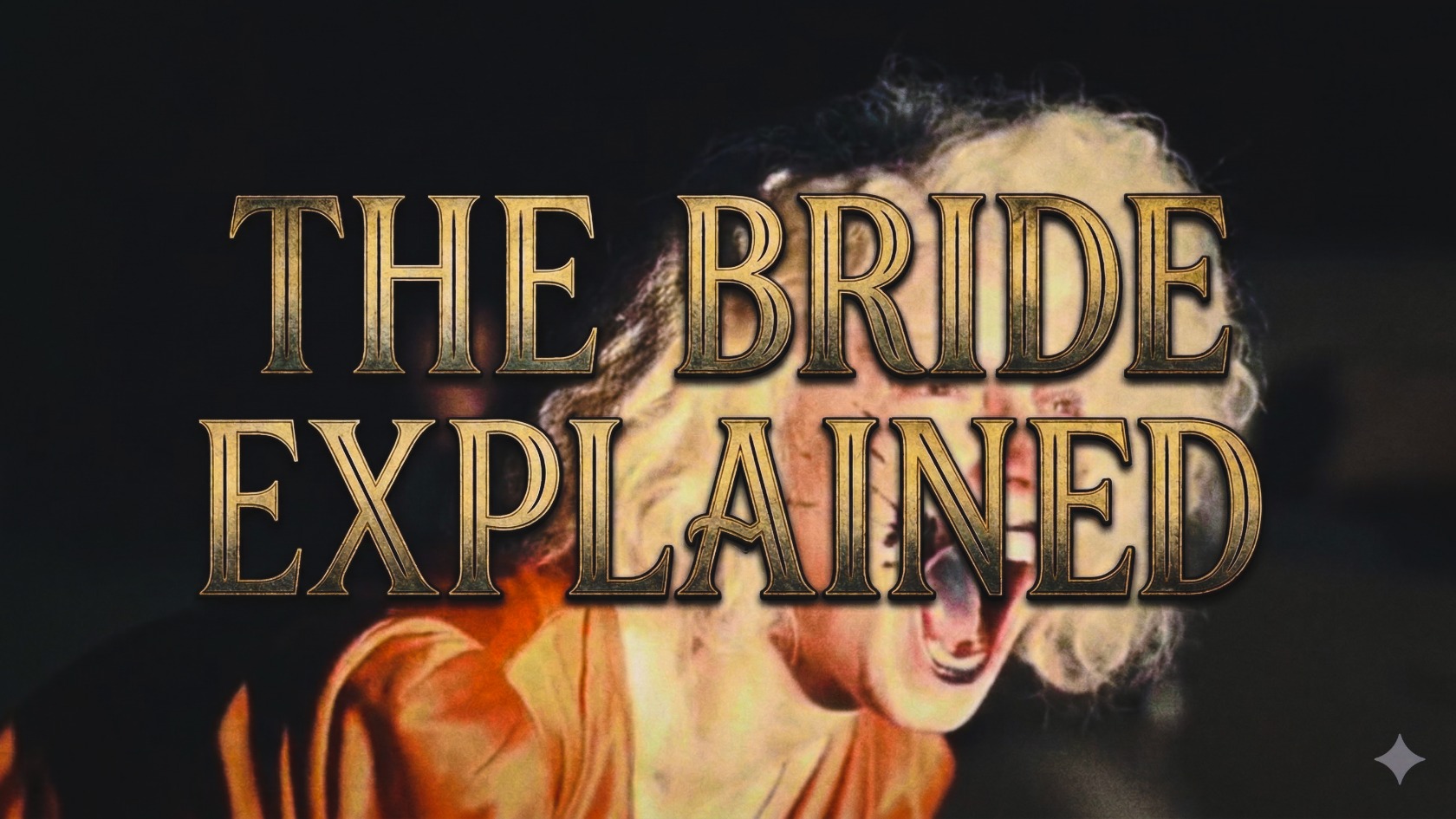
Here Comes the Motherfucking Bride
Cinema has never been short of Frankenstein adaptations. From James Whale’s gothic 1935 masterpiece to Guillermo del Toro’s ravishing recent interpretation, the myth of the man-made monster has been dissected, elevated, and lovingly embalmed across a century of filmmaking.
But no one has ever done to it what Maggie Gyllenhaal does in The Bride! and whether that’s exhilarating or exhausting depends almost entirely on your appetite for maximalist, feminist Grand Guignol served at maximum volume.
The Bride! is a 2026 American Gothic romance film written and directed by Maggie Gyllenhaal, starring Jessie Buckley and Christian Bale alongside Peter Sarsgaard, Annette Bening, Jake Gyllenhaal, and Penélope Cruz.
The film draws inspiration from the 1935 film Bride of Frankenstein, which was based on Mary Shelley’s 1818 novel Frankenstein. It had its world premiere at the Empire Leicester Square in London on February 26, 2026, and was released in the United States by Warner Bros. Pictures on March 6.
As Gyllenhaal told the Los Angeles Times: “If you are Ida or Mary Shelley or many women in the world and you’ve been sort of tamped down and silenced and not able to express everything it is that you wanted or needed to express, it’s like if you’ve had your hand on a geyser.”
That geyser analogy is perhaps the most honest description of this film you’ll find anywhere. The Bride! erupts rather than flows. It scalds more than it warms. And it absolutely refuses to be contained.
Mary Shelley Speaks from Beyond
The film opens not in 1930s Chicago, but in a space between worlds. The film is set in 1936, when Frankenstein’s monster shows up in the neon-lit gangland metropolis of Chicago. But before we arrive there, we are greeted by its architect.
Jessie Buckley plays both the novelist Mary Shelley and her creation, who this time never stops talking.
In the film’s black-and-white framing device, Shelley introduces the story by saying that it was too forbidden for her to publish at the time, but now the tale can be told.
“Be warned, the sequel is coming!” she cries, like a portent. “If Frankenstein frightened you, my next story will make you stand up and yell, ‘Help!'” And then, with a grin sharp enough to cut glass, she delivers the film’s battle cry: “Here comes the motherfucking bride!”
It’s a bold, irreverent, and unmistakably Gyllenhaal-coded opening , part punk rock proclamation, part manifesto. The exclamation point in the film’s title is far from camp. Instead, it’s a singular statement, one of knowing and wanting to be known. The Bride! is the name this woman chooses. Not “Bride of Frankenstein.” Not Penelope Rogers. Not even Ida. Just: The Bride. With an exclamation point that dares you to argue.
The World: 1930s Chicago, Reimagined
The story is set in a parallel-universe 1930s Chicago that feels reimagined rather than real.
This is not a faithful period reconstruction. It’s a fever dream of the era ; gangsters, neon, Depression-era desperation, and the electric crackle of a world on the edge.
From the visuals’ Sin City-adjacent aesthetics to an aura that frequently winks at film noir, from the Bride’s signature burnt orange dress of puff sleeves and cut-on-the-bias hem straight from the genius mind of costume designer Sandy Powell to her teased-and-crimped hair, everything here is considered at length and thought-provoking to look at.
Cinematographer Lawrence Sher shot the film entirely with IMAX-certified digital cameras, marking his first collaboration with Gyllenhaal, while the score was composed by Hildur Guðnadóttir.
The technical ambition is undeniable. This is a film that looks extraordinary, even when its narrative threads begin to fray.
Act One: Ida Moll and the Birth of the Bride
We meet Ida the woman who will become The Bride not dead yet, but already possessed by something uncontainable. We meet her when she’s out having drinks, surrounded by a circle of rapacious men, one of whom forces her to eat an oyster that she regurgitates right back at him.
Ida is electric, combustible, and utterly unpredictable. The men around her don’t know what to do with a woman who refuses to be managed.
Ida’s violent display and wild accusations toward the powerful men in the room lead to her being killed. But don’t worry, she won’t stay dead for long.
She is pushed down a staircase , bones cracking, neck twisted , a woman destroyed by the very men who wanted to silence her.
Meanwhile, across Chicago: Frankenstein’s monster (Christian Bale) has arrived in town with the hopes that mad scientist Dr. Euphronius (Annette Bening) might make him a bride. They dig up Ida in a potter’s field, re-route some electricity from a streetlight, and The Bride is born.
Dr. Euphronius initially refuses on moral and ethical grounds, but Frank tempts her with the thrill of science and invention. It’s a Faustian negotiation conducted in a city already soaked in corruption , one more transaction between ambition and consequence.
The resurrection is deliberately stripped of mounting tension. The doctor simply pulls a lever, a voltage surge lights up the room, and hey presto there’s the Bride, sitting up like a broken doll. Gyllenhaal isn’t interested in the mechanics of creation. She’s interested in what happens after.
Identity, Names, and the Problem of Being Owned
Upon being resurrected, the Bride, now amnesiac and unable to recall her past life, refuses to play the submissive mate to Frank, who initially lies to her, claiming they were already lovers before her death.
This gaslight delivered by a man whose loneliness reads as genuine, whose cruelty is structural rather than malicious is the film’s central moral engine.
Frank leads his bride-to-be to believe that her name is Penelope Rogers, fueling her assumption that they were and are betrothed, a form of gaslighting made all the more sinister due to Frank’s supposedly kind, introverted, and at times innocent nature.
But the Bride is not what Frank ordered. She is, from her first conscious breath, an autonomous consciousness operating on overdrive. This bride is a wise angel and full-tilt loon ,she’s alive, but doesn’t quite know who she is. But then she’ll start declaiming in a haughty British accent, as if she were channeling someone; it’s her creator, Mary Shelley, who Buckley plays as well in the film’s black-and-white framing device.
The Bride speaks in borrowed voices before finding her own ricocheting from Mary Shelley’s verse to select tractates from her mother Mary Wollstonecraft’s proto-feminist credo, to Herman Melville’s declaration from Bartleby the Scrivener: “I would prefer not to.” Indeed, potentiality is the character’s driving force. It’s part and parcel with the many ways she attempts to express herself through the words of others before finding her own voice.
She has, throughout the film, three names: Ida (given by Mary Shelley’s possessing spirit), Penelope Rogers (given by Frank as a lie), and finally in the film’s closing act the name she grants herself.
Act Two: Monsters on the Run , Bonnie and Clyde in Monster Form
There’s a great deal of plot here: the two lovers becoming fugitives, with a pair of Chicago detectives (Peter Sarsgaard, Penélope Cruz) in hot pursuit; the monster’s obsession with big-screen song-and-dance man Ronnie Reed (Jake Gyllenhaal); and Ida’s distinctive look black lips and tongue, with a bloody inkblot on her cheek inspiring imitators.
The Bride’s visual signature , Jean Harlow’s thick curtain of blonde hair, a silk orange flapper dress, and a permanent stain of black chemical blood on the side of her mouth that looks like spilled ink becomes a countercultural icon. Women across Chicago begin imitating her look, adopting her black lips as a symbol of resistance.
Think adult women behaving like the teen-girl pop cults of Ladies and Gentlemen the Fabulous Stains or The Legend of Billie Jean who rise up against their male oppressors.
Frank and the Bride’s relationship deepens during their fugitive journey. When Frank and the Bride go to the cinema, there is bittersweet beauty in their escape through the darkness of the theater and the luminous glow of the characters on screen.
Frank’s obsession with Ronnie Reed’s movies specifically the dance-musical sequences produces the film’s most wildly divisive set piece: a massive “Puttin’ on the Ritz” musical number that plays as a homage to Mel Brooks’ 1974 parody Young Frankenstein and which critics have called everything from joyously surreal to jarringly out of place.
There are themes of consent and autonomy, the role of women, and the corruption of power. When the film is running at full speed, these themes are electric.
But the film is not always running at full speed. The pacing does start to drag the further we get into the film, and it becomes clearer they are going to do the thing you suspected from the start but must wait an age to commit to. It’s not helped by a side plot with Peter Sarsgaard and Penélope Cruz that feels like it is in an entirely different movie.
The Ending Explained:
The final act converges several threads simultaneously. The gangsters who murdered Ida in the first scene return , the Bride’s past involving gangsters and politicians gets resurrected at the end to reinforce the film’s female revenge angle.
The police pursuit tightens. Society is fracturing under the weight of the Bride’s unintentional feminist revolution.
In the climax, Frank is forced to confront the fundamental contradiction at the heart of his desire: he built or rather, had built , a companion to fill his loneliness, but the woman who emerged is too fully herself to be a remedy for anyone’s emptiness. While he desperately clings to the Bride out of fear of losing his lone connection, he eventually learns that love cannot exist without freedom.
The film’s most emotionally resonant beat arrives when the Bride finally names herself. Lastly, Ida/Penelope is able to name herself during the film’s final scenes.
She is not Ida , the name of a dead woman. She is not Penelope Rogers , the name of a fiction Frank used to possess her. She is The Bride. Her identity, owned by no one, is her own declaration.
Unlike other adaptations, they do end up together not because the Bride has a duty to fill Frank’s loneliness, but because she wanted to stay by his side. At its core, this movie is a story about finding freedom, and the Bride, after discovering herself over the course of the movie, takes full agency and chooses to be with Frankenstein for the rest of her life.
It is a genuinely subversive twist on the source material: the Bride’s choice is not coerced, not manufactured, not the result of being created for someone. It is free. And that freedom more than any horror trapping or genre flourish is what Gyllenhaal has been building toward the entire time.
The film closes on a note that emphasizes the Bride’s transformation from a mere creation into a powerful figure who challenges societal norms and expectations, leaving the audience with a sense of both resolution and ongoing struggle.
Then, as the credits roll, Monster Mash plays. Make of that what you will.
There is a mid-credits scene.
Jessie Buckley’s Triple Performance
However divided critics may be on the film itself, virtually no one disputes the engine driving it. Buckley offers a no-holds-barred performance and gives her all into the incredibly physical role of playing the Bride.
Playing three distinct characters , Mary Shelley, Ida, and the Bride within a single body is a feat that most actors would buckle under. Jessie Buckley is the standout in this film, even overshadowing the ever-amazing Christian Bale. She moves between literary manifesto and primal scream and wounded confusion with the agility of a wire-walker who’s also somehow carrying fire. Film fans of her incredible range and willingness to push a performance to its utmost limit will be enthralled and occasionally appalled.
Christian Bale brings much vulnerability to the part. This Frank is closer to Boris Karloff’s iconic monster , with a square forehead, kindly reluctant eyes, and a soft presence.
His Frank is not terrifying. He is heartbreaking. A creature who understands love as possession because no one ever showed him the alternative.
What the Film Is Really About
The Bride! is less interested in Frankenstein mythology than in what that mythology has always suppressed: the voice of the woman at the center of it. In the 1935 original, Elsa Lanchester’s Bride appears for roughly five minutes, hisses, and is destroyed.
Gyllenhaal’s film is a 126-minute act of correction. She becomes a laborious study guide for a Feminism 101 class, emphatically indicating points on sexual violence, consent, bodily autonomy and female power. She even yells “Me too!” late in the film.
That’s the film’s greatest risk and its most contentious creative choice. Its feminism is, as multiple critics noted, foghorn loud yet completely ineffective for some, and for others a rare, righteous shriek from a studio film that means every word it says.
The Bride! is more a film to feel than to explain. It is a movie lover’s movie that disarmingly worships cinema , a cacophony of ideas, some invigorating, some half-realized, that playfully mines Mary Shelley’s gothic classic, a romantic turn-on, and a rightful feminine scream all in one.







Post Comment