Scrubs (2026) : Complete Series Review & Season Breakdown
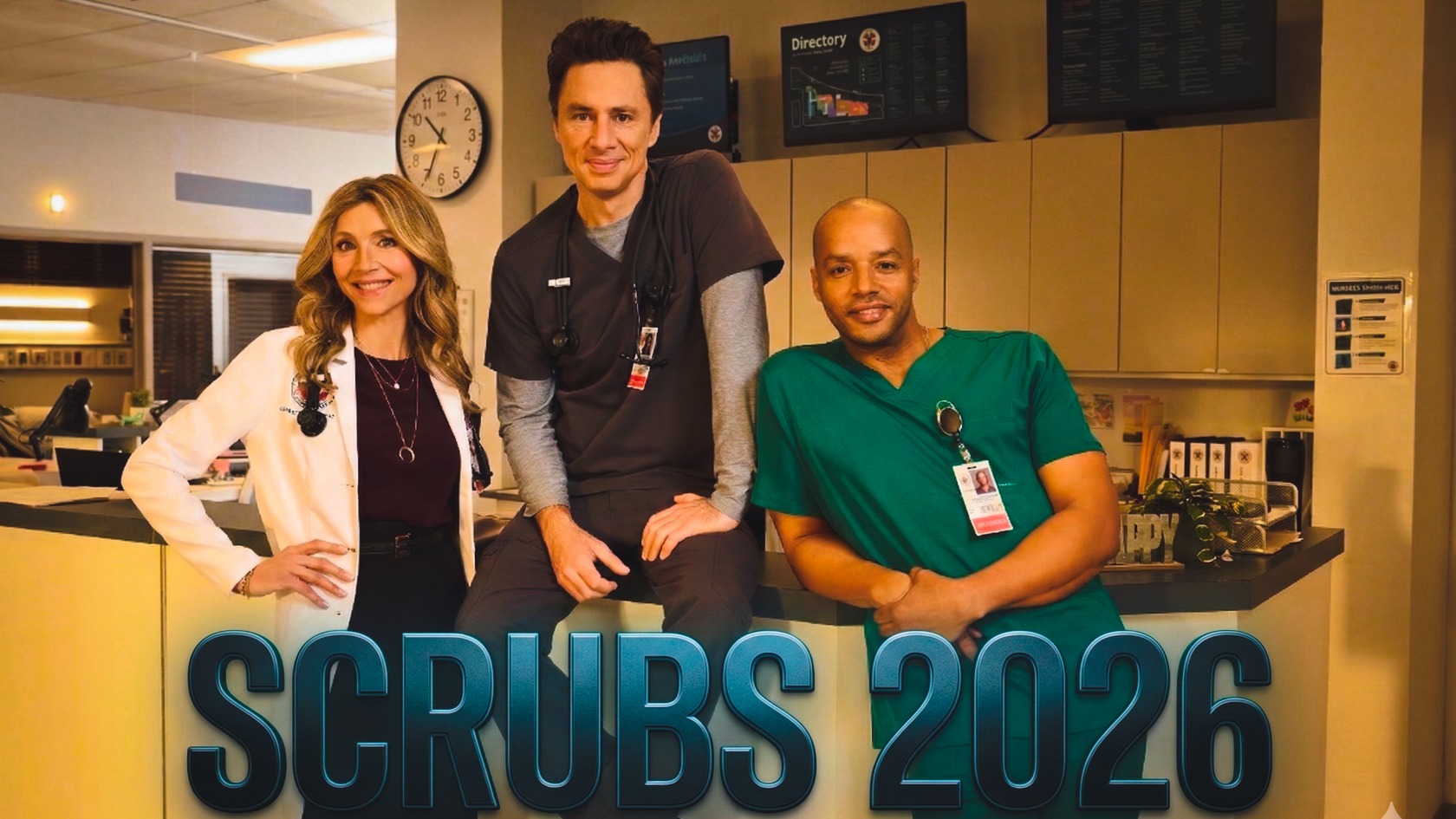
Sacred Heart Never Closed
There is a particular cruelty in nostalgia. It promises you something that cannot fully be delivered not because the talent isn’t there, not because the love has faded, but because time only flows in one direction, and the version of a show you fell in love with existed in a specific moment that is, by definition, gone. Most revivals learn this the hard way.
Scrubs Season 10 which premiered on ABC on February 25, 2026, sixteen years after the original run ended arrives as one of the rare exceptions. It doesn’t pretend time hasn’t passed. It looks you in the eye, acknowledges the grey hairs and the sciatica and the divorce, and says: we’re still here. That might just be enough.
The revival season has received positive reviews from critics. On Rotten Tomatoes, the season holds an approval rating of 90% based on 40 reviews, with the critics consensus reading: “Scrubs revives and revamps its signature laughs and cast to deliver another fan-favorite run of medical gags, heartfelt dramedy, and instant fun.”
On Metacritic, it holds a score of 72 out of 100 based on 25 reviews, signifying generally favorable reviews. Those are not fluky numbers. That’s a revival that earned its return
The Road Back to Sacred Heart: How We Got Here
Talk of a revival season or movie has circulated since the show ended in 2010. The first notable milestone occurred on November 17, 2018, when the entire Scrubs cast held a reunion panel hosted by Vulture. The 2020 podcast Fake Doctors, Real Friends with Zach and Donald began building more momentum, and in 2025 the revival season was officially greenlit by ABC for a total of nine episodes.
Executive producers include series creator Bill Lawrence, Braff, Faison, Chalke, Jeff Ingold, Liza Katzer, and Aseem Batra, with Batra serving as showrunner.
That last name matters. Under OG Scrubs writer Aseem Batra , whom viewers may also remember as “fun-size intern” Josephine this revival proves that making the characters more conscious of their behavior while folding that awareness into the storytelling works to the show’s benefit.
Batra knows this world from the inside. She built its walls. The revival benefits immeasurably from that institutional memory.
The most important creative decision made before a single frame was shot: the revival picks up as if Sacred Heart had never been demolished.
“This is definitely written as if the eighth season was the finale of Scrubs as it was kind of supposed to be,” creator Bill Lawrence tells TVLine. “Season 9 is like a what if, or like an Elseworlds situation,” adds Donald Faison.
Season 9 , the famously divisive med school spinoff is gone. Erased. Consigned to whatever parallel universe stores bad creative decisions. Sacred Heart was basically a living, breathing character, and in just a few short moments, the new Scrubs completely wiped all that away.
The hospital’s doors were never locked. They just weren’t filming inside for a while.
Welcome Back to Sacred Heart
Since leaving Sacred Heart Hospital in 2009, J.D. has become a concierge doctor to wealthy people in San DiFrangeles, California.
In 2026 he serendipitously returned to Sacred Heart for a patient, where he found Dr. Cox still as Chief of Medicine, struggling to connect his abusive educational style with the HR-protected new generation of interns and resident doctors.
The premiere wastes no time. It is called “My Return” directed, appropriately, by Zach Braff himself and it functions as a deliberate mirror image of the very first episode of the original series in 2001.
Everything has changed, and everything is exactly the same: J.D. walking these corridors with wide, slightly terrified eyes, daydreams firing off like neurons, the Lazlo Bane theme song (restored to its original version after the Season 9 cover) washing over Sacred Heart like a tide coming back in.
But the show doesn’t let the sentimentality be the whole story, because immediately it delivers its first gut punch: J.D. and Elliot are divorced.
The revival wastes no time with its biggest shocker. For Bill Lawrence, the decision felt like the honest extension of where the characters left off, not the fantasy J.D. imagined in the Season 8 finale. “Nothing ever turns out 100% happy.
It’s always more complicated than that,” he says. Looking back at the couple’s history, Lawrence adds, “I would not say if you watched the first 9,000 episodes of ‘Scrubs’ that you would go, ‘That’s a couple that’s definitely rock solid.'”
This is Scrubs at its most emotionally honest giving fans what they recognize while refusing to pretend life works out like a finale fantasy. The series never did. Why start now?
Old Faces, New Roles, and the Weight of Time
Zach Braff as J.D. : J.D. is now the new Chief of Medicine at Sacred Heart Hospital.
Zach Braff strikes just the right balance between the in-over-his-head J.D. fans remember and the more grounded, experienced version this new chapter demands.
The daydreams are still there , glorious, absurdist windows into a mind that processes reality sideways but they’re accompanied now by something heavier.
Accountability. This J.D. has made mistakes over sixteen years. He knows it.
Donald Faison as Turk : The show’s other heartbeat returns entirely intact. J.D. and Turk have advanced in their careers, and can no longer do their signature “Eagle!” bit on account of Turk’s sciatica.
That single physical joke , these two grown men, these celebrated surgeons, attempting their running leap and immediately clutching their backs is funnier and more emotionally efficient than entire episodes of lesser TV. Turk is the show’s anchor.
Faison plays him with the warmth of a man who has never once doubted that friendship is the point of everything.
Sarah Chalke as Elliot : Post-divorce Elliot is perhaps the most fascinating creative swing in the revival. The happily-ever-after J.D. and Elliot finally earned in Season 8 after years of will-they-won’t-they is thrown right out the window but in practice it only makes the show feel more like Scrubs.
These two have been complicated since way back in Season 1, Episode 1, when they first got under one another’s skin.
Their dynamic crackles with shared history, residual tenderness, and the exquisite discomfort of two people who know each other too well to ever be comfortable strangers.
John C. McGinley as Dr. Cox : McGinley will appear in three episodes of the revival.
His reduced role is the revival’s most strategically elegant structural move. Cox’s retirement doesn’t mark the end of McGinley’s revival run. Asked whether his appearances explore Cox’s adjustment to life outside the hospital, McGinley will only say that Cox has “much bigger problems” on the horizon.
In the meantime, his departure from Sacred Heart handing the baton to J.D. is handled with the restraint of a show that understands what this character means. Cox stepping back is the revival’s emotional thesis made flesh: the mentor era is over. The students are running the hospital now.
In Episode 2, J.D. looks up at a portrait of Cox that hangs beside Kelso’s, as if searching for answers. But when custodial staff removes it to make room for his own, the message is clear: there’s no one left to consult. The answers have to come from him.
Judy Reyes as Carla : Reyes is back in four episodes. “The show is a true ensemble, so we’re always together. Our days are long and the work is really hard. But when it’s there, the words are easy to remember, the scenes are fun to play, and the actors are great to be with,” she told Deadline.
Carla’s return is uncomplicated joy. Reyes carries decades of this character in her bones, and every scene she inhabits feels like the show exhaling.
Neil Flynn as the Janitor : After his absence from early trailers caused fan panic, showrunner Aseem Batra confirmed the return of the beloved character.
His reappearance in the revival generates the kind of audience reaction that critics can’t manufacture and studios can’t manufacture: pure, unreserved delight.
Sacred Heart’s Next Class
One of the revival’s most important tests was always going to be the new interns. Every Scrubs revival attempt risks the same structural failure: drowning the legacy cast in fresh faces who haven’t earned the emotional investment. Season 10 largely avoids this trap.
Ava Bunn portrays Samantha “Sam” Tosh, a medical intern fixated on social media who chronicles her training journey on TikTok. Jacob Dudman has been cast as Asher Green, a British medical intern who is uncomfortable around needles.
Braff told Esquire that the decision to make Asher English was deliberate: “That gave us an interesting way to have some commentary on him digesting the American health-care system.
He’s a bit nervous and behind the rest in terms of his confidence and his ability.” David Gridley joins as Blake Lewis, a 35-year-old medical intern whose age plays a significant role in the revival’s new storyline.
Joel Kim Booster stars as Dr. Eric Park, a surgeon who immediately becomes J.D.’s adversary, even though Dr. Park is correct about absolutely everything and J.D. is wrong about absolutely everything.
That character description is Scrubs comedy writing in its purest form conflict rooted in human ego rather than villainy.
Vanessa Bayer joins as Sibby, a character described as being “in HR or mental health or some amalgamation of elements that let her be a general wet blanket, restricting some of the same old behaviors , Todd’s sexism, Cox’s abuse, J.D.’s everything as if to suggest that society hasn’t changed, but one smiling administrator has.”
This is the revival gently acknowledging that some of the original show’s casual cruelties wouldn’t land the same way in 2026, while still finding a way to preserve the anarchic spirit underneath.
“I felt like I was in college all over again,” said Ava Bunn. “It was very, very fun.” David Gridley added: “The writers have done a good job of integrating us in a way that isn’t overwhelming.”
What the Season Gets Right
The tone is intact:
The best approach is to write like these characters’ lives have just continued on since the cameras stopped rolling, which is exactly what happens here.
At its core, Scrubs has always been a comedy about doctors doing doctor things: saving lives, grappling with the cruelty of the American health-care system, and trying to stay sane with some help from each other. This revival very much keeps that spirit alive.
It honours the show’s structural DNA:
Scrubs retains its sparky mix of screwball dialogue, physical slapstick and surreal fantasies, punctuated by soppy bits that stay just the right side of saccharine. Snappy 22-minute episodes never outstay their welcome.
It doesn’t pretend nothing has changed:
Bill Lawrence noted: “A lot of TV I do right now has an undercurrent of hopefulness and optimism in humanity. If anyone’s working in a teaching hospital, they’re doing it because they want to be of service, and they’re doing it because they think there’s a greater good out there. And stories like that mean more to me right now than ever.”
It carries its grief honestly :
The revival pays tribute to late actor Sam Lloyd who played Ted Buckland — with a bar in the revival named Lloyd’s Tavern.
It is a quiet, generous gesture, the kind of thing the original Scrubs always did well: finding space for real loss within its comedy. The show understood that the best jokes about death only land if you’ve first proven you take death seriously. Nothing has changed.
What the Season Gets Wrong
The revived Scrubs offers stasis: the same sentimentality, scored to the plaintive tones of Lazlo Bane’s “Superman”; the same adorkable platonic chemistry. That might be good enough for longtime fans, apart from the existence of an extensive back catalog just a few clicks away on Hulu. Why watch a season that tries to stick as closely to the original as possible, when you can just watch the original itself?
It’s a valid charge, and the more critical reviews are not wrong to raise it. The revival is hampered by the biggest offending element of the show’s closing seasons namely that J.D. keeps treading water and slowing down everybody and everything in the show that’s trying to grow.
There are also moments where the modern-day updates feel performative , the social media subplot, the HR administrator designed to flag past transgressions where the show is clearly nervous about its own history rather than genuinely interrogating it.
Scrubs at its best never played it safe. The revival, at times, plays it very safe indeed.
Season Arc: The Passing of the Torch
The emotional spine of the entire nine-episode season can be stated cleanly: J.D. Dorian, perpetual student, becomes the teacher. Dr. Cox stepping down is not just a plot mechanic. It is the season’s central argument that growth is not optional, that mentorship must eventually be relinquished, and that the most generous thing a person who shaped you can do is trust you enough to let go.
For Bill Lawrence, the beat of J.D. watching Cox’s portrait be removed from the wall stemmed directly from conversations with Braff about how much J.D. could realistically stay the same. “It was a huge Zach Braff thing,” he says.
J.D.’s arc across the season is learning to occupy authority without imitating it. He is not Cox. He was never going to be Cox. His job is to figure out what kind of Chief of Medicine he is which means confronting the same core question that has animated the character since 2001: beneath all the fantasies and deflections and bromantic rituals, who is J.D. Dorian when no one is watching?
Meanwhile, the J.D.-Elliot divorce , devastating at first reveal quietly evolves into something the show handles with extraordinary care.
The revival’s third episode sees J.D. and Elliot reforge their friendship, pushing them back through Scrubs‘ familiar old formulaic cycle. It’s this rollercoaster that lends the show back that familiar brand. Whether a second act is coming , romantic or otherwise is the slow burn the season is clearly building toward.






Post Comment