Mercy (2026) : Complete Review & Ending Explained
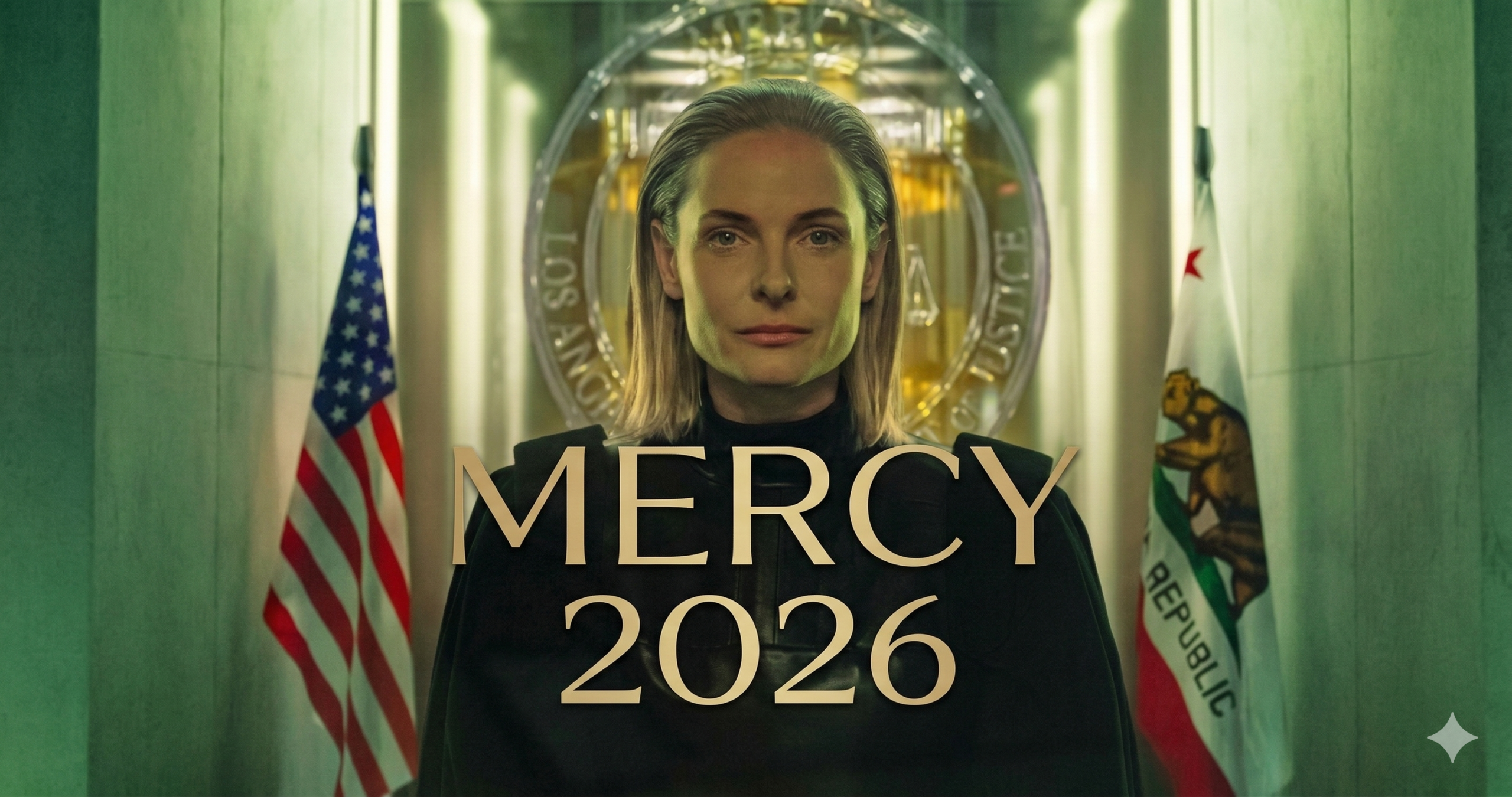
Ninety Minutes to Live in the Age of the Algorithm
There is no shortage of films prepared to warn us about artificial intelligence. Since the moment HAL 9000 refused to open the pod bay doors, cinema has been running the same cautionary simulation on a loop, iterating on the theme with varying degrees of elegance. Minority Report made it poetry. RoboCop made it satire. Mercy makes it a headache and yet, against genuinely considerable odds, it also makes it intermittently thrilling.
Mercy is a 2026 American science fiction thriller film directed by Timur Bekmambetov, starring Chris Pratt and Rebecca Ferguson.
The plot involves a detective (Pratt) who is accused of murdering his wife and must prove his innocence to an artificial intelligence judge (Ferguson). The film was released in the United States by Amazon MGM Studios on January 23, 2026.
The film grossed $54.3 million worldwide against a $60 million budget and received negative reviews from critics. On Rotten Tomatoes, 25% of 173 critics’ reviews are positive.
That 25% is earned. It just shouldn’t be the ceiling. Mercy arrives loaded with one of the most genuinely timely premises in recent Hollywood memory , AI as judge, jury, and executioner, in a surveillance state where every camera in the city is a potential witness and then proceeds to squander most of it in favour of countdown-clock mechanics and plot twists that announce themselves three scenes in advance.
It is a film that had the ingredients to matter, and chose instead to be a popcorn thriller. The tragedy is not that it failed. It’s that it knew exactly what it was reaching for and pulled its hand back at the last moment.
Los Angeles, 2029
In a futuristic Los Angeles with crime on the rise, the Mercy Capital Court uses artificial intelligence judges to put defendants on trial for violent crimes. The AI judges give the defendants all available resources to find and provide all the evidence needed, and are given 90 minutes to prove their innocence, or be executed via a sonic blast.
This is the world Bekmambetov constructs, and for the first ten minutes of Mercy, it is genuinely unnerving.
The surveillance architecture is not science fiction , it is tomorrow’s infrastructure described in yesterday’s breathless marketing language. The screenplay by Marco van Belle raises legitimately disturbing questions about our utter lack of privacy in today’s world of social media profile sharing, surveillance cameras, “citizen journalists” wielding smartphones, Gemini, ChatGPT, body cams, and so on.
Every doorbell, every drone, every Ring camera feeds into a unified municipal cloud. The Mercy Court acts as judge, jury, and executioner.
Chris will have the city’s “Municipal Cloud” at his disposal, giving him access to every camera, cell phone, and database.
There’s a handy onscreen Guilty Meter that displays the probability that Chris committed the crime and right now it’s in the high 90s. He has 90 minutes to get that number below 92%, or he will be executed on the spot.
The premise is kinetic and democratic in a perverse way: you are not simply arraigned before justice, you are handed the tools of your own salvation. The system’s cruelty is not malice , it is confidence. It has already decided.
Strapped to the Chair
Detective Christopher “Chris” Raven (Chris Pratt) wakes up in the Mercy Court interrogation seat knowing almost nothing. He was drunk the night before.
He got into a fight at a bar. He blacked out. And now an artificial intelligence tells him that his wife Nicole (Annabelle Wallis) has been murdered, that the digital evidence points overwhelmingly to him as her killer, and that he has ninety minutes to shift that probability or die.
Maddox contends that there’s a 97.5% chance that Chris offed his spouse, and she grants him an hour-and-a-half to lower that percentage below the 92% guilty threshold. What this means in practice is that Chris frantically questions his buddies and scrutinises on-screen material in the hope of spying something out of place.
Chris’s investigation is hampered because he was wasted at a local tavern in the hours just after the crime was committed, got into a nasty barroom brawl, and then blacked out, only to regain consciousness after he was arrested and strapped into that chair.
He doesn’t have a lawyer. He has his wits, his detective’s training, a hangover, and the entire surveillance infrastructure of Los Angeles piped directly to a screen in front of him. It is an unusually democratic version of hell.
The evidence against Raven looks damning. He has a drinking problem. He has a documented temper. Earlier that night, he violently resisted arrest at a bar. A home security camera captures him entering the house minutes before Nicole is stabbed. From a probability standpoint, Mercy’s case seems airtight. But from a justice standpoint, it feels reckless. Raven does not have a lawyer.
He is severely hungover. His only advantage is that he is a police officer with friends who can help from the outside.
Those friends form the film’s outside-the-chair cast: his partner Jaq Diallo (Kali Reis), colleague Holt, and others working from the outside to feed him the evidence he needs.
The investigation spills from the courtroom into the streets of Los Angeles in a way that keeps the film’s visual language from entirely collapsing under the weight of its central gimmick , one man, one chair, one screen.
The Film’s Most Interesting Character
Rebecca Ferguson plays Judge Maddox, an AI who is part of the Mercy program.
She is the film’s most compelling presence, which is both a compliment to Ferguson and a structural problem for a movie nominally built around Chris Pratt.
Ferguson is one of the best actors around, who is reduced here to playing what is essentially a talking head — an emotionless program speaking in a robotic voice.
They’re never in the same room together, because Judge Maddox isn’t actually in any room. That static dynamic between Chris and Judge Maddox is countermanded with an endless barrage of images shot in varying styles: private cell phone clips, police drone footage, visuals captured by restaurants, street corner cameras, a neighbor’s “bird cam.”
And yet within those constraints, Ferguson builds something genuinely unsettling: a consciousness that is utterly certain of its own neutrality, impeccably courteous, and completely blind to the implications of that certainty.
Ferguson carries herself with the calm, composed arrogance of a program that’s convinced it’s irreproachable and will locate the truth by processing information rather than understanding it.
The film’s most philosophically interesting moment is a brief scene in which Maddox visibly malfunctions upon hearing Chris reference his “gut instincts.” The film foreshadows its finale with a scene in which Maddox goes on the fritz after hearing about Chris’s “gut instincts,” which don’t compute in her ultra-rational mind.
It is the best thing Mercy does , a flash of genuine inquiry into whether justice is a function of data or a function of something that data cannot measure. The film doesn’t explore it. It moves on. But for a moment, it looked like a better version of itself.
Red Herrings and Real Suspects
As the clock ticks, Chris begins systematically dismantling the evidence against him and reassembling it around other figures. Early suspicion falls on Holt , a colleague with murky connections to Nicole before the investigation pivots dramatically when a name surfaces from the case files: Rob Nelson.
Suspecting Holt may have killed Nicole, Chris tries to contact Rob. Holt instead answers the phone, and he explains that Rob is responsible for the missing chemicals.
Chris reviews his daughter Britt’s social media posts, which reveal that a stranger had been hiding in their basement since the barbecue. His neighbor’s security cameras display a rustling in the bushes, and Rob is seen exiting the neighbor’s trunk in parking lot surveillance footage.
Rob is not merely a suspect. He is a man with a specific and devastating grievance. The SWAT team arrives at Rob’s house, finding it empty, but they uncover stolen chemicals and detailed plans to craft a bomb. Maddox discovers that Rob’s brother, David Webb, was the first person Mercy Court executed, and Chris realises that Rob is orchestrating revenge against him and the court.
This is where the film’s architecture sharpens. Rob is not a simple villain. Rob murdered Nicole, but his motivation is not cruelty , it is strategy. He knows police will shoot him before he reaches the Department of Justice building.
The explosives in the Viking truck are meant to destroy the Mercy data centre. Britt is leverage , she prevents intervention. Rob does not intend to escape. He intends to permanently end the system. From his perspective, this is not terrorism. It is correct. If Mercy Court exists, more innocent people will die. Destroying it becomes, in his mind, a moral act.
The film draws a disturbing parallel: Chris created Mercy to stop criminals. Rob commits a crime to stop Mercy. Both believe they are protecting future victims. Both justify harm using justice.
The Ending Explained: The Machine Is Innocent. The Humans Are Not.
The climax arrives at speed. Chris confronts Rob, and they fight until Chris is able to disarm Rob. Chris prepares to kill Rob, but Britt and Maddox talk him down. Jaq shoots Rob, who proclaims that David was innocent of the murder he was executed for, as Rob was on the phone with David at the time of the victim’s death. Maddox retrieves footage that confirms this.
And then the film delivers its real revelation. It is revealed that Jaq dumped David’s phone, which would have been enough evidence to exonerate David, in an effort to prove Mercy’s efficacy. Jaq and Rob are both taken into custody. As Britt reconciles with Chris, Maddox shuts off and Chris’s case is dismissed.
To understand why this matters, we need to understand what Jaq’s action actually means. The investigation reveals that Jaq destroyed David Webb’s phone to guarantee a conviction. Her motivation mirrors Chris’s earlier mindset. She believed Mercy Court worked and removed doubt, thereby protecting society. She did not intend to kill an innocent man. She intended to help justice.
This is the film’s most genuinely disturbing idea, buried in its final act: the wrongful execution of David Webb was not the result of a malfunctioning AI. It was the result of a human being , a true believer deciding that the system needed to succeed badly enough to justify corrupting it.
The film complicates blame. Rob murdered Nicole. Jaq caused David’s execution. Chris created the system. Maddox carried out the sentence. Responsibility spreads across human decision-making.
This leads to the film’s final philosophical question: if a machine executes an innocent person, who committed the murder? The programmer? The officer? The data provider? Or the society that demanded certainty?
The film’s answer or rather its refusal to give a clean one is its most honest moment. Mercy refuses a simple answer. Maddox made the judgment, but every human around it shaped the information.
As for the system itself: Bill Peterson’s neighbor’s backyard motion camera captured Rob leaving the house. But a network outage prevented the AI from retrieving it before the trial. Mercy Court’s flaw becomes clear: it does not fail because it is malicious. It fails because it is incomplete. And an incomplete system with irreversible punishment is indistinguishable from injustice.
The machine shuts down. The system is discredited. Chris solves the mystery and proves his innocence, but the victory feels hollow. The real trial was not about Nicole’s murder. It was about Chris confronting the consequences of his belief that justice must always be immediate.
The film’s final idea is uncomfortable: justice is not designed to eliminate mistakes. It is designed to slow them down. Mercy Court promised perfect decisions. The legal system promises careful ones. Chris once saw caution as weakness. Now he recognises it as protection.
The Performances
Chris Pratt as Chris Raven : Pratt can be a forceful and convincing actor with the right material, most notably the Guardians of the Galaxy series, but his physicality is a key component of his best performances. For the great majority of time here, Pratt is immobilised, and his emoting isn’t always entirely convincing. You can see him…trying. It is genuinely the fairest assessment. Pratt is committed.
The material contains him. A different kind of actor , one whose primary instrument is interiority rather than movement might have found more inside this concept. Pratt finds what he can, and in the film’s most human moments (his terror at his daughter’s kidnapping, his final decision not to kill Rob), he finds enough.
Rebecca Ferguson as Judge Maddox : The film’s most interesting performance is its most constrained. Rebecca Ferguson’s non-Dredd-ful judge is the only good reason to watch it, as one critic drily noted.
Appearing exclusively from the neck up, speaking in a register calibrated to be simultaneously reassuring and inhuman, Ferguson builds a character who is genuinely novel not the HAL 9000 of menacing silence, not the warm AI companion of science fiction comfort food, but something colder and stranger: a consciousness that believes it is serving justice while being utterly indifferent to the human cost of error.
The Screenlife Format: Gimmick or Grammar?
Bekmambetov is the godfather of the “screenlife” genre , the approach of telling stories entirely through screens, cameras, and digital interfaces. He produced Unfriended, Searching, and Missing, and as a director he has taken some admirable gunslinger swings with the likes of Night Watch and Abraham Lincoln: Vampire Hunter.
With Mercy, he brings the format to IMAX , the largest possible canvas for the most claustrophobic possible concept.
A can’t-miss event for the subset of viewers fascinated by the screenlife format. For those who aren’t part of that group, Mercy will either be a solid, by-the-numbers program with enough formal panache to keep things interesting, or a migraine-provoking nightmare.
The format is most effective when the film leans into its own absurdism , the guilty meter ticking down, the cascade of conflicting footage, the sense of a city being forensically autopsied in real time.
It’s least effective when it asks us to sit with Chris while he watches a screen while we watch a screen showing a screen showing Chris watching a screen. There is a point at which formal experimentation becomes a mise en abyme of diminishing returns.
What the Film Gets Right, and What It Gets Wrong
Mercy succeeds as a delivery mechanism for tension. The story unfolds in real time, with the clock ticking down from 90 minutes, and that makes for some admittedly effective dramatic tension.
The countdown structure is borrowed from every ticking-clock thriller in history, but it works. The 90-minute trial maps onto the film’s runtime in a way that gives the whole enterprise an unusual urgency , we feel the clock not as a narrative device but as a physical pressure.
It succeeds as a showcase for one specific, underwritten idea: that automated justice corrupts not through malfunction but through the humans who certify its outputs. The ending of Mercy attributes the system’s failure to human manipulation rather than a malfunction of AI.
The film frames the story as a cautionary example of how human decisions can influence automated systems.
Where it fails and it fails consistently and frustratingly is in its refusal to seriously engage with the implications of its own premise. Despite existing on, and being about, screens, the film has nothing to say about this dynamic.
Its sole concern is the reliability (or lack thereof) of machines, especially when it comes to matters of life and death. This is a debate that can only go one way, and Mercy doesn’t pretend otherwise.
The real question Mercy should be asking is not whether AI can make mistakes in a courtroom. Of course it can. The real question is why we built it anyway , what vacuum of trust in human institutions drove an entire society to outsource death sentences to a probability engine. That question is gestured toward and never answered. It is the film’s deepest wound.













Post Comment