Memory of a Killer (2026) : Complete Recap & Review
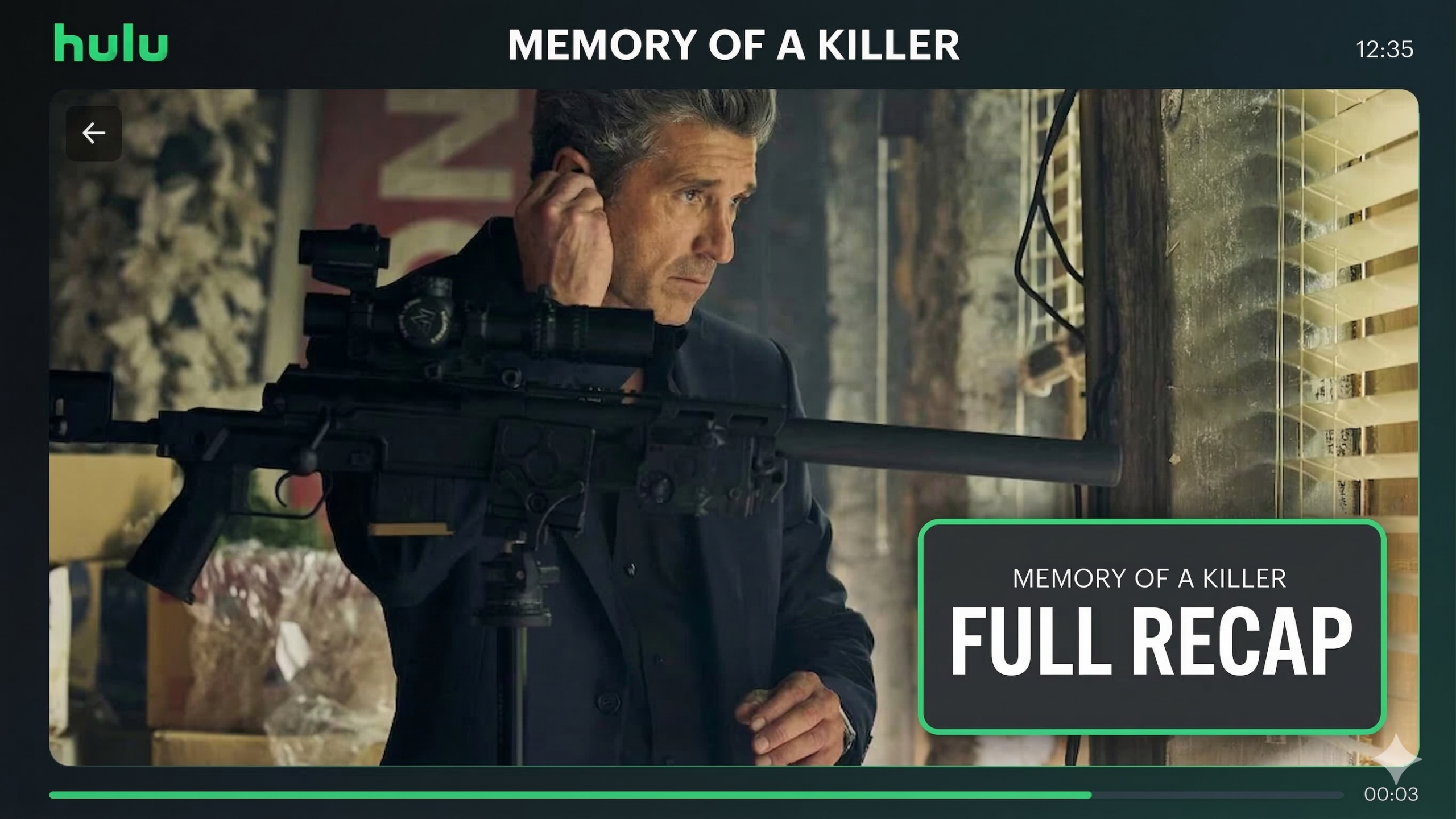
The Assassin Who Cannot Remember Who He Is
There is a particular cruelty to a mind unravelling in slow motion. It strips not just facts and faces but the very architecture of self , the ability to know, in any given moment, who you are and what you are capable of. For most people, that dissolution is a private tragedy. For Angelo Doyle, contract killer, loving father, and grandfather-to-be, it is an existential catastrophe of the highest order. The secret that Alzheimer’s threatens to erase is not just his identity. It is the wall between his daughter’s life and his career in murder.
Memory of a Killer is an American crime drama television series created by Ed Whitmore and Tracey Malone that premiered on Fox on January 25, 2026. It is based on the 2003 Belgian film De Zaak Alzheimer and the 1985 novel of the same name. Angelo Doyle is a contract killer and family man struggling to keep his two lives separate. His worlds begin to collide when an attempt is made on his pregnant daughter’s life. Angelo often visits his Alzheimer’s-ridden brother in a memory care facility, while there are signs that the disease is starting to affect Angelo as well.
On the review aggregator website Rotten Tomatoes, the series holds a 50% approval rating based on 12 critic reviews. Metacritic, which uses a weighted average, assigned a score of 58 out of 100 based on 9 critics, indicating “mixed or average” reviews.
Those scores tell a story of a show perpetually at war with itself , ambitious premise, pedestrian execution, and occasional flashes of genuine power that remind you what this series could have been if it had committed fully to its own darkest instincts. What keeps it watchable, and what keeps it stuck, are often the same things.
De Zaak Alzheimer and the Road to Fox
The source material , a Belgian noir novel by Jef Geeraerts published in 1985, adapted into a critically acclaimed film in 2003 , is one of European crime fiction’s most psychologically unnerving premises. An aging hitman, already watching his brother disappear into dementia’s fog, recognising the same symptoms in himself.
A final assignment that becomes a race against his own dissolving mind. The Belgian film is celebrated precisely for its refusal to sentimentalise the concept. The disease is not redemption. It is annihilation and the tragedy is that it comes for both the guilty and the innocent with equal indifference.
The American adaptation has a more complicated production history. On November 10, 2025, the original showrunners Schulner, Whitmore, and Malone stepped down and were replaced by Aaron Zelman and Glenn Kessler.
That mid-development upheaval left fingerprints on the finished product. The tonal inconsistency that critics have noted , the series frequently unsure whether it wants to be prestige drama or procedural thriller feels less like creative ambiguity and more like the seam where two different visions were stitched together mid-production.
It was recently adapted into the dismally awful Liam Neeson vehicle Memory, one of the lesser films from a star who sometimes makes questionable choices.
The Fox series is unquestionably the superior interpretation more patient, more structurally ambitious, more interested in the human cost of the premise. But the comparison to that film is less a compliment than a low bar cleared.
The Cast: Two Worlds, One Fracturing Man
Patrick Dempsey as Angelo Doyle/Angelo Flannery : Angelo lives two totally separate lives fearsome NYC hitman, and sleepy upstate Cooperstown photocopier salesman and father. Having built and maintained a brick wall between his two worlds, Angelo has seamlessly juggled and compartmentalized for years.
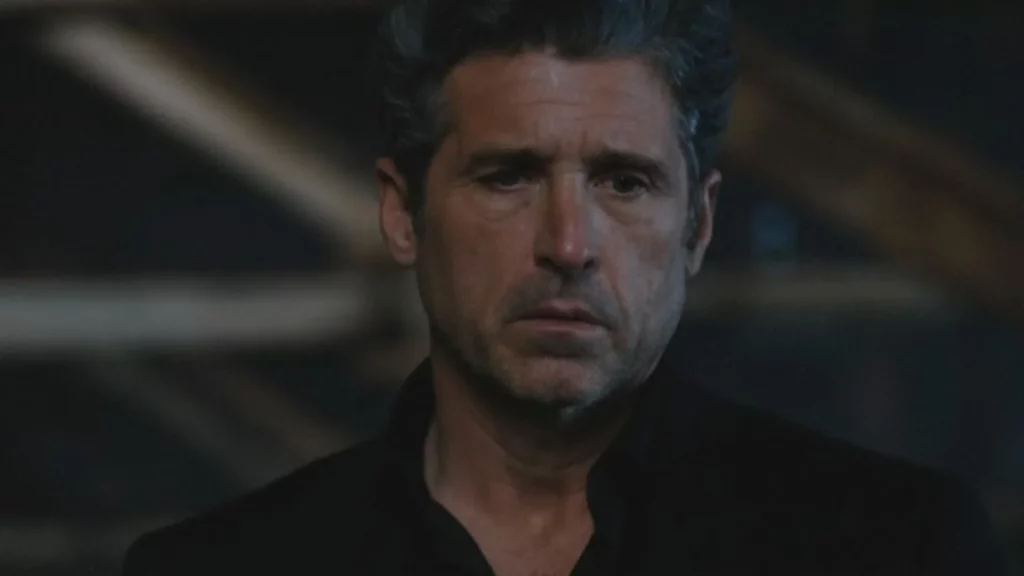
But now that’s all about to change, because Alzheimer’s is a foe he can’t outrun, and he knows too well how this ends, as his older brother is already lost to the condition.
For viewers whose primary reference for Dempsey is Derek Shepherd , the beatific neurosurgeon of a decade and a half of primetime sentiment , the adjustment is jarring and intentional. This Angelo is cold in the places that his Grey’s Anatomy persona was warm, and his warmth is deployed sparingly, reserved for Maria and for the visits to his brother that function as the show’s emotional north star.
Patrick Dempsey delivers a very layered performance. Angelo is methodical, frighteningly calm, and deeply exhausted.
The problem, noted by critics across the spectrum, is that Dempsey’s chosen register , controlled, inexpressive, professionally blank begins to read as limitation rather than characterisation. The wall Angelo has built to separate his lives becomes the wall between performance and audience. You watch him, but you are not always inside him.
And for a series whose entire premise depends on us sharing his terror at a mind beginning to slip, that distance is a structural problem.
Michael Imperioli as Dutch Forlanni : The man who gives Angelo his assignments, and that man’s nephew who serves as Angelo’s right-hand man.
Imperioli brings a weight of ambiguity to Dutch that the role requires and that the writing only intermittently supports. Angelo and Dutch do seem to just like each other. They have an affinity for each other, a long history but they have trust issues with each other, and the question is whether or not a relationship like that can survive those trust issues.
Watching Imperioli in scenes with Dempsey, you feel the accumulated texture of a long and morally compromised friendship , men who have done unspeakable things together and built genuine affection in the gaps between the violence. It is the series’ most interesting relationship and its most underwritten.
Odeya Rush as Maria Kahn : Angelo’s pregnant daughter carries the show’s emotional stakes. Her arc across the season from victim of the shooting to active, refusal-to-be-passive investigator is the series’ most satisfying character progression.
Maria quietly reclaims her agency. Her decision to go to the gun range, to push Dave for answers, and eventually to investigate the hiking trail herself shows a woman unwilling to wait for safety to be handed to her.
The show’s critics have been divided on Rush’s performance , some finding her unconvincing, others seeing genuine depth but the writing around Maria consistently gives her more structural purpose than her father’s storyline deserves.
Gina Torres as FBI Agent Linda Grant : If this show does end up working, the arrival of the great Gina Torres as the cop who starts to sniff around Angelo’s life will likely be one of the main reasons.
Grant operates as the series’ external conscience , methodical where Angelo is reactive, institutional where he is criminal, and yet drawn to him in ways that complicate her professional clarity. Torres brings a quality to the role that the show consistently fails to capitalise on fully, appearing too infrequently to drive the tension her character promises.
Richard Harmon as Joe Ferrara : Dutch’s nephew and Angelo’s increasingly compromised partner-in-crime. Joe is paired with Angelo to keep tabs on him, but his incompetence consistently forces Angelo to compensate.
Harmon plays Joe’s mix of eagerness, inadequacy, and hidden depths with genuine conviction. Their partnership . the seasoned professional saddled with the untested nephew, the hitman whose own mind is becoming unreliable paired with a handler whose reliability is in question is the show’s most dramatically productive relationship.
Episode By Episode Recap
Episode 1 : “My Return”
The premiere efficiently constructs the dual architecture of Angelo’s existence. In the opening minutes, we watch him take out a target with terrifying precision , cold-blooded efficiency that stands in jarring contrast to the scene that follows: Angelo sitting in an OBGYN office with Maria, smiling at an ultrasound of his first grandchild.
That juxtaposition is the show’s central image, and it is executed with enough craft to make the tonal dissonance feel purposeful rather than accidental.
The premiere establishes two ticking clocks: the drunk driver who killed Angelo’s wife is being released from prison , reintroducing his past into his present; and a mysterious hitman is closing in on Angelo himself. The episode ends on that second threat , a shadow converging, a professional hunting the professional. Memory of a Killer’s pilot is a fantastic start to the season; it’s violent and emotional in equal measures.
Watching Angelo lose his mind while trying to settle his old debts is a ticking clock that feels much more urgent than your standard police procedural.
Episode 2 : “Ferryman”
Maria is shot not killed, but targeted with lethal intent.
The attack is a declaration: someone knows enough about Angelo’s life to reach through the wall he has spent years constructing. Angelo learns the name “the Ferryman” from both the hitman who took the shot and the man who killed his wife. This name triggers Angelo’s protective instincts, prompting him to launch a parallel investigation outside official channels.
The mythological resonance is made explicit. The showrunner confirmed it , the Greek mythology reference to Charon, the ferryman of souls to the underworld, is a very compelling metaphor that will be explored and explained throughout the season.
What does it mean that somebody goes by the name of this figure in Greek mythology, and what do they represent?
The answer is layered. The Ferryman doesn’t just kill , he transports. He moves people from one state of existence to another: from life to death, from safety to exposure, from certainty to the void. He is, in this reading, a mirror of Angelo’s disease. Alzheimer’s is its own ferryman conducting the self, piece by piece, across a river it cannot return from.
A crucial secondary development: Angelo leaves a news clipping about a target in the wrong jacket. Maria finds it. Neither confirms to the other that they know what the other knows. Showrunner Aaron Zelman: “We like to leave things up to the audience to decide. We don’t think Maria has put all of it together yet but certainly the question of what she suspects is one the season will answer.”
Episode 3 : “Samurai”
Dutch orders Angelo to kill an Internal Affairs agent threatening their operation.
The assignment is a perfect crystallisation of the show’s ethical architecture: Angelo is asked to murder a law enforcement officer who is, functionally, doing exactly what law enforcement should do.
The corruption being exposed is real. The agent seeking to expose it is right. And Angelo’s job is to ensure that rightness never reaches daylight.
“Samurai” is sharp. It’s an episode about fathers failing their children, about systems that rot from the inside, and about how violence doesn’t just destroy bodies , it corrodes identity. By the final moments, Angelo isn’t running from who he is anymore. He’s hunting the truth, even if it leads him straight into the river.
Episode 4 : “Unhappy Ending”
The episode that critics have most consistently praised as the season’s high-water mark. Angelo tracks down Leo a henchman with Ferryman connections and extracts nothing useful before killing him. But the killing yields a discovery more disturbing than any confession: at a warehouse linked to the Ferryman’s men, he discovers surveillance photos of his entire family.
This proves that the Ferryman has been watching them closely. This isn’t business. It’s personal.
The Alzheimer’s subplot crystallises in a moment of devastating simplicity. Angelo apologizes to Jeff for not setting up the baby’s crib, only for Jeff to gently remind him that he already did it.
That small, domestic failure , forgetting a crib assembled with his own hands is more frightening than any of the episode’s violence. It is the disease announcing itself in language Angelo cannot deflect with competence or brutality.
And then the episode’s final sucker punch: Angelo calls one of the numbers from Leo’s phone, and to his surprise, Nicky answers suggesting that Nicky is somehow connected to Leo. Maybe she’s a helper, someone being used, or made to work for the Ferryman.
Not every ending is meant to satisfy. Some are meant to warn you that the worst is still coming.
Episodes 5-6 : “Samurai” / “Uncle Jacob”
Angelo’s complex relationship with his brother Michael is explored: in order to save his own life, Angelo framed Dutch’s own brother and killed him. Furthermore, Angelo had Michael admitted to psychiatric care in exchange for Dutch sparing his life.
This revelation retroactively colours every visit Angelo has made to his brother in the memory care facility. His guilt is not just the ambient guilt of a man who has done terrible things. It is specific, contractual, and intimate. His brother’s dissolution is, in a real sense, the price Angelo paid for his own survival.
A visit to a psychiatrist confirms that, like his brother Michael, Angelo too has been diagnosed with Alzheimer’s. While the doctor provides some meds to delay the rapid mental degradation, he advises keeping a support system , someone with whom he can confide, preferably his daughter.
Needless to say, this is an impossible proposition given the kind of life Angelo leads.
The Nicky situation is addressed through an elaborate trap: Angelo brings Nicky to his NY apartment and sets a trap by letting her overhear a fake conversation where he mentions his plan of apprehending the Ferryman at a specific location at a specific time.
If his suspicions are not misplaced, Nicky is going to inform the Ferryman about the conversation. However, as no one arrives at the location Angelo had mentioned, it appears Nicky is in the clear for now.
Episode 7 : “Dr. Parks”
Angelo learns that a previous job may be the key to unmasking the Ferryman. Meanwhile, Dave has a big break in his investigation that could expose Angelo’s true identity.
The episode title refers to Dr. Robert Parks , a name that has appeared in Angelo’s earlier recollections whose murder five years prior is increasingly central to understanding the Ferryman’s motivation. The flashback structure that drives the episode is the season’s most formally ambitious moment: a hitman with dementia reconstructing the past through fragments, unsure which memories are accurate and which are constructed.
The opening flashback to Robert Parks’ murder immediately frames the episode around consequences. This is not a job that stays buried. Every kill echoes, and now those echoes are aimed directly at his daughter.
Who Was The Ferryman
By the midpoint of the season, the Ferryman has been established less as a character than as a gravitational force , someone who moves through Angelo’s world with godlike foreknowledge, who has been monitoring his family for months or years, and whose hatred is rooted not in Angelo’s criminal career but in something specific and personal.
The Ferryman is positioned as a calculated, vengeful force in the criminal underworld. The mythological reference to Charon , the ferryman of souls to the afterlife serves as a metaphor for death, transition, and Angelo’s own fading memories due to early-onset Alzheimer’s.
The episode confirms this: the threat has shifted from random violence to a targeted personal attack tied to Angelo’s past hits.
The season’s structural logic points toward several potential identity reveals. Dutch , the friend and handler whose trust issues with Angelo run deep, who may have a brother’s grievance buried in their shared history remains the most dramatically satisfying candidate. The showrunner’s careful non-denial when asked directly if we’ve already seen the Ferryman on screen is the season’s most telling editorial choice.
As showrunner Zelman told TV Insider: “The question of who the Ferryman is and what they want , it’s going to be surprising, and it’s going to be a fun guessing game as we go through the season. I think that it’s a spoiler I won’t reveal. I won’t say one way or another.”
What a Killer Fears More Than Death
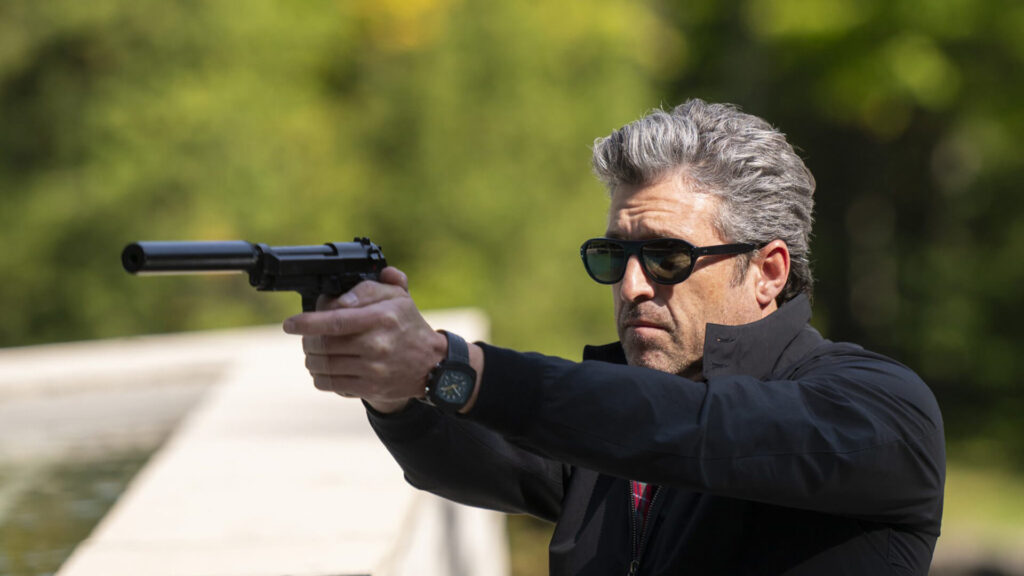
Memory of a Killer is, beneath its crime thriller architecture, a meditation on what it means to be held accountable when your own mind cannot maintain the evidence of your crimes. Angelo has spent decades compartmentalising building internal walls as impenetrable as the external ones that separate his identities. Alzheimer’s doesn’t respect walls. It dissolves them at the molecular level.
The series has always been about compartmentalisation how Angelo has kept his work as a contract killer sealed off from his identity as a father. But the season makes it painfully clear: the walls are cracking, and Alzheimer’s isn’t even the most dangerous thing coming for him.
The deepest irony the show is building toward is this: Angelo created two identities to protect one. The disease may force him to choose between them or may strip both away, leaving him neither the killer nor the father, but some reduced third thing. The series asks whether a man who cannot remember what he has done can still be held responsible for it. It has not yet answered that question. The final episodes will be its test.
The Problems the Show Cannot Solve
For all its genuine strengths, Memory of a Killer carries several structural problems that have followed it from the pilot.
There’s too little world-building, almost no setup for Angelo as a character outside of his descriptors like “assassin,” “father,” and “patient.” The show’s universe feels surprisingly contained and even slight.
The supporting cast particularly Dutch’s criminal network remains underwritten. We understand the mechanics of Angelo’s employment but not its texture. The New York underworld he operates in feels like a set rather than a world.
The Ferryman mythology, for all its symbolic resonance, creates a plotting problem: an adversary defined by omniscience and mythology is functionally impossible to defeat through the kinds of investigative detective work the show keeps staging. Angelo cannot outmanoeuvre someone who is already, structurally, ahead of every move.
And the show’s most fundamental tension between prestige drama and broadcast procedural remains unresolved. With so much competition out there, it feels increasingly difficult to preach patience with a show that has so little personality. After all, first impressions are often all that we remember.
That last line lands with unintentional resonance against the show’s own premise.












Post Comment