Love Story (2026) : Complete Recap & Ending Explained

Ryan Murphy’s Love Story is the kind of series that tells you how it ends before it even begins and still manages to break your heart. Premiering on FX and Hulu on February 12, 2026, this nine-episode limited series is the fifth installment in Murphy’s American Story franchise, and it may be the most emotionally devastating one yet.
Created by Connor Hines and inspired by Elizabeth Beller’s biography Once Upon a Time: The Captivating Life of Carolyn Bessette-Kennedy, the show charts the intoxicating, turbulent, and ultimately tragic romance between John F. Kennedy Jr. and Carolyn Bessette , two people whose private love became a national obsession.
With Sarah Pidgeon delivering a star-making performance as Carolyn and Paul Anthony Kelly embodying the golden-boy magnetism of JFK Jr., Love Story is less interested in the mythology of the Kennedy dynasty than it is in what happens when two people try to love each other inside a pressure cooker of fame, family expectation, and a media culture that devours its subjects alive.
The Opening
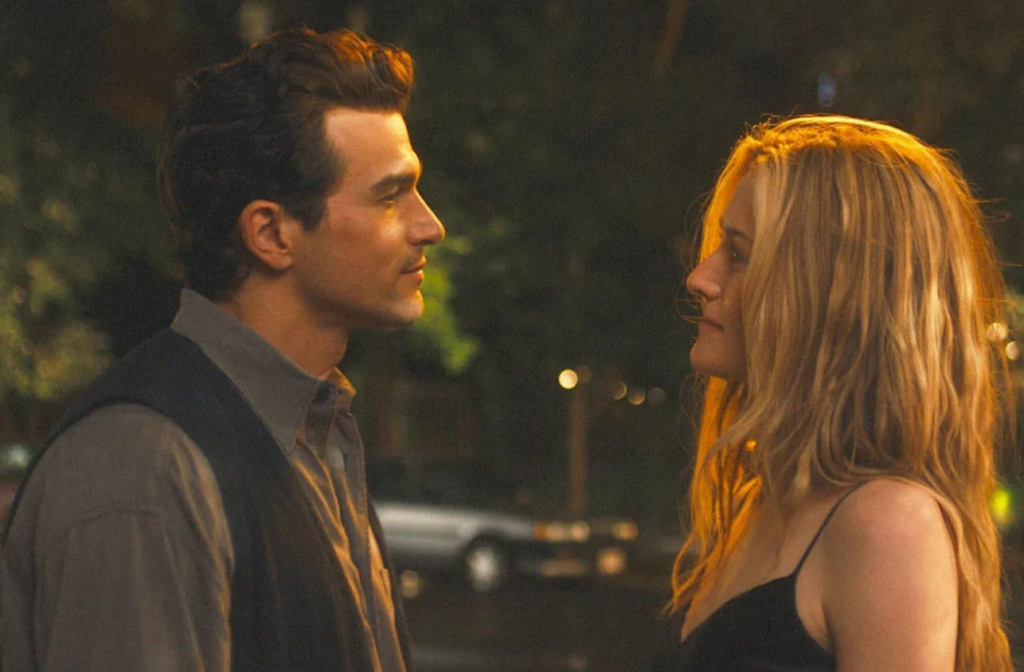
The series opens with a gut punch. It is July 16, 1999 , the day that anyone familiar with the Kennedy saga knows all too well. Carolyn Bessette-Kennedy (Pidgeon) is hiding in the back of a Manhattan nail salon, paparazzi swarming the building outside.
She looks diminished, folded in on herself , a far cry from the blazing, self-assured woman we will meet in the episodes that follow. When she finally pushes through the wall of flashing cameras to her waiting car and arrives at the airstrip, the tension between her and John (Kelly) is immediately palpable.
Her older sister Lauren (Sydney Lemmon) is there too. Despite the friction, John apologizes to Carolyn, tells her he loves her, and thanks her for coming. They kiss.
They board the small Piper Saratoga that John will pilot himself, bound for Martha’s Vineyard. The plane takes off. It will never safely land again.
This prologue is the series’ thesis statement: Love Story wants you to carry the weight of that knowledge through every romantic dinner, every stolen kiss, every whispered promise that follows. The tragedy isn’t a twist. It’s the atmosphere.
Recap
Episodes 1–3: “Pilot,” “The Pools Party,” “America’s Widow”
After the devastating cold open, the show dials back seven years to the summer of 1992, where it begins the patient work of building two fully realized worlds before crashing them together.
John’s World: At thirty-one, JFK Jr. is the closest thing America has to a prince. He bikes through Manhattan, plays football in Central Park with his friends, and tries desperately to live a normal life , all while being trailed constantly by photographers hungry for the next tabloid cover.
He’s failed the New York Bar exam multiple times (a fact gleefully reported by every newspaper in the city), and his position as an assistant in the DA’s office hangs by a thread. His mother, Jacqueline Kennedy Onassis (a delicately controlled Naomi Watts), reminds him constantly of the obligations that come with the Kennedy name. When John floats the idea of abandoning law to start a political magazine wanting to make politics as popular as baseball , Jackie gently but firmly steers him back toward the family’s expectations.
She also warns him, with the authority of a woman who lived it, that whoever marries into the Kennedy family will have the hardest role of all: she will always be a satellite, orbiting her husband’s gravity, never her own star.
His romantic life is equally tangled. His on-again, off-again relationship with actress Daryl Hannah (Dree Hemingway) is presented as a draining cycle.
Daryl is a social creature who brings her friends and their drug habits into John’s apartment, clashing with his disciplined lifestyle. Yet John lacks the emotional fortitude to cleanly break it off, and Daryl keeps reinserting herself into his public life at every opportunity.
Carolyn’s World: Meanwhile, Carolyn Bessette is thriving on her own terms. Working as a sales associate at Calvin Klein’s flagship store, she’s sharp, stylish, and fiercely independent. Her talent is quickly recognized by Klein himself (Alessandro Nivola), who promotes her through the ranks and eventually brings her into his inner circle.
Carolyn’s philosophy on men is clear-eyed: don’t give them too much attention, because they’ll only take advantage. She’s casually seeing model Michael Bergin (Noah Fearnley), but she isn’t looking for anything serious.
The Meet-Cute: Fate brings them together at one of Calvin Klein’s events. John is immediately taken with Carolyn, making no effort to hide his interest. She, however, is not so easily charmed. She refuses to give him her number, telling him to contact her through the Klein store if he’s serious. To her surprise, he shows up the very next day, pretending he needs a custom suit.
They go on a date. They share a first kiss. But Carolyn pulls back, aware of exactly what getting involved with America’s most eligible bachelor would mean for her life. When she later sees John apparently back together with Daryl, it confirms her suspicion that she’s being treated as a secondary option.
Jackie’s Death: The emotional turning point of the first act arrives in Episode 3, “America’s Widow.” Jacqueline Kennedy Onassis, who has been battling cancer, passes away.
The show handles this with genuine tenderness. John and his sister Caroline (Grace Gummer) share memories of their childhood and their mother’s fierce devotion to raising them after their father’s assassination. John holds himself together through the funeral arrangements and the public statement to the press.
But that night, alone and emotionally shattered, he doesn’t go to Daryl. He doesn’t go to his friends.
He goes to Carolyn. He shows up at her apartment, breaks down in front of her, and she holds him , understanding instinctively that this is a man who rarely allows himself to be vulnerable with anyone. Initially, she stops him when he leans in for a kiss. But then she gives in. The episode ends with them spending the night together , the true beginning of their love story.
Episode 4: “I Love You”
The fourth episode accelerates the relationship while exposing the fault lines that will eventually destroy it.
John and Carolyn begin seeing each other in secret, sneaking in and out of his Tribeca apartment through back entrances, stealing moments at Calvin Klein parties where they pretend to be strangers all while the electricity between them is visible to anyone paying attention. T
There’s a wonderful small detail: John slips an olive from his cocktail into Carolyn’s hand during a party, and she eats it without breaking conversation. It’s the kind of private intimacy that makes their connection feel real.
Meeting the Friends: John introduces Carolyn to his inner circle at a dinner, and it does not go particularly well. She arrives late, speaks confidently about John’s magazine venture (perhaps more knowledgeably than his friends expect), and leaves early.
After she’s gone, several of John’s male friends dismiss her as another woman playing hard to get to reel him in. The women in the group are more generous in their assessment, but the seed of resentment has been planted.
The Birthday Disaster: Things get worse when John brings Carolyn to what he describes as a family gathering at the Kennedy residence failing to mention that it’s actually Caroline’s birthday party. Carolyn arrives with no gift, no preparation, and no idea why Caroline greets her so coldly. It turns out that Caroline had no idea her brother was bringing a date.
John essentially abandons Carolyn at the family dinner, leaving her adrift among Kennedy relatives who don’t know what to make of her. It’s a preview of the isolation she’ll experience for the rest of their relationship.
The Anonymous Letter: The episode’s most destabilizing moment comes when someone slips an anonymous letter into John’s gym bag during a football game in Central Park. The letter is a character assassination of Carolyn alleging drug use, past relationships, and the claim that she’d been scheming to meet JFK Jr. all along, pressuring Calvin Klein for an introduction.
It’s a vicious piece of work, clearly planted by someone in John’s circle, and John makes the catastrophic mistake of confronting Carolyn about its contents.
She breaks up with him on the spot.
It takes his sister Caroline, of all people, to set John straight telling him bluntly that he should trust his girlfriend over some anonymous saboteur and distance himself from whichever friends helped orchestrate the attack. John goes to Carolyn’s apartment, apologizes, and they confess their love for each other.
But the episode ends on a foreboding note: tabloid photographs of John and Carolyn together have been published, accompanied by invasive commentary about Carolyn’s appearance and body.
When she arrives at work, Calvin Klein has laid out every newspaper on the table and demands an explanation. The public eye has found Carolyn Bessette, and it will never look away again.
Episodes 5–6: “Battery Park” and “The Wedding”
As the relationship deepens through the mid-1990s, Carolyn faces an agonizing choice: the life she built for herself or the life that comes with loving John Kennedy.
The couple navigates the reality of merging two fundamentally different worlds , hers defined by independence and professional ambition at Calvin Klein, his defined by the inescapable gravity of the Kennedy name.
John proposes, and despite Carolyn’s clear-eyed understanding of what it means, she says yes. But the engagement is not without turmoil: a very public altercation between the couple is caught on camera, becoming tabloid fodder that follows them relentlessly.
As press coverage intensifies, those around them including Carolyn’s mother Ann (Constance Zimmer) , voice serious concerns about whether Carolyn is prepared for a lifetime under this kind of scrutiny.
Episode 6, “The Wedding,” covers their secret 1996 ceremony on Cumberland Island, Georgia , a small, private affair designed to keep the press out. It’s one of the series’ most beautiful sequences, a brief pocket of peace before the storm. But even on their wedding day, the tension between public obligation and private happiness is never fully absent.
Episodes 7–8: “Obsession” and “Exit Strategy”
These are the most painful episodes of the series, and where Love Story becomes something genuinely powerful.
By Episode 7, “Obsession,” the Carolyn we met in the pilot , the blazing comet, effortlessly commanding every room she entered is nearly unrecognizable. Marriage to JFK Jr. has placed her inside what the show frames as a gilded cage.
The paparazzi are relentless, camped outside their Tribeca loft every single day. Carolyn can’t walk to a nail salon without a gauntlet of flashbulbs. She can’t have coffee with a friend without being photographed and analyzed. Every outfit, every expression, every perceived mood is dissected by tabloids. The series draws unmistakable parallels to the experiences of Princess Diana and, more recently, Meghan Markle , women whose identities were consumed by the institutions they married into.
What makes this particularly devastating is the growing disconnect between John and Carolyn.
John has lived inside the fishbowl his entire life; he’s adapted to it the way a deep-sea creature adapts to pressure. He doesn’t fully understand why Carolyn can’t simply adjust. He loves her, but he can’t grasp why she’s unable to bloom in the cage he’s always called home. Carolyn, meanwhile, feels her autonomy, her career, her very selfhood being systematically erased. She isn’t JFK Jr.’s wife , she’s just “JFK Jr.’s wife.”
The penultimate episode, “Exit Strategy,” is the show’s most gut-wrenching hour. Carolyn explores ways to reclaim some semblance of independence. She considers her options.
She and John fight about the future about whether to have children, about his political ambitions, about whether she can survive the life he’s offering. The parallels to Diana’s story become almost unbearable here, because unlike Diana, Carolyn won’t get the chance to find her way out.
John, meanwhile, is consumed by his magazine George and the persistent question of whether he’ll enter politics. The expectations of the Kennedy legacy , the same ones his mother warned him about are now crushing both of them, but in different ways. John feels the pull of destiny. Carolyn feels the weight of it.
The Ending Explained
The series concludes where it began: July 16, 1999.
We’ve come full circle, but now we understand everything about the couple in that opening scene that we didn’t before. Carolyn’s diminished body language at the nail salon isn’t just fear of paparazzi , it’s the posture of a woman who has been ground down by years of relentless public consumption. The tension at the airstrip isn’t just a marital spat , it’s the accumulated weight of two people who love each other deeply but may have been fundamentally incompatible with the circumstances of their lives.
John, Carolyn, and her sister Lauren board the Piper Saratoga. John is piloting. They are heading to the wedding of his cousin Rory Kennedy on Martha’s Vineyard. The conditions are hazy.
John is a relatively inexperienced pilot. In real life, the NTSB determined the crash was caused by spatial disorientation , John lost his bearings in the darkness over the Atlantic and the plane plunged into the ocean off Martha’s Vineyard.
The series does not sensationalize the crash itself. There are no drawn-out disaster sequences. Instead, Love Story treats their final moments with restraint and sorrow. The focus is on the quiet before the end: John’s apology, the kiss, Lauren’s presence as both buffer and witness to a love that, despite everything, still existed between them.
And then absence. The plane disappears. The screen goes dark. What follows is the aftermath: the search, the discovery of wreckage, and the nation’s grief for a couple who had become, for better and worse, public property.
What the Ending Really Means
The genius of Love Story is that it reframes one of the most well-known tragedies in modern American history not as a story about fate or dynasty, but as a story about what happens when private love is forced to exist in public space.
The series argues that the forces that killed John and Carolyn were at work long before that plane left the ground. The relentless media scrutiny, the impossible expectations of the Kennedy name, the way American culture builds pedestals specifically designed for people to fall from , these were the real destroyers. The plane crash was the final, physical manifestation of a destruction that had been happening emotionally for years.
Carolyn’s arc is the heart of this argument. She enters the story as a woman who knows exactly who she is. She leaves it as someone who has been defined entirely by someone else’s name. The series makes clear that this isn’t because she was weak , it’s because the machine she married into was designed to consume the identities of everyone it touched.
Jackie Kennedy knew this. She tried to warn her son. She tried to warn whoever would listen. But love doesn’t listen to warnings.
John’s tragedy is different but equally devastating. He was a man born into a role he never chose, who spent his entire life trying to be his own person while the world insisted he be his father’s son. His magazine George was his attempt to engage with politics on his own terms. His love for Carolyn was his attempt to build a private life inside a public existence. Both efforts were, in the end, defeated by the same forces.
The final image of the series , the couple together, briefly at peace, before boarding a plane that will carry them into oblivion is Murphy and Hines’s ultimate statement: love is not enough to save you from the world. But it’s the only thing that makes the world worth enduring.














Post Comment