In the Blink of an Eye (2026) : Complete Recap & Ending Explained
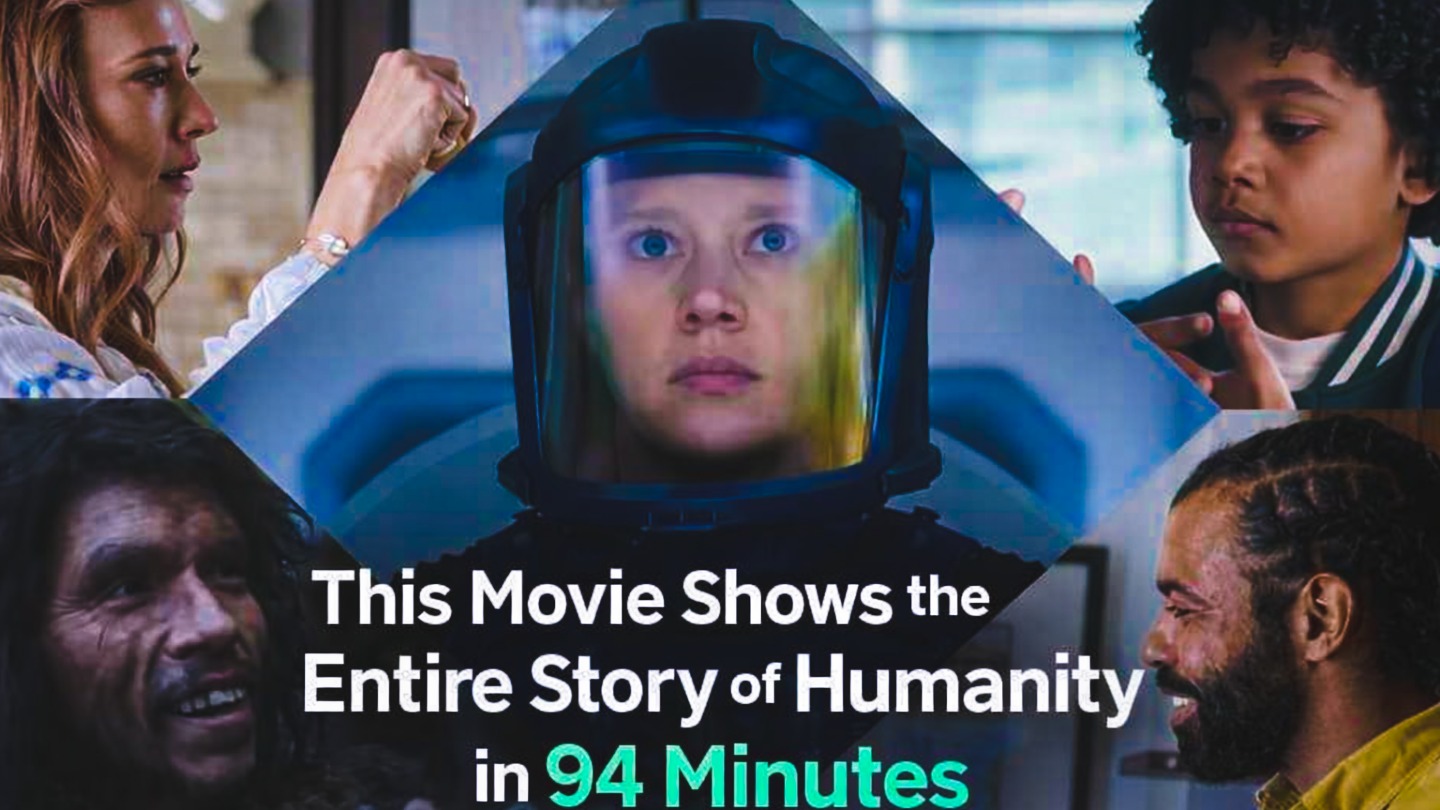
Andrew Stanton Returns and Reaches for the Stars
There is something inherently audacious about making a film that spans 47,000 years of human existence and compresses it into 94 minutes. That is precisely what Andrew Stanton , the visionary director of WALL·E and Finding Nemo attempts with In the Blink of an Eye, his long-awaited return to live-action filmmaking. The director previously analyzed a similar futuristic concept in WALL·E, the animated film that he also co-wrote with Jim Reardon.
This time, he only takes the directorial reins with a script by Colby Day, who previously wrote the Adam Sandler-led sci-fi yarn, Spaceman.
The film premiered at the 2026 Sundance Film Festival on January 26, 2026, where it won the Alfred P. Sloan Prize, and released on Hulu on February 27.
The critical reception was swift and divided: on Rotten Tomatoes, only 20% of 41 critics’ reviews are positive, while Metacritic assigned the film a score of 37 out of 100, indicating “generally unfavorable” reviews and yet, buried beneath the critical disappointment is a film with genuine philosophical ambition one that asks what makes a human life meaningful when measured against the vast, indifferent scale of cosmic time.
The film cited 2001: A Space Odyssey (1968), Magnolia (1999), and Interstellar (2014) as influences. Whether it earns a place among them is another matter entirely.
Three Stories, One Thread
In the Blink of an Eye captures a snapshot of humanity’s past, present, and future, all in the span of a single, multi-perspective narrative. It brings to life three stories: the first featuring a Neanderthal family struggling against nature, the second following an anthropologist named Claire as she makes major discoveries on the personal and professional front, and a third set in the far future, journeying alongside a nigh-immortal astronaut named Coakley, who is tasked with making humanity interplanetary.
The connective tissue between these three stories isn’t plot — it’s theme. Loss. Birth. Legacy. The passing of knowledge from one hand to the next. And at the center of it all, a single, unassuming object: an acorn. A tiny little seed withstands the forces of nature to one day become one of the strongest pillars of the forest. In short, it is the hard times that make us stronger, so we are able to build a better future, not only for ourselves but for generations to come.
The film opens with the Big Bang , the universe’s own blink of an eye before settling into the dust of prehistory.
Story One: 45,000 BCE : The Neanderthal Era
In 45,000 BCE, one of the last remaining Neanderthal families on Earth finds itself isolated from any larger settlement and chooses to reside in a cave. Thorn, the patriarch, has an accident while gathering food and endures significant internal bleeding, and has to be taken care of by his family, comprising his wife, Hera, and their two young children.
Wordlessly making their way through the tribulations of raising a family in an age before Google or Mr. Rogers well, “wordlessly” insofar as the guttural grunts spoken between them go untranslated , Thorn (Jorge Vargas) and his family find in their modest means of survival little more than the fuel for a future anthropologist’s academic research.
Stanton leans almost entirely on visual storytelling here, and it is the film’s most purely cinematic stretch. We don’t need language to understand what it costs this family to survive. Thorn recovers from his injuries — his wife Hera nursing his broken body back to health , only for the family to be struck again. Tragedy soon strikes the family when their youngest baby dies due to mysterious causes.
Hera gifts Thorn an acorn pendant during his recovery , a small, hand-carved symbol of potential, patience, and the promise that small things survive to become something greater. The acorn is passed down, generation by generation, becoming the film’s central symbol.
Shortly after the birth of her third child, Hera passes away due to health complications, leaving the Neanderthal family shattered. Thorn and his children take on a nomadic lifestyle, but are ultimately found by a tribe of humans who take them in.
What follows is one of the film’s most meaningful quiet moments: Thorn, a Neanderthal, integrates into a community of Homo sapiens. Thorn was an excellent craftsman, and when he joined the new group, he shared his inventions , fire, the flute, and cave paintings, with his new campmates. What the film was trying to suggest is that in human evolution, every small step matters. It was through community and shared values that we survived for so long.
Thorn’s daughter Lark married a sapiens in the settlement and carried her family’s legacy forward. After Thorn died, his daughter and his son buried his body near the cave where the family used to live. The acorn pendant passes to Lark, and then to her daughter , whose body, millennia later, Claire will unearth from the soil.
Story Two: 2025 CE , Claire and the Science of Memory
In 2025 CE, Claire (Rashida Jones), an anthropologist, has an on-and-off relationship with Greg (Daveed Diggs), a statistician working at her university. Claire’s work involves the examination of prehistoric human remains, and this time, the skeleton she is working on turns out to be holding an acorn pendant.
Claire is the bridge figure of this triptych , the woman whose scientific curiosity reaches backward into the past even as her personal life pulls her urgently forward. Claire learns that her mother has been diagnosed with a fatal disease and has very little time left to live.
Abandoning her job at the university, Claire heads back to Canada, but finds herself incredibly lonely. As she enters a long-distance relationship with Greg, the two begin to fall in love, and this newfound companionship is key for Claire when she later loses her mother.
The parallel between Claire’s grief and the prehistoric Thorn’s grief is the film at its most intentional both figures lose someone who defined their world, and both choose to endure rather than collapse.
But the echoing of emotional beats across timelines is also where critics found Blink most heavy-handed. At just around 90 minutes, it often feels like the Cliffs Notes version of a 500-page novel.
Claire’s academic breakthrough comes from her study of the Neanderthal-sapiens genetic crossover , specifically, the way ancient intermingling of species led to biological advantages that were passed down across millennia. It was through the study of sapiens and Neanderthalensis genomes that Claire was able to make a breakthrough that helped her son, David, to lay the foundation of his futuristic gene replacement technology, Elixir.
In 2030, we learn that Claire and Greg tied the knot and are now the parents of a child named David. This child grows up to become a world-famous inventor, creating an anti-ageing technology by the name of Elixir.
The acorn pendant from the excavation site becomes an heirloom passed from the skeleton to Claire, from Claire to David, and eventually embedded into the founding mythology of the company that would, centuries later, redefine the limits of human life.
Story Three: 2417 CE , Coakley and the New World
In the far future, an astronaut named Coakley (Kate McKinnon) has been tasked with making a centuries-spanning interstellar journey to raise a new generation of children. She is a genetically modified human , a product of David’s Elixir technology, engineered to survive what no ordinary human could endure. Coakley was a synthetic human, which is why she survived more than 350 years of space travel without cryosleep.
Her companion is ROSCO, an AI co-pilot and for much of the journey, her only companion. The third storyline is where the film most clearly echoes WALL·E: a solitary figure aboard an ark of humanity’s last hope, tending to the fragile mechanisms that sustain life, confronting the crushing weight of a mission that won’t conclude within a single lifetime.
Coakley learns that the greenhouse in her spaceship has been infected, and the plants that supply her oxygen are rapidly dying. While Coakley initially plans to take her own life and leave enough oxygen for the babies, her AI friend and assistant ROSCO suggests that it be shut down, and the space be used for a second greenhouse, to which Coakley obliges with a heavy heart.
The sacrifice of ROSCO m an AI choosing its own termination to preserve biological life is the most emotionally resonant moment of the third storyline, and one of the film’s most moving beats. Coakley experiences loss through the loss of her children and the AI tool that accompanied her for a long time. ROSCO’s shutdown mirrors every loss in every previous generation: Hera’s death, Claire’s mother’s death. The form changes. The grief doesn’t.
While the first four babies pass away due to numerous complications, the fifth baby makes it, and grows on to become Coakley’s second in command. With half of the mission now accomplished, she decides it’s time to head to a brand new world.
The Ending Explained
Kepler 16b: A New Beginning
In the Blink of an Eye ends with a statement of hope, as it is revealed that humanity has successfully started anew on the new planet Coakley calls home.
Although the journey to this new planet may have taken centuries, in the end, the scenery Coakley steps onto is indistinguishable from Earth’s nature, with dense, lush greens spreading as far as the eye can see. Having spent an incomprehensible amount of time alone in the spaceship, Coakley finally regains her connection with nature, and this time she is not alone. Most of the children she raised have grown up now and are right there by her side when the ship’s gates open.
It is implied that the group turns into a matriarchal society of sorts, retracing humanity’s forward journey in a new light. A civilization beginning again, led by a woman who was designed not to die and who now must watch the lives of those she loves come and go like seasons, generation after generation.
V’s Death and the Meaning of Mortality
The ending’s most philosophically charged moment comes with the death of V , the first child born aboard the spaceship, Coakley’s oldest companion on Kepler 16b. From Coakley’s arrival on the planet, we jump several decades into the future, where V, the first child to be born on the spaceship, has now died of old age.
For Coakley, who seemingly hasn’t aged a day, seeing V’s journey from start to finish is as heartbreaking as it is inspirational. She acknowledges that death is not necessarily the culmination of one’s life, but merely a signifier of the wheels turning, as each human existence is part of a much larger cycle, both literally and spiritually.
The fact that Coakley is brought to the funeral ceremony by a child is symbolic by itself, as it confirms that we now have multiple generations of humans on this new, terraformed planet.
The movie’s ethos, as such, is not to reject death but to acknowledge it as something that gives life even more meaning.
The Skeleton, the Acorn, and the Invisible Thread
In the final moments of the movie, we learn that the skeleton being studied by Claire’s team is most likely that of Lark’s daughter and Thorn’s granddaughter. In one of the scenes, we see that the child sports a birthmark on her left cheek, and later that same birthmark can be seen on the dead, old woman’s face.
The remains of Thorn’s unnamed descendant are discovered by Claire’s team after all this time, and a brush down reveals the acorn pendant, which then goes on to be worn by Claire herself, and then made into an heirloom for Elixir as a company.
The acorn travels 47,000 years. From Hera’s hand to Thorn’s, from Thorn’s burial to Claire’s laboratory, from Claire’s pocket to David’s company logo, from David’s Elixir to Coakley’s immortal body to the soil of a new planet. With thousands of years of history behind it, the acorn serves as the linchpin for the entire narrative, tying together many of its themes.
Why Did Earth Die? The Immortality Trap
The film never explicitly shows us what happened to Earth. But it leaves enough breadcrumbs to theorize. In his speech, Claire’s son David said that the human lifespan was nothing more than the blink of an eye to the universe around us. He believed that time had been our enemy, and through his technology, he wanted to defeat it.
But Claire had a different perspective. She believed that life only had meaning because it came to an end.
David’s technology might have had a hand in destroying the planet — maybe after creating an antidote for mortality, the humans realized that they had created a curse they couldn’t exorcize. That’s why they sent Coakley with a Noah’s ark to a far-off planet to rebuild things from scratch.
The implication is chilling: immortality didn’t save humanity. It may have ended it. The very thing David created to defeat death metastasized into the condition that made Earth uninhabitable.
Coakley later told V that it was actually bad to live for too long.
An immortal woman, who knows exactly what it cost humanity to reach the stars, standing over the grave of someone she loved and choosing to believe that the limit of a life is what makes it worth living.
The Three Stories: How They Connect
While In the Blink of an Eye never explicitly points out a connection between its three stories, there are enough clues to piece together a singular timeline. The very fact that humanity has no way of piecing together Neanderthal names from way back implicitly suggests that these are names given by modern scientists and anthropologists , possibly Claire herself.
The chain is this: Thorn survives, shares fire and music with Homo sapiens, and his daughter Lark carries the genetic and cultural legacy forward. Lark’s granddaughter is buried with the acorn. Claire finds the skeleton, finds the acorn, makes the genomic breakthrough that inspires David. David builds Elixir. Elixir produces Coakley. Coakley seeds Kepler 16b with the children who will become the next chapter of the human story. Every blink leads to the next.
Final Verdict: Ambitious, Flawed, and Quietly Sincere
In the Blink of an Eye is a film that wants to be 2001 and Magnolia simultaneously one part cold cosmic meditation, one part warm weeping hymn to human connection and doesn’t quite manage to be either. The final act is particularly hurried, using montage in place of storytelling, underlining the relative hollowness of a story that reaches for the stars but finds only dust.
And yet. There is something stubbornly moving about a film that insists, with complete sincerity, that a single acorn handed from a dying Neanderthal mother to her husband can echo across 47,000 years and become the symbol of a civilization reborn on another planet. The film doesn’t end with triumphant music or explosive resolution. Instead, it closes on quiet endurance.
Andrew Stanton is a dreamer, with an unshakeable faith in humanity. In a cinema landscape increasingly defined by franchise mechanics and algorithmic storytelling, that faith even when it produces a film this imperfect is worth something. Sometimes the blink of an eye is enough to change everything.








Post Comment