How to Get to Heaven from Belfast 2026 Review | Ending Explained

Intro
Released in February 2026, How to Get to Heaven from Belfast is the spiritual successor to Derry Girls, but with the innocence stripped away and replaced by a murder mystery that is as hilarious as it is harrowing.
Lisa McGee has traded the high school corridors for a cross-country road trip of panic, delivering a thriller that feels like The Hangover directed by Alfred Hitchcock, if Hitchcock had a penchant for dark Irish wit.
Recap
The series introduces us to three estranged childhood friends in their late thirties, each paralyzed by their own mid-life crisis:
- Saoirse (Róisín Gallagher): A chaotic, fast-talking screenwriter whose career is stalling.
- Robyn (Sinéad Keenan): A stressed-out mother of three trying to keep a lid on a simmering rage.
- Dara (Caoilfhionn Dunne): A dependable but inhibited carer who has never left her comfort zone.
The catalyst for their reunion is a funeral. They receive news that their fourth friend, the enigmatic Greta (Natasha O’Keeffe), has died by suicide.
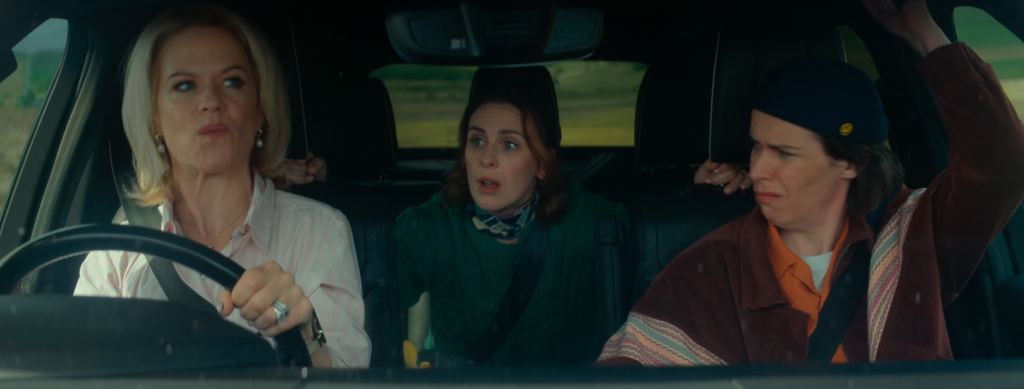
The trio travels to the wake in rural Ireland, only to discover that nothing adds up. The coffin is closed, the stories are inconsistent, and Greta’s family is behaving strangely.
The show pulls its first major rug-pull early on: Greta is alive. The woman in the coffin is actually Jodie, Greta’s childhood friend from a place called Heaven’s Veil. We learn that Greta faked her death to escape a shadowy past.
But her escape went wrong. She accidentally killed Jodie (pushing her down the stairs during an argument) and, seizing a grim opportunity, swapped identities with the corpse to disappear.
As the trio hunts for Greta, they uncover the dark secret binding them all. Years ago, in the cult-like community of Heaven’s Veil, a young Greta and Jodie burned down a church, accidentally killing eight children inside.
They did it out of a warped anger, believing God had abandoned them to abuse. Later, a journalist named Charles Sampson tracked them down to expose the truth. In a panic, Jodie stabbed him to death. The three main women (Saoirse, Robyn, Dara) helped bury Charles’s body to protect their friends, binding them in a pact of silence.
Greta’s faked death was orchestrated by The Evaporation Society (or Metamorphosis), a clandestine underground railroad for women needing to vanish, run by the stoic Booker (Bronagh Gallagher). However, Greta compromises the entire operation by returning to Heaven’s Veil.
She can’t bear to leave her husband, Owen, and their daughter. This act of love turns her into a liability, and the organization orders Booker to “clean up” (i.e., kill) Greta.
The Ending Explained
Booker corners Greta, but instead of executing her, she reveals a rot within the system. The head of The Evaporation Society has been betraying the women they were sworn to protect, selling them out for profit. In a violent purge, Booker, her sidekick Feeney (Saoirse-Monica Jackson), and a midwife gas the corrupt leadership at their HQ.
Booker decides to reboot the society on her own terms. She spares Greta, providing her, Owen, and their daughter with new passports and identities. Greta gets the fresh start she desperately wanted, driving off into the unknown with her family.
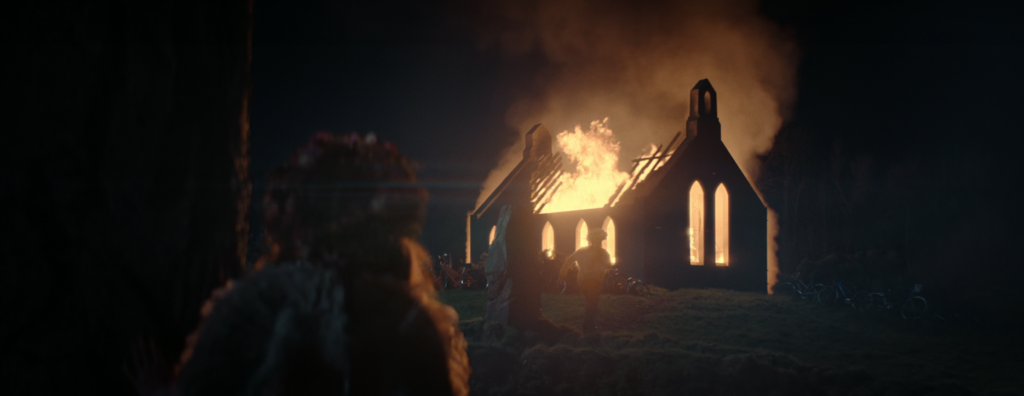
Saoirse, Robyn, and Dara are left holding the bag metaphorically and literally. Confronted by the police (officer Liam) and Charles Sampson’s son, Andrew, the trio finally breaks. They confess to burying the journalist’s body years ago.
However, in a twist of anticlimactic realism, they are not charged. Whether due to the complexity of the case, the lack of hard evidence, or Andrew’s desire for closure over vengeance, they are allowed to walk free. The legal system, usually a hammer, decides to be a shrug.
The series ends on a cliffhanger that screams Season 2. The women are free, drinking to their survival, when Dara produces a hot-pink bag that Greta left behind. This bag belonged to Conrad, a man Greta hitched a ride with earlier in the season (who was found murdered with a screwdriver in his neck).
The trio unzips the bag. We don’t see what’s inside, but their faces drop in sheer horror. “We are not getting involved,” Robyn declares firmly. The screen cuts to black.
What was in the bag?
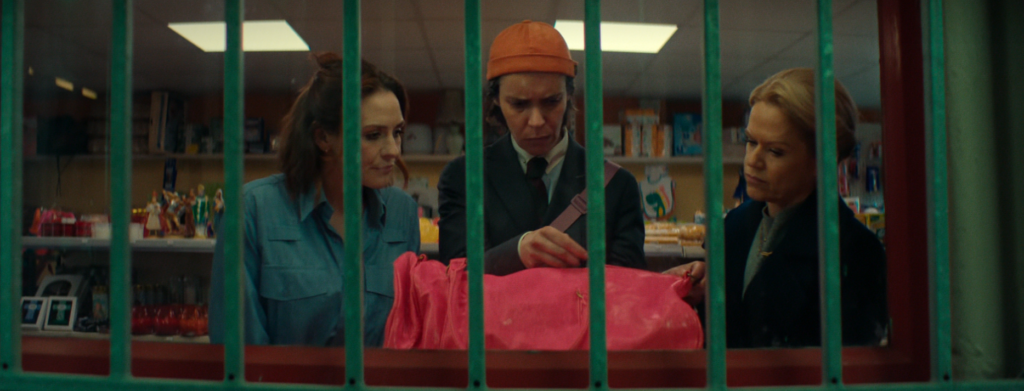
While the show never explicitly shows the contents, the context clues (Conrad’s murder, the organization’s corruption, and the friends’ horrified reaction) suggest it is something incriminating or valuable enough to get them killed likely money, severed body parts, or evidence that proves the “corruption” in the Evaporation Society goes deeper than they thought.
Review
Rating: ★★★★☆ (4/5) The Verdict: A chaotic, pitch-black tragicomedy that proves Lisa McGee is the master of Irish anxiety.
The Good
The Power of Three The show lives or dies on the dynamic between its leads, and thankfully, they are spectacular.
Róisín Gallagher (Saoirse) is the standout, playing the messy creative trope with such frantic, self-destructive energy that you can’t look away. She captures that specific brand of Irish fatalism laughing at the funeral because crying would be too productive.
Sinéad Keenan (Robyn) is a coil of tension waiting to snap. Her portrayal of a mother suppressing a scream for eight hours of television is both hilarious and deeply relatable.
Caoilfhionn Dunne (Dara) provides the necessary heart, grounding the absurdity with a quiet, devastating loneliness.
McGee’s signature rhythm is all over this. The dialogue is rapid-fire, overlapping, and crammed with devastating insults delivered as terms of endearment.
The transition from sitcom to hour-long drama has allowed McGee to let scenes breathe, but she hasn’t lost her ear for the surrealism of everyday Irish life. The subplot involving the Evaporation Society , a bureaucratic nightmare of an underground railroad is pure McGee: terrifying in concept, but administered by people who are just annoyed about the paperwork.
Special mention must go to Saoirse-Monica Jackson (Feeney). Casting the former Erin Quinn as a dead-eyed, unhinged accomplice was a stroke of genius. She plays Feeney like a character who wandered in from a completely different, much more violent movie, and every second she is on screen is gold.
The Bad
For the first four episodes, the show is a tight, propulsive mystery. However, once the initial shock of the empty coffin and the body swap wears off, the plot begins to meander.
The introduction of the wider conspiracy (The Evaporation Society) forces the show to juggle too many tone shifts. It wants to be a gritty crime thriller and a farcical road trip comedy, and in episodes 5 and 6, the gears grind audibly.
While Bronagh Gallagher is menacing as Booker, the broader conspiracy she represents feels a bit abstract. The show is at its best when it focuses on the women’s micro-betrayals and shared trauma; when it tries to expand into a grand narrative about international crime syndicates, it loses some of its unique regional flavor.
The Ending & Final Thoughts
The finale manages to stick the landing by returning the focus to the friendship. The decision to have the women escape the law not through a master plan, but through the sheer incompetence/apathy of the system, is a perfect thematic button.
That final shot, the trio staring into Conrad’s pink bag with abject horror is one of the best Season 2 baits in recent memory. It suggests that while they have physically escaped Belfast, the moral cost of their journey is just coming due.












Post Comment