Fallout Series Season 2 Episode 2 Explained | The Golden Rule
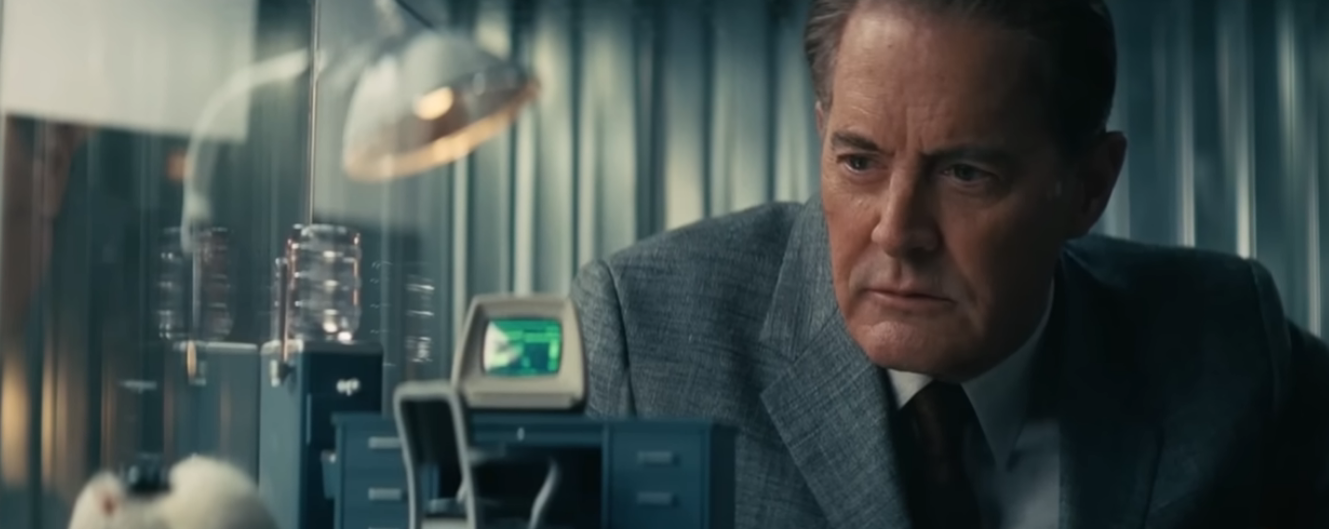
Intro
If the Season 2 premiere, The Innovator, was the adrenaline shot that woke us up from our cryo-sleep, then Episode 2, The Golden Rule, is the radiation sickness setting in: a slow, burning reminder that in the Wasteland, morality is not just a luxury; it is a liability.
Directed by Frederick E.O. Toye, this hour is a dense, grim, and aesthetically spectacular meditation on the cost of kindness. It takes the show’s satirical edge and sharpens it into a shiv, deftly twisting the knife into both our protagonists and the audience’s expectations.
We are witnessing the systematic deconstruction of Lucy MacLean’s soul, the terrifying militarization of the Brotherhood of Steel, and a flashback that redefines the tragedy of Shady Sands with a brutality that feels almost Biblical.
Recap & Analysis: The Golden Rule
The Cold Open: A Trojan Horse in Shady Sands
The episode opens with a flashback to 2283 that is as devastating as it is necessary. We finally see the destruction of Shady Sands, but it isn’t the impersonally dropped bomb we might have expected. It is intimate terror.
We see a young Maximus and his parents, Joseph and Julia, celebrating the repair of a water purifier which is a symbol of civilization’s fragility. The arrival of the mesmerized caravan trader, muttering the iconic New Vegas NPC line, “Patrolling the Mojave almost makes you wish for a nuclear winter,” is a masterstroke of fan service weaponized into horror.
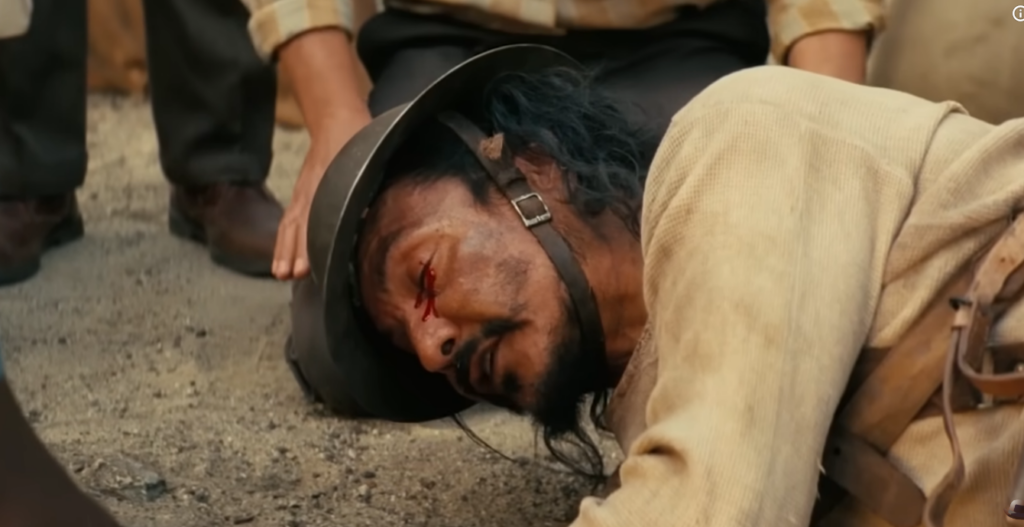
The reveal that this NPC is a walking nuke which is a human Trojan horse controlled by a chip (distinctly House-esque tech), adds a layer of sinister premeditation to Hank MacLean’s crime.
Seeing Maximus shoved into a refrigerator which is a cheeky nod to Indiana Jones that the show somehow makes heartbreaking rather than ridiculous, establishes his trauma not just as survivor’s guilt, but as a witness to the ultimate betrayal of the Golden Rule: innocent people destroyed by the whims of distant gods (or Overseers)..
Lucy & The Ghoul
In the present (2296), the dynamic between Lucy (Ella Purnell) and The Ghoul (Walton Goggins) remains the show’s beating heart. The writers are smart to keep them tethered, as their friction drives the thematic engine of the season. Lucy, desperate to cling to her Vault-born altruism, insists on saving a woman wounded by radscorpions, burning her last Stimpak in the process.
The Ghoul’s cynical warning is the episode’s thesis statement. When that same woman later leads Lucy straight into a trap set by Caesar’s Legion slavers, the betrayal lands with a sickening thud. It’s a harsh lesson: In the Vault, the Golden Rule (“Do unto others…”) ensures social cohesion. In the Wasteland, it ensures you get eaten.
The Ghoul’s subplot, involving his consumption of a dying man to survive, serves as a grotesque mirror to Lucy’s mercy. He survives because he takes; she suffers because she gives.
🔥Wasteland Propaganda Posters🖥️ Get your Faction Prints here:
Maximus & The Brotherhood
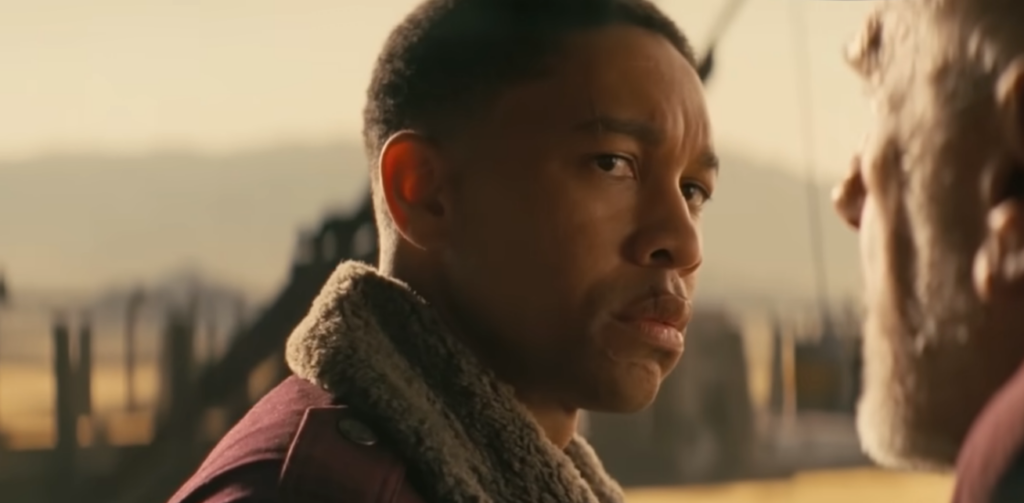
The Brotherhood of Steel plotline is shifting gears from religious absurdity to terrifying fascism. With Cold Fusion in hand, the West Coast chapter is no longer a scrambling cult; they are an empire in the making. Maximus (Aaron Moten), now a Knight, finds himself disillusioned not by the failure of the Brotherhood, but by its success.
The raid on the pre-war facility (heavily implied to be Area 51) showcases the Brotherhood’s new “might makes right” doctrine. They aren’t salvaging tech; they are conquering it.
The arrival of the East Coast envoy at the end suggests a looming civil war: a clash between the Arthur Maxson-style imperialism and the chaotic fiefdoms of the West. Maximus is trapped in the middle, realizing that “making the world better” might just mean “making the Brotherhood stronger,” two goals that are rapidly diverging.
The Dervish Camouflage
The show confirms that the reason this base remained hidden for 200 years is the Dervish Camouflage System, the same tech found in the Hidden Valley bunker in New Vegas. It generates sandstorms to mask the location.
Alien Tech
Inside, we see undeniable proof of the Zetans (aliens). There is a spacecraft under a tarp, a frozen alien body, and scribes toying with alien shock batons.
The Civil War
Quintis is planning a coup. By gathering the leaders of the Grand Canyon, Yosemite, and Coronado chapters, while purposefully excluding Arthur Maxson’s Commonwealth chapter, he is setting the stage for a Brotherhood Civil War. He believes his “Cold Fusion” power source gives him the leverage to break the chain of command.
Norm & Vault 31
Norm’s entrapment in Vault 31 shifts into a bizarre corporate thriller. His decision to wake the cryo-frozen “Bud’s Buds” executives by bluffing them is a stroke of genius. It highlights the banal evil of Vault-Tec: these people are so conditioned to corporate hierarchy that they can be manipulated by anyone who projects enough middle-management confidence. It’s funny, yes, but in a way that makes your skin crawl.
Shady Sands & The New Vegas Connection
The Weapon
We finally see the smoking gun: a Mark 28 Tactical Nuclear Warhead. Veterans of Fallout 4 will recognize this as the specific munition Liberty Prime tosses around the Commonwealth. The fact that Hank had access to this implies a terrifying level of connectivity between Vault-Tec and pre-war military stockpiles.
The NCR Trooper
The openning scene gives us a direct nod to Fallout: New Vegas. An NCR trooper patrolling the streets mutters the iconic line: “Patrolling the Mojave almost makes you wish for a nuclear winter.” While hilarious to fans, the show contextualizes this brilliantly, the soldier is repeating the phrase because he has a RobCo mind-control chip implanted in his neck, forcing him to loop dialogue just like a generic NPC.
The Review
The Golden Rule succeeds because it refuses to let anyone off the hook. The writing is opinionated and sharp, refusing to coddle the audience with easy victories.
The direction by Toye is claustrophobic. The radscorpion attack is filmed with a frantic, messy energy that makes the CGI monsters feel dangerously tangible. But the real horror is in the human moments, the look on the betrayed Lucy’s face, or the blank stare of the mesmerized bomber in Shady Sands.
Walton Goggins Supremacy
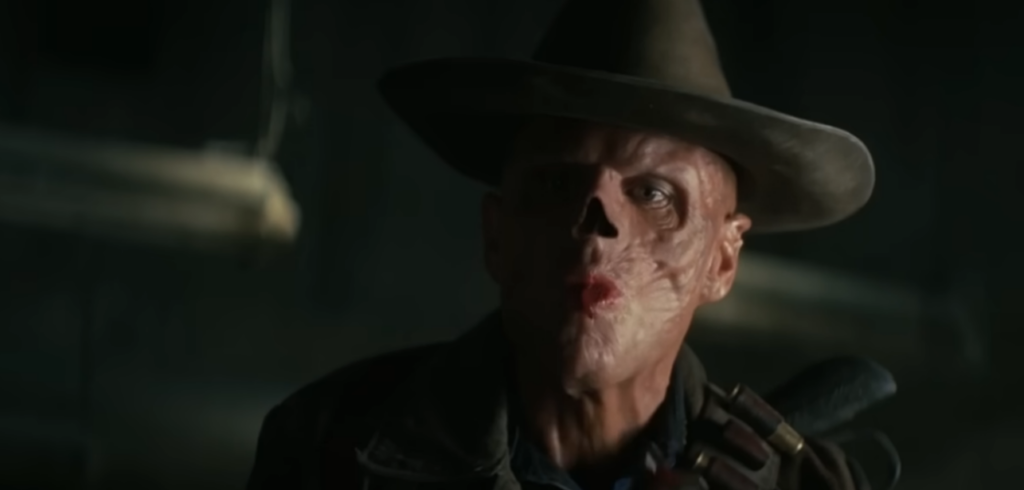
It must be said again: Walton Goggins is doing career-best work here. He manages to make The Ghoul’s cannibalism feel like a weary necessity rather than villainy. His delivery of the Golden Rule monologue is dripping with a century of disappointment. He is the Wasteland’s Greek Chorus, narrating the decline of humanity with a mouthful of jerky.
The New Vegas Texture
The showrunners are treating the New Vegas setting with reverence. The aesthetic, the amber hues, the specific faction politics of the Legion feels authentic to the lore without being impenetrable to newcomers. The nuclear winter line could have been a cheap meme; instead, they made it the soundtrack to a massacre.
If there is a critique, it is that the pacing of the Brotherhood subplot feels slightly disjointed from the Lucy/Ghoul narrative. Maximus feels isolated in his own show at times, though the converging plotlines suggest this separation won’t last long.
The Ending Explained
The episode concludes with a series of grim realizations that set the table for the rest of the season.
The Legion’s Return
The group that captures Lucy is unmistakably connected to Caesar’s Legion. While the Legion was thought to have collapsed or fractured after the events of the games, this cell appears organized and brutal. By capturing Lucy, they force her into a world where her Vault rhetoric is useless. This isn’t just raiders; this is a slave ideology. The ending implies Lucy will have to break her own moral code to escape, she cannot negotiate with slavers. She will likely have to kill, and kill with hate, effectively proving The Ghoul right.
The East Coast Arrival
The arrival of the East Coast Brotherhood of Steel airship (the Prydwen’s sister ship, perhaps?) changes the geopolitical landscape. The East Coast chapter (from Fallout 3 and 4) is historically more organized, imperialistic, and fanatical than the West. Their arrival suggests the West Coast elders (Quintus) have bitten off more than they can chew. Maximus will likely be forced to choose between his loyalty to his local chapter and the true power of the Brotherhood, or perhaps defect entirely as he realizes both sides are tyrants.
The Hank & House Connection
The flashback confirms that Hank MacLean didn’t act alone in destroying Shady Sands. The control chip in the bomber’s neck is proprietary RobCo technology, the signature of Mr. House. This implies a terrifying alliance: Hank (Vault-Tec) and House (RobCo) may have collaborated to wipe out the NCR (Shady Sands) to eliminate competition for control of the region.
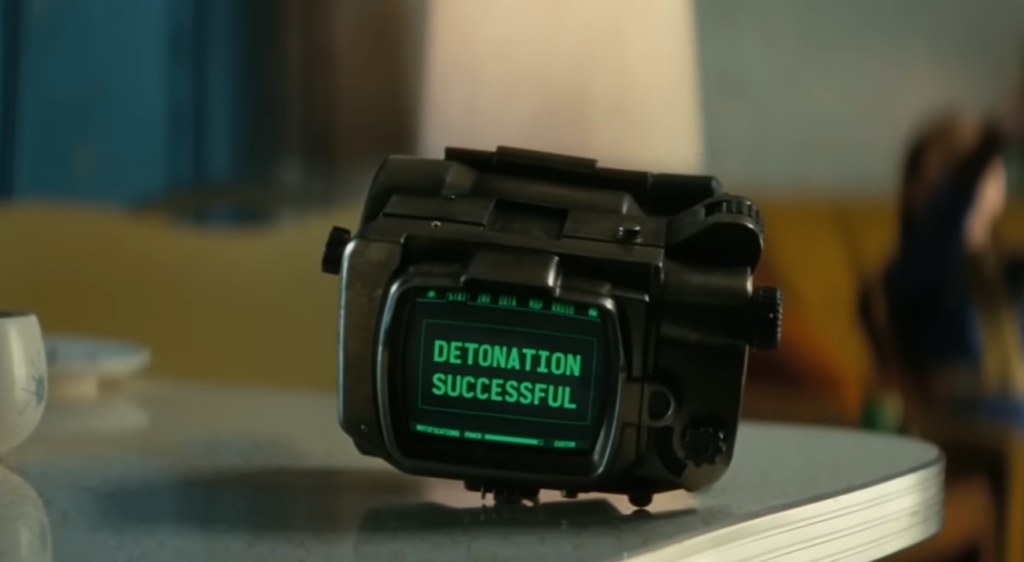
The Golden Rule of the episode title has a double meaning here: “He who has the gold makes the rules.” House and Hank are playing a game of Monopoly with human lives, and everyone else is just a piece on the board.
The Golden Rule is a harsh, brilliant hour of television that strips away the adventure-serial fun of Season 1 to reveal the rotting skeleton underneath. It argues that in the Fallout universe, altruism is a form of suicide, and survival requires a monstrous evolution.







Post Comment