Detective Hole Netflix (2026) : Full Movie Recap & Ending Explained
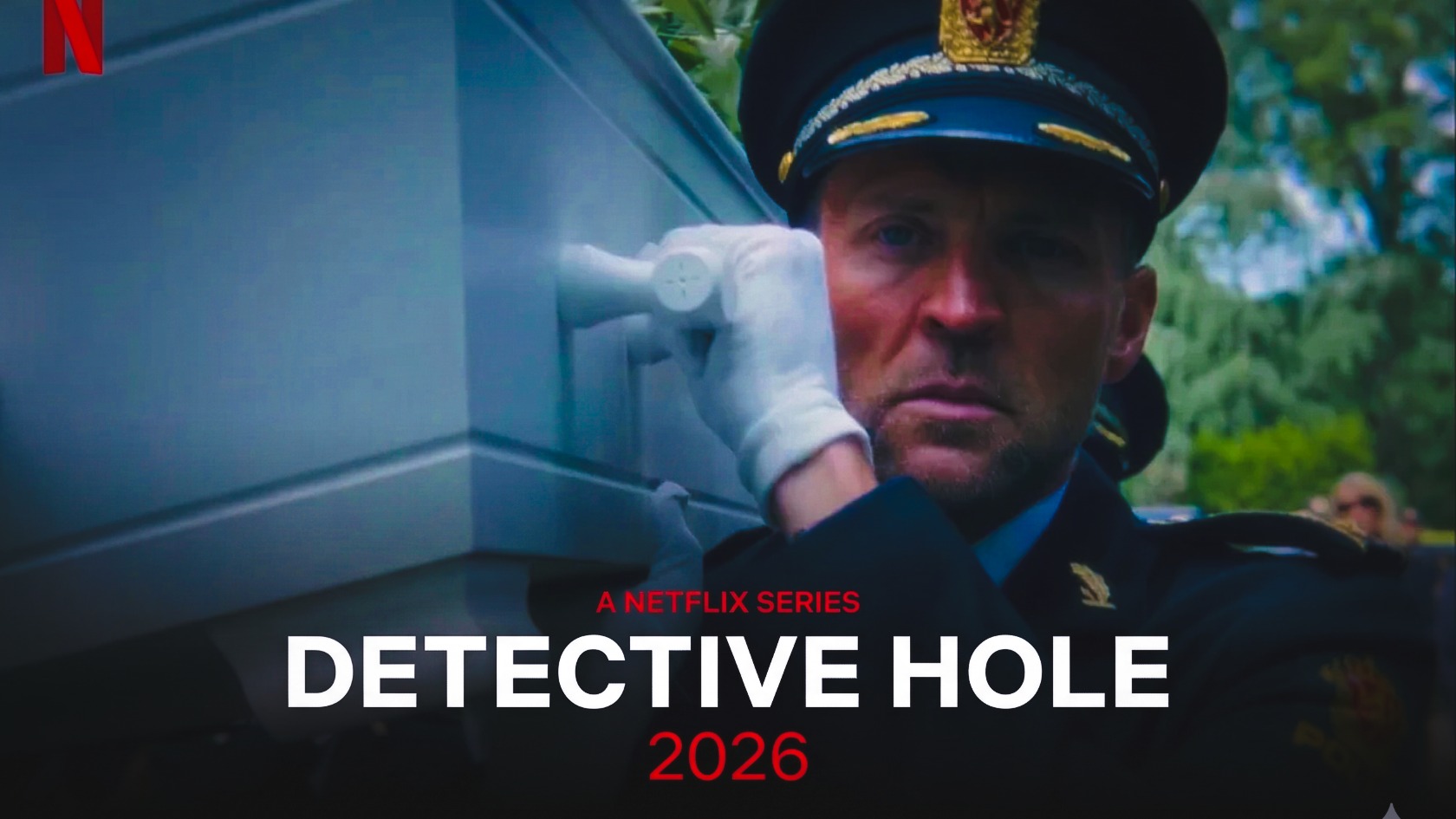
Jo Nesbø’s Detective Hole is one of 2026’s most accomplished streaming achievements ; a Nordic noir that earns every inch of its darkness, grounds its brutality in character rather than spectacle, and finds in Tobias Santelmann and Joel Kinnaman two of the finest lead performances in recent crime television.
The mystery at the series’ heart ; a husband who built a serial killer from scratch to punish the man who took his wife is one of the most elegantly constructed deceptions in recent genre fiction, and the adaptation honours both its ingenuity and its human horror. Willy Barli is not a monster. He is a man so consumed by possessiveness that he murdered four people to maintain a narrative. And the series understands that this is, in some ways, more frightening than an unknowable predator.
Tom Waaler’s death does not resolve the problem. It reveals the problem’s true depth. And Harry Hole, walking away from the woman he loves because he knows he is too dangerous to be near, stands alone in an Oslo that is simultaneously the city he protects and the institution that is trying to consume him.
Nordic noir has never been this punishing, this precisely observed, or this willing to let its hero win the battle and lose everything else.
Rating: 8.5/10 : Brutally effective, atmospherically impeccable, and anchored by two career-defining performances. Slightly overlong but never less than gripping. The best Norwegian crime drama since The Bridge, and arguably the finest literary adaptation of its genre in years.
The Series at a Glance: Nordic Noir's Most Anticipated Adaptation
Jo Nesbø's Harry Hole novels have sold more than 50 million copies worldwide, establishing the troubled Oslo detective as one of the defining antiheroes of modern crime fiction ; a figure as famous in Scandinavia as Sherlock Holmes is in Britain, and nearly as damaged. Netflix's long-awaited adaptation arrives with an extraordinary pedigree and a proposition that is almost impossible to resist: what if the creator adapted his own work, set it against a Gothicised version of Oslo's real geography, and scored it with Nick Cave and Warren Ellis?
Jo Nesbø's Detective Hole is a Norwegian crime drama television series, an adaptation of Jo Nesbø's Harry Hole novels, specifically the fifth instalment The Devil's Star. Harry Hole, a troubled Oslo police detective, must contend with both a horrific serial killer and his corrupt colleague Tom Waaler.
The series was released on Netflix on 26 March 2026. On the review aggregator website Rotten Tomatoes, the first season holds a 93% approval rating based on 15 critic reviews.
A perfectly cast Tobias Santelmann delivers electric work as the brilliant but brooding, self-destructive Hole, while Joel Kinnaman is equal to the task as Hole's police colleague, the ambitious and chillingly duplicitous Tom Waaler. Contributing greatly to that Nordic noir vibe: the use of dozens upon dozens of iconic Oslo locations, showcasing both the brightest and most lush as well as the dark and trash-lined underbelly of the city; a steady, blood-spattered stream of gruesome kills; and a typically effective and atmospheric score from the famed duo of Nick Cave and Warren Ellis.
This is Nordic noir at its most extreme ; a nine-episode fever dream of institutional corruption, psychological obsession, and a serial killer whose most ingenious creation turns out not to be his murders, but his motive.
The World Harry Hole Inhabits
The series establishes its setting with almost oppressive physicality. A heat wave hits a holiday-quiet Oslo. In an apartment by the cemetery, small black lumps begin to drip through the floor. At the same time, police detective Harry Hole is lying on the floor in his small apartment, drunk, dismissed, and abandoned by his girlfriend.
This is the man we are going to follow for nine episodes. He is not a detective in a comfortable armchair, surrounded by admiring colleagues. He is a functioning alcoholic with a brilliant mind and a self-destructive genius for applying it in ways that make institutional authority deeply uncomfortable.
Harry falls headfirst back into the bottle, loses his girlfriend Rakel Pia Tjelta and her son Oleg, and nearly loses his job on the force because he can't put the bottle down. But Harry ; who strongly suspects Waaler killed his partner is pulled back into service when a grisly serial killer surfaces, and Hole is the only detective with any experience in that arena.
The partner Harry lost ; Ellen Gjelten (Ingrid Bolsø Berdal) ; is central to the series' emotional wound even before she appears on screen. Harry and Ellen share a long, tender professional relationship established immediately in the first episode. The series knows what it is doing by building that relationship before it destroys it.
The Two Investigations Running in Parallel
Detective Hole operates on two tracks simultaneously, and the series' central structural tension comes from watching them converge.
Track One: The Bike Courier Killer. A serial murderer is operating through Oslo's sweltering streets ; we don't see the killer, but we hear his voice, in Swedish, repeating the same mantra: Open your eyes. It's a simple pattern. A red guiding star, a five-pointed devil's cross, will show you the way.
Each crime scene bears the same signature: a missing finger and a tiny pentagram-shaped red diamond left in the victim's eyelid. The murders follow a ritualistic pattern that suggests something ancient, organised, and deeply intentional.
Track Two: Tom Waaler. Harry suspects that his colleague Captain Tom Waaler is hiding something. Tom appears to have connections to several criminal operations, and he even does business with arms smuggler Martin Aminov. He's operating in a grey zone where he's able to justify for himself that what he's doing is morally right, even though the means to get there isn't exactly by the book.
In the hunt for his corrupt colleague Tom Waaler, Harry has lost his closest colleague and only he knows that Tom Waaler is behind the murder.
This is the knowledge Harry carries through the entire series ; the certain conviction that the man sitting beside him in the police station is a murderer and his inability to prove it is the engine of his psychological deterioration.
The brilliance of the series' construction is that these two investigations are not separate. They are, ultimately, a single mechanism and Waaler is exploiting both simultaneously.
The Killer's Signature
The serial killer does have a pattern ; he cuts off a different finger from each victim, always kills on the fifth floor, and Harry eventually discovers a geographic pattern by overlaying a devil's symbol over a map of the city.
The pentagram geography is one of the series' most visually striking conceits ; Oslo itself reimagined as a crime scene, with the city's streets forming the lines of a satanic symbol. Nesbø, who adapted his own novel for the screen, gives Harry the kind of lateral intellectual breakthrough that the genre demands while making it feel earned rather than convenient.
But everything about the pattern is wrong not in the sense that Harry misreads it, but in the sense that the pattern itself is a fabrication. Someone built it. Someone constructed a serial killer mythology with the deliberate intention of directing the investigation away from the truth and toward a specific individual.
Ellen's Death
Nothing in Detective Hole prepares you for what happens to Ellen, and the series deploys that shock with calculated ruthlessness.
After shooting Olsen in the stomach, Waaler drags Ellen into the cabin and swiftly takes a fire iron to her head multiple times before making a dying Olsen shoot her. Waaler then finishes Olsen off and calmly calls in the murder, claiming he found Ellen dead and shot Olsen in self-defence.
The killing of Ellen Gjelten ; a character the series has spent considerable time establishing as warm, competent, and Harry's truest professional anchor is one of the most genuinely shocking deaths in recent Scandinavian television. As producer Eric Fellner told Variety: Ingrid is a big actress in Norway. It's gonna blow people's minds, because they're settling in for her to be the third lead.
He is not wrong. Ellen's death does something crucial to the series: it transforms Harry's suspicion of Waaler from a procedural subplot into something deeply personal, and it establishes Waaler not merely as a corrupt cop but as a man capable of methodical, cold-blooded murder dressed as professional tragedy.
Martin Aminov
Late in the series, a man named Martin Aminov (Simon J. Berger) emerges as the chief suspect ; a playboy who deals in both weapons and pink diamonds, conveniently connecting him to both Waaler and the actual serial killer, who constructed his elaborate pattern specifically to frame Aminov.
Martin Aminov is, in the architecture of the mystery, a brilliant piece of engineering. He has the profile, the connections, the access to diamonds, and the psychological background to plausibly be a ritualistic killer. The investigation's momentum carries him toward a conviction that seems inevitable.
But Harry is never entirely convinced. Something about the geometry of the murders feels too deliberate ; too perfectly calibrated to point at one specific man. Harry begins to suspect that the crimes are not what they seem. He realizes what Willy must have done.
The Lisbeth Barli Revelation
The pivot that changes everything arrives when the police receive a package in the mail.
The police receive a finger in the mail belonging to Lisbeth Barli (Dagny Norvoll Sandvik), who died earlier in the series. After forensic evidence is discovered under her fingernail, the killer is revealed to be Lisbeth's husband, Wilhelm Willy Barli (Frank Kjosås), a theater producer.
The fennel seed clue is one of the series' most memorably grotesque detective strokes. When investigators find biological material under Lisbeth's fingernails containing fennel seeds, they trace it to the restaurant Theatercaféen, where her husband, the respected theater director Willy Barli, had eaten on the day she disappeared. Because fennel seeds take around 12 hours to pass through the digestive system, Harry realizes what Willy must have done. After killing Lisbeth, Willy cut off her finger and hid it inside his rectum before the police searched his apartment with a dog after he reported his wife missing.
It is the kind of detail that only Jo Nesbø would write and only mean people would think of. The concealment is simultaneously disgusting and procedurally airtight ; a piece of evidence so outlandish that it reads as unimpeachable precisely because no one could have invented it.
But the most disturbing revelation about Lisbeth is not the finger. It is what Willy did with the rest of her.
Willy keeps her body hidden inside his apartment ; sealed inside an air mattress filled with alcohol in an attempt to preserve it. What appears to be a waterbed is actually a tomb.
This detail has driven enormous viewer reaction, and justifiably so. It is not shock for shock's sake ; it is the series' most precise characterisation of Willy's psychology. He is not a man who committed a crime of passion and panicked. He is a man who could not let go. Who could not accept that his wife had chosen someone else. Who, in the most literal and most horrifying possible sense, refused to release her.
Who Is Willy Barli, and Why Did He Do It?
Harry confronts Willy, who confesses to the murders. Years earlier, Willy had discovered that Martin and Lisbeth had been having an affair. Although Willy thought their relationship was over, he later found out that Martin and Lisbeth were still in contact. She had been sending him money in preparation to leave Willy. As a result, Willy killed his wife and devised an elaborate scheme to make it appear like Martin was killing people in Oslo, including Lisbeth.
Willy, who is a director at a theater, orchestrates the entire illusion by: killing his wife Lisbeth; creating additional murders to mimic a serial killer pattern; planting evidence to frame Martin; and using the diamonds as a recurring signature. Season 1 of Detective Hole isn't a serial killer case at all. It's a deeply personal revenge plot disguised as something bigger.
The theatrical background is not incidental ; it is the series' most pointed piece of characterisation. Willy Barli, theater director, constructed the Bike Courier Killer the way he would construct a production: with attention to symbolism, to pattern, to the effect on an audience. The police were his audience. Martin Aminov was his villain. And the murders ; the real murders of innocent people were the staging.
You know how they always say it's the husband? Well, all the symbolism, the patterns, the missing fingers ; it was cover for the husband of the first victim.
The brilliant, disturbing irony of the series' mystery is built into its premise: the investigation into a serial killer was, from the beginning, a murder investigation. Just not the kind anyone was looking for.
Episode 6
No discussion of Detective Hole can proceed without addressing what happens in Episode 6.
George finally entices Waaler to come out of the darkness and into the light here with me ; an appeal he will quickly live to regret. As the two exchange first a cigarette and then a kiss, George seals his fate when he foolishly reveals he recognises Waaler from the news, since the detective has been publicly leading the investigation into the serial killer. Waaler lures George into the nearby toilet cubicles ; equipped with a glory hole in the walls for the sex workers to service their clients where the corrupt detective intimates he's going to perform oral sex on George. Instead, he uses a sword to cut off the sex worker's penis, then, as he sinks to the floor bleeding out, thrusts the weapon through the hole and into George's neck.
Producer Fellner warned: There's a scene in Episode 6 that's going to blow your mind. He's not wrong.
It is a scene that exists at the absolute outer limit of what prestige television will attempt. Brutal, precisely staged, and deeply revealing about Waaler ; a man who can commit acts of extreme violence and then walk back into the station and run the investigation into the serial killer he is simultaneously protecting. The title of the series suddenly reverberates differently.
The Ending & Who is The Killer
Episode 9, Duke Ellington's Piano, delivers the double conclusion the series has been building toward across nine hours.
The Willy Confrontation: Harry confronts Willy at his home, laying out the evidence that ties him to the murders. The key clue comes from Lisbeth's severed finger, which Willy sent to the police.
Harry discovers another body: Lisbeth's sister Toya was in Willy's apartment and found out what happened. Willy killed her too. Before Harry can arrest him, Willy flees onto the balcony of his apartment. In the chaos that follows, Willy leaps to his death from the balcony, choosing to end his story on his own terms.
Willy Barli dies by suicide after Hole realises he is the Bike Courier Killer. He jumps out of his fifth-floor balcony window, where he is impaled on an outdoor rotary clothes airer stationed in the garden below. Toppled by the weight of Barli's body, it looks like a blood-spattered pentagram from above ; a shot perfectly captured by cinematographer Ronald Plante.
The pentagram image ; the symbol that defined the entire serial killer mythology reproduced in Willy's final act. The theater director exits the stage he built, and his curtain call is the symbol he created. He wanted his story to have a happy ending, Harry says. It is the most chilling line in the series.
The Waaler Confrontation: Tom Waaler, a corrupt cop and longtime adversary of Harry Hole, first tries to lure Harry into joining his illegal arms-smuggling operation. When that fails, he kidnaps his girlfriend Rakel's son Oleg in an effort to force Harry to drop his investigation. Using Oleg as leverage, Waaler orchestrates a final confrontation, summoning Harry and Aminov to a student housing building with a plan to frame Harry for both kidnapping and murder. He handcuffs them together to set the scheme in motion, but Harry anticipates the setup, swallowing the cuff key and using the building's surveillance to undermine Waaler's plan.
In one of the most brutal scenes of the season: Tom ends up handcuffed to a moving elevator. His arm is severed. He ultimately dies from his injuries. His injury doesn't stop him, and Tom still tries to hunt down Harry. In the end, Tom isn't successful and instead dies from blood loss after losing his arm.
It is a death that is entirely consistent with the character: Waaler, who always believed the end justified the means, is defeated not by Harry's righteousness but by Harry's tactical intelligence. He anticipated the setup. He used Waaler's own instrument of control ; the handcuffs against him. And Waaler bleeds out still trying, still refusing to stop, because stopping would require acknowledging that someone outmanoeuvred him.
Waaler's Psychology
Tom Waaler appears to have gone completely off the rails when he lost someone he loved ; the colleague Harry Hole killed when he had a serious car accident while being drunk and chasing a suspect.
As Øystein Karlsen explains: A lot of the things that Harry does will make the audience go 'oh no, don't do that,' and then he does it anyway, and the same goes for Tom. They're more similar than your first impression of them, and in another world they probably could have been friends.
The brief exchange leaves Harry with the sense that he never fully understood the man he had been chasing and suggests that the story behind Tom Waaler may be even more complicated than it first appeared.
The fact that Harry tries to figure out what happened to Tom after his death, and why he became the way he is, is also his way of trying to understand himself and how someone like Tom could have gone in a totally different direction and had a great career.
This is the series' most quietly devastating psychological insight: Harry and Waaler are mirror images. Both brilliant. Both willing to transgress the law's formal boundaries. Both shaped by a specific loss. One became a detective who drinks too much and grieves too loud. The other became a crime lord in a police uniform.
The Ending Explained
After Waaler's death, Harry assumes briefly that the worst is over. It is not.
Harry meets with Chief Superintendent Agnes Sjolid, who tells him she won't dismiss him. There are other rotten apples in the police force beyond Tom, and she needs his help to find them. But to do that, Harry would have to stay quiet about Tom's weapons smuggling operation. When Sjolid asks if Tom had any partners, Harry says not that he knows of.
The series ends with the chief of police attempting to recruit Harry to root out corruption from within the force. It's a trap, of course ; the chief is actually the woman running the entire weapons operation.
This final revelation ; that the woman offering Harry a path to institutional legitimacy is herself the head of the criminal network he just dismantled the public face of reframes everything. The ending shows that solving a single case doesn't fix systemic corruption. While Harry catches the killer, the larger network of crime within the police remains active.
Harry, who told Sjolid that Waaler had no partners he knew of, has either genuinely not identified her yet or is playing the same game she is. The series does not resolve this. It leaves Harry standing at the mouth of a much larger cave than the one he thought he was investigating.
Harry gives reporter Maya a way to make things right: he'll provide a story exposing everything but only if something happens to him or the people he loves. It is the insurance policy of a man who knows he is now operating inside a system where the people who could betray him include the person who just promoted him.
Harry's Personal Life
Rakel, at this point, has decided to take Harry back but he walks away for her sake and Oleg's. Being close to him is a danger to their lives.
It is the series' most quietly noble moment, and Santelmann plays it with complete restraint. Harry Hole is capable of extraordinary sacrifice just not for himself. He dismantles his own possibility of happiness with the same methodical precision he brings to a crime scene, because the evidence is clear: the people who love him get hurt.
The choice to walk away from Rakel is the series' emotional ending, even if it is not the plot's ending. A man brilliant enough to catch a killer who hid a murder inside a serial killer mythology is not clever enough to build a life. Or is simply too aware of what he costs to try.
Review
If the Netflix Norwegian crime thriller series Jo Nesbø's Detective Hole had been packaged into five or even six episodes, it might well have been masterful. Stretched over nine long chapters and stuffed with a dizzying array of subplots, the production stalls a bit in the middle and occasionally turns down some side roads that result in dead ends but it's still an effectively grisly and beautifully mounted effort, with superb performances from the ensemble cast.
The critical consensus is accurate. Episodes 4 and 5 are the series' softest stretch ; the central mystery temporarily loses its momentum, and some supporting subplots involving gang warfare feel like scaffolding for later seasons rather than organic elements of this one. But the series never loses its atmosphere, never loses its lead performances, and never loses the central dread of watching two men who are more alike than they know move inevitably toward each other.
The series was filmed in more than 160 different locations over 113 days in Oslo, including notable spots from the book series, such as Harry's favourite hangout, Restaurant Schrøder. The city of Oslo used as character, as mood board, as murder weapon is the series' most consistent achievement.
Season 2: Will Harry Return?
According to Øystein Karlsen, whether Jo Nesbø's Detective Hole continues comes down to how audiences respond to the first season.
The architecture for a second season is in place. Netflix hasn't officially confirmed a second season yet, but the ending clearly sets up a continuation involving deeper corruption and new investigations.
Nesbø's Harry Hole series runs to twelve novels ; an enormous reservoir of source material for a show that has just proven it can handle the character's complexity and the world's darkness at the highest level of production quality.












Post Comment