Gone (2026) : ITV Full Series Recap & Ending Explained
Who Really Killed Sarah Polly?
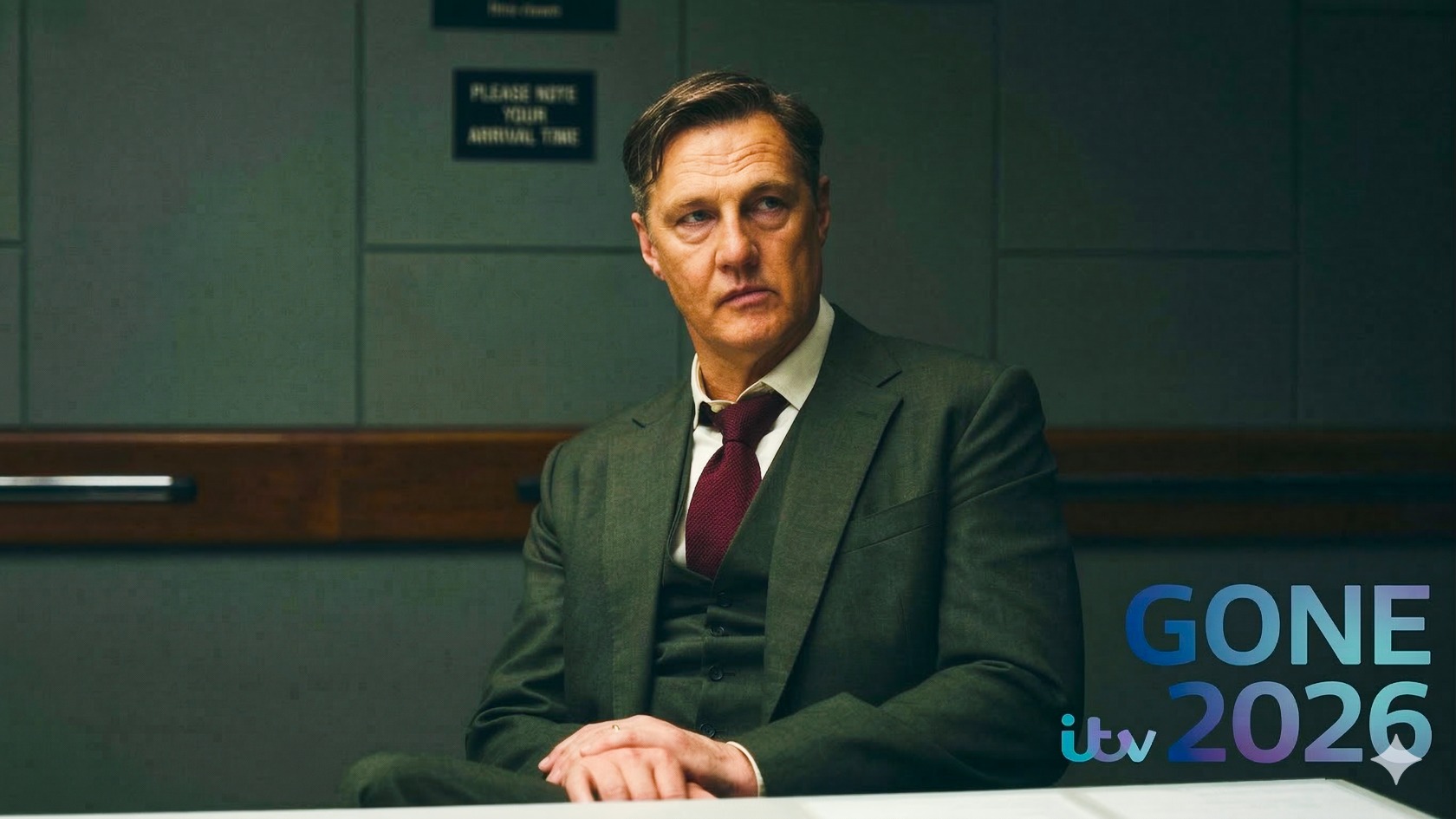
Gone is a six-part British crime thriller that premiered on ITV1 and ITVX on 8 March 2026, written by George Kay and starring David Morrissey and Eve Myles. On paper, it’s a missing-person-turned-murder mystery. In practice, it’s a slow, surgical dismantling of male authority, institutional reputation, and the secrets that respectable people bury beneath manicured lawns.
Like Kay’s earlier work, The Long Shadow, Gone is another story about masculinity and institutions — about powerful men and gamely struggling women, about people defined by their identities and stifled by their environments. It is confident enough to resist cheap thrills, and it earns every moment of unease it generates.
Episode 1 : The Disappearance
The series opens at St. Bartholomew’s, a prestigious private boys’ school outside Bristol, where rugby is practically a religion and reputation is everything. Headmaster Michael Polly (David Morrissey) watches his team win from the sidelines and barely blinks. He drives home at exactly 4:30 PM, as he does every single day. Order is his identity.
But something is wrong. His wife, Sarah Polly, is not home. Her keys are neatly placed where they always are. Her phone goes to voicemail.
Sarah’s disappearance is initially classed as low risk , after all, she is a grown woman with no criminal record, no history of mental illness, and no addiction. But when her phone is found, the case is elevated to high risk.
Enter DS Annie Cassidy (Eve Myles), the detective assigned to investigate. Annie is quickly struck by Michael’s unusual behavior even with his wife missing for almost an entire day, he seems far more concerned about his rugby team and the school’s upcoming examinations than about Sarah herself.
The episode ends on a knife’s edge: a neighbour’s dog discovers something in the dense woodland behind the Polly house. The audience knows, with a cold certainty, that this is going to get much worse.
Episode 2 : A Body, A Suspect, and a Breakdown
Episode two picks up in the shadow of that discovery. With a body unearthed during the search for Sarah, the series pivots from a missing-person drama into something darker and more procedural , a full-blown murder investigation.
Strangulation marks confirm the worst. Sarah Polly has been murdered. And yet hovering awkwardly at the centre of it all is Michael Polly, who continues to present a face of near-total emotional lockdown.
He complains about detectives dirtying his carpet. He frets about the school calendar. He is, by any ordinary measure of human grief, baffling.
Michael is suspended from his teaching post. Given one final opportunity to address the rugby team he clearly adores coaching, he delivers a composed farewell speech ; dignified, controlled. And then, after walking away, he finds a secluded spot and breaks down, weeping uncontrollably.
It is the series’ first genuinely ambiguous moment. Are these tears of trauma? Of stress? Of guilt? A mixture of all three? The show refuses to tell you, and that refusal is the whole point.
Episodes 3 & 4 : Secrets Peel Away
Annie is assigned as the Family Liaison Officer, giving her sustained access to the Polly household and to Michael. What she finds is a man constructed almost entirely of layers.
The investigation uncovers that Sarah had been conducting an extramarital affair with Stephen Sedgwick, the wealthy father of a student named Dylan. Michael had actually known about the affair but had not told anyone about it , he even hid it from the police during the investigation. What’s even more suspicious is that he had gone over to Stephen’s house late at night on the day of Sarah’s disappearance but had never actually rung the doorbell or tried to enter.
His explanation, when pressed, is almost pitiable: he wanted to know if Sarah was there, but couldn’t bring himself to face the humiliation of confronting the man she had chosen over him.
Sarah’s diary surfaces, and its contents are damning. She described her home life with Michael as suffocating. His daughter Alana tells the police: “She was scared of him.”
The picture assembled is of a cold, controlling patriarch from whom Sarah had been slowly trying to escape — physically, emotionally, and romantically.
Michael, meanwhile, begins confessing to Annie in a different register. He admits that his marriage had been disintegrating for months, that there had been arguments, that he had done things he was not proud of. He claims that his failure to be an ideal husband was what had driven Sarah towards seeking love and affection elsewhere.
It sounds like honesty. Or it sounds like a very carefully constructed narrative.
Episode 5 : The Attempted Suicide
The series takes its most dramatic turn when Michael attempts to hang himself, leaving behind a note addressed directly to Annie. In the note, he claims responsibility for Sarah’s death.
Annie is not convinced. Her instinct is precise: this is not a murderer’s confession. It is the self-flagellation of a man who believes, on some profound level, that his failures of love created the conditions in which his wife died. There is a crucial difference and that difference is everything.
The alibi that had always lingered in the background is now confirmed. At the probable time of the murder, Michael had been interviewing a candidate at the school for the position of language teacher, meaning that he has a definite alibi.
He did not kill Sarah. But he is not entirely innocent either not in the moral sense that the show cares about.
Michael is found by locals before he can die and rushed to hospital. Even then, he continues to claim guilt. He is a man who has spent so long being responsible for every outcome within his institutional walls that he cannot imagine a world in which he is not, in some sense, the cause of every catastrophe within them.
Episode 6 : The Truth About Rory
The finale redirects everything toward a figure who had been hovering at the edge of the narrative all along: Rory, a fiercely loyal member of the school’s inner circle, deeply devoted to the reputation and sanctity of St. Bartholomew’s.
Rory had discovered that Sarah was having an affair with Stephen Sedgwick. Knowing well what damage the exposure of a teacher’s affair with a student’s father would do to the school, he picked Sarah up and confronted her, forcing her to end the relationship over text, citing how catastrophic the scandal would be for the institution they both served.
In the argument that followed, Rory strangled Sarah to death with his bare hands , apparently just to stop her from shouting and creating a scene. He then dumped her body in the forest behind the headmaster’s house, dropping his house keys at the scene.
It was not premeditated. It was not even malicious in the conventional sense. It was the act of a man so colonised by institutional loyalty that he snuffed out a human life to protect a school’s rugby season and its Ofsted rating. It is among the most quietly devastating villain motivations in recent British crime drama.
Annie pieces it all together and finds herself alone with Rory at his house ; a genuinely dangerous situation. Knowing well that Rory would react terribly, perhaps violently, if she confronted him or tried to secretly record his confession, she instead lays her phone on the table , switching it off to assure him that she is not contacting the authorities or making a move against him. Once he reveals the whole story, Annie comforts him with kind words and gestures, continuing to play sympathetically towards him.
Then she makes her move. Reminding Rory of how he genuinely loved Sarah and had not murdered her out of any evil motive, Annie convinces him to go on record and tell the story to the investigative detectives for the sake of the woman he loved.
It is one of the best scenes in the series: quiet, intimate, and genuinely tense. Eve Myles earns every frame of it.
The Cold Case: Tina Bradley
Running parallel to the main investigation is Annie’s obsession with a cold case murder of a young woman named Tina Bradley, which had occurred eight years prior. Gone has this second subplot running in the background, with Annie still quietly investigating Tina’s death throughout the series.
The Tina Bradley thread is never fully resolved within the six episodes , it functions as both a character engine for Annie (giving her the emotional restlessness that drives her into cases with such intensity) and as a structural invitation for a potential second series. It suggests that Annie Cassidy is a detective who carries her unsolved cases the way other people carry grief.
Ending Explained : What Really Happened, and What Does It Mean?
In Gone‘s ending, Rory is seen sitting for the police investigation and is about to confess to the murder.
The mechanics of justice are in motion. But the show is not particularly interested in the courtroom that follows.
What the finale really confronts is something more unsettling: Michael Polly is innocent of murder, and yet guilty of so much else.
He is guilty of emotional negligence, of valuing institutional prestige over human warmth, of creating a home so airless that his wife had to look elsewhere for breath. Sarah’s affair with Stephen was not simply romance , it was a bid for survival. And Rory’s act, however grotesque, was the logical endpoint of a culture that St. Bartholomew’s had spent decades cultivating: one in which the school’s name mattered more than any individual soul within it.
The ending deliberately resists the kind of explosive reveal typical of crime thrillers. Instead, it focuses on the idea that the most troubling truths often exist in shades of grey.
Michael’s identity was bound tightly to authority , headteacher, patriarch, community figure. As Cassidy peels away that image, the drama suggests that environments built on strict control can hide emotional isolation and suppressed conflict.
The ambiguity surrounding Michael’s emotional responses is crucial. His behaviour could indicate guilt, grief, or simply a man who has spent decades repressing every vulnerability. The series repeatedly challenges viewers to confront their own assumptions about power and masculinity.
In the end, the mystery of Sarah’s death is less about one individual act and more about the environment that allowed secrets to accumulate.
Annie, for her part, closes one case while remaining haunted by another. She is not triumphant. She is the kind of detective who wins and still feels the weight of what winning cost everyone involved.