Cold Storage (2026) : Complete Recap, Review & Ending Explained
The Thing from Skylab That Forgot to Die
Picture this: a beeping sound. The kind of low, persistent, battery-dying chirp that crawls under your skin at 2am and refuses to stop. Most nights, that beep means nothing. But on one particular night shift at the Atchison Storage Facility in Kansas, that beep means the end of the world is approximately ninety-nine minutes away and the only people standing between a mutating space fungus and the Missouri River watershed are a bored ex-con security guard nicknamed Teacake, a sharp new hire with an obnoxious ex-boyfriend, a retired government operative with a bad back, and an eighty-something widow who came in planning to shoot herself and left having saved humanity.
Welcome to Cold Storage , the most cheerfully unhinged B-movie of 2026.
Cold Storage is a 2026 horror comedy film directed by Jonny Campbell from a screenplay by David Koepp based on his 2019 novel of the same name. It stars Georgina Campbell, Joe Keery, and Liam Neeson and follows the attempts at containing a parasitic fungus that leaks out of an abandoned military base.
On the review aggregator website Rotten Tomatoes, 78% of 87 critics’ reviews are positive. The website’s consensus reads: “A smart but familiar B-movie throwback, Cold Storage delivers campy performances, gooey splatter, and wry sci-fi wit with infectious enthusiasm.”
That consensus is accurate, if slightly generous. Cold Storage is not a great film. It is, however, a supremely fun one , a creature feature that understands its own DNA better than most genre exercises of recent years, swinging gleefully between the schlocky and the sincere, and landing, more often than not, exactly where it aims.
David Koepp Adapts David Koepp
That Cold Storage works as well as it does is substantially attributable to one man being both the novelist and the screenwriter.
Part apocalyptic zombie shocker, part alien conspiracy thriller, Jurassic Park screenwriter David Koepp’s novel receives a fun, scary adaptation.
Koepp , the craftsman behind Jurassic Park, Mission: Impossible, and Spider-Man brings to his own material an unusual authorial clarity: he knows which scenes are load-bearing and which are flavour, because he built them.
The resulting script is unusually efficient for its genre, setting up its internal rules early, honouring them consistently, and delivering its twists from established character and logic rather than narrative convenience.
The novel was published in 2019. The gap between page and screen gave the premise , a mutating biological organism exploiting institutional neglect and government secrecy to threaten mass extinction the unintentional benefit of arriving at precisely the moment when audiences have developed a refined and personal understanding of pandemic mechanics.
Cold Storage is a horror comedy about a fungus, yes. But it is also, inescapably, a film about what happens when the government stores a catastrophe in a basement and hopes nobody remembers to check on it.
Act One: 1979 → 2007 → Tonight
The Skylab Prologue: Space Debris with Consequences
Cold Storage begins with a brief introduction about how the Skylab space station had been home to numerous scientific experiments conducted by NASA, and how it was eventually decommissioned in 1979 and essentially destroyed through atmospheric re-entry. Although the authorities at NASA believed that they had successfully recovered and destroyed every piece of debris from Skylab, they had missed one small but crucial piece.
An oxygen tank survives and lands on Western Australia. A farmer takes it and makes a makeshift Skylab museum around it.
This is, historically, not entirely invented , pieces of Skylab genuinely did land in Western Australia, and were genuinely collected (or in some cases, not collected) by locals. Koepp builds his premise from this factual foundation, then extrapolates into glorious biological horror.
The oxygen tank had originally been aboard Skylab carrying an infectious fungus that was known to spread easily among small animals, essentially turning them into zombies. The authorities at NASA wanted to test if the same fungus would act differently when taken to outer space.
But the effects of outer space were totally devastating , it mutated into a much more powerful form, which could easily spread among the largest and most intelligent of animals, including humans.
When the farmer tried to clean the tank using dish soap and potatoes to remove the rust from the metal object, he unknowingly created a breeding ground for the fungus inside, which immediately got out through the fissures in the tank.
The result is catastrophically immediate. The fungus spreads through the surrounding area with horrifying speed, killing and reanimating everything in its path. The Australian outback sequences that open the film , bathed in harsh, sun-bleached white light, scored to something ominous and synthetic owe a direct debt to The Andromeda Strain, and the film wears that influence without embarrassment.
2007: The Containment Team
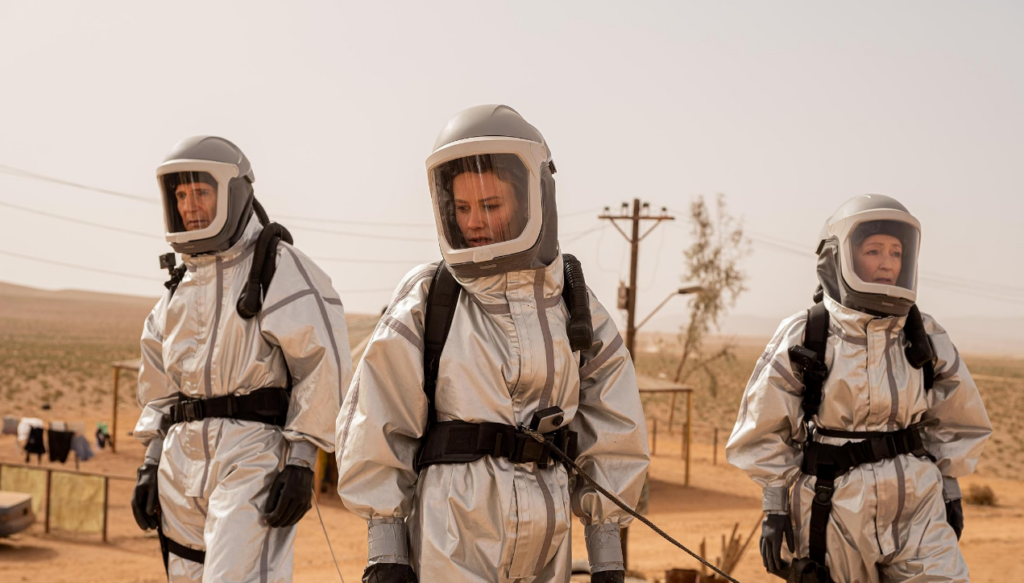
In 2007, biochemist Dr. Hero Martins accompanies Pentagon bioterror operatives Robert Quinn and Trini Romano to a tank that had been sent into space carrying an infectious fungus for study.
The 2007 sequence introduces us to our third-act cavalry before we need them . the genre’s classic dramatic insurance policy, investing us in Quinn and Trini as a team before we meet them separately in the present day.
Sosie Bacon plays Dr. Hero Martins with a combination of scientific authority and dawning horror , a character who exists primarily to explain the fungus’s properties to the audience while also demonstrating what the stakes look like at human scale.
Her fate in the 2007 sequence , she does not survive the Australian containment operation casts a specific moral shadow over Quinn. He is a man who has spent eighteen years knowing what he was involved in and watching institutional inertia allow it to fester in a Kansas basement.
After the death of Hero, the American authorities had completely burnt the village down to stop the spread of the fungus and locked up the contaminated oxygen tank inside a cold storage at the Atchison Storage Facility in Kansas.
High-grade thermistors had been used to ensure that the extremely low temperatures would be maintained inside the storage room so that the fungus would not have any chance to survive or spread.
And then, as governments reliably do with uncomfortable knowledge: they filed it, forgot it, and moved on. As years passed, the US military moved out of the Atchison facility, or at least part of it, abandoning the cold storage where the fungus had been contained.
The area had been taken over by a private self-storage company, with the fungus practically forgotten.
Act Two: The Night Shift from Hell
The Present Day: Teacake, Naomi, and a Beep
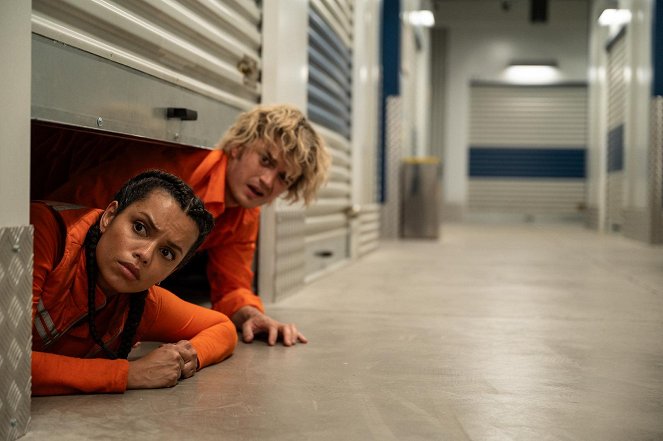
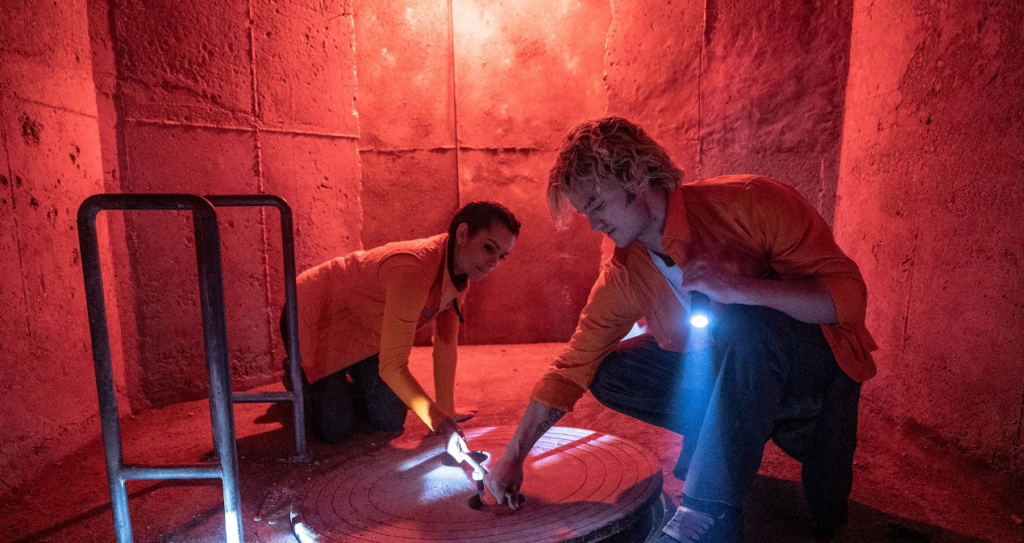
Teacake knows nothing about the military substructures beneath his feet. Nor does he have a clue about the fungus sample just four hundred feet down. He just knows that there’s been this odd, beeping sound tonight sort of like an alarm that keeps bleating out at regular intervals.
Joe Keery plays Travis “Teacake” Meacham, an employee out on parole who is desperate to hold onto his security job at the facility.
Keery carries the film’s comedic centre of gravity with the same loose-limbed, endearingly hapless energy that made him a fan favourite on Stranger Things , a man who is perennially in over his head and who has developed a resigned, philosophical relationship with that condition.
The nickname explanation, saved for the film’s final scene, is a perfect piece of characterisation: a small story about social belonging and food, delivered in the aftermath of apocalypse, that tells you everything about who Travis Meacham actually is.
Georgina Campbell’s Naomi Williams is the film’s practical intelligence , the person who actually investigates the beep while Teacake debates whether investigating beeps is technically in their job description. Georgina Campbell brings grounded intensity as Naomi Williams, anchoring the film emotionally while chaos unfolds around her.
She is a single mother, her daughter waiting at home, her ex-boyfriend (Mike) a complication she is actively managing, and her new colleague a pleasant puzzle she hasn’t decided what to do with yet. The romantic subplot between Naomi and Teacake is the film’s warmest thread, developed without sentimentality through the specific intimacy of two people surviving something terrible together.
Their investigation of the beeping leads them downward through a wall of sheetrock, into hidden corridors, toward the sealed government vault that nobody thought to put on the employee orientation map. What they find is the opening act of a biological catastrophe already in progress.
Act Three: The Old Guard Arrives
Robert Quinn and Trini Romano: Grumpy Operatives Save the World
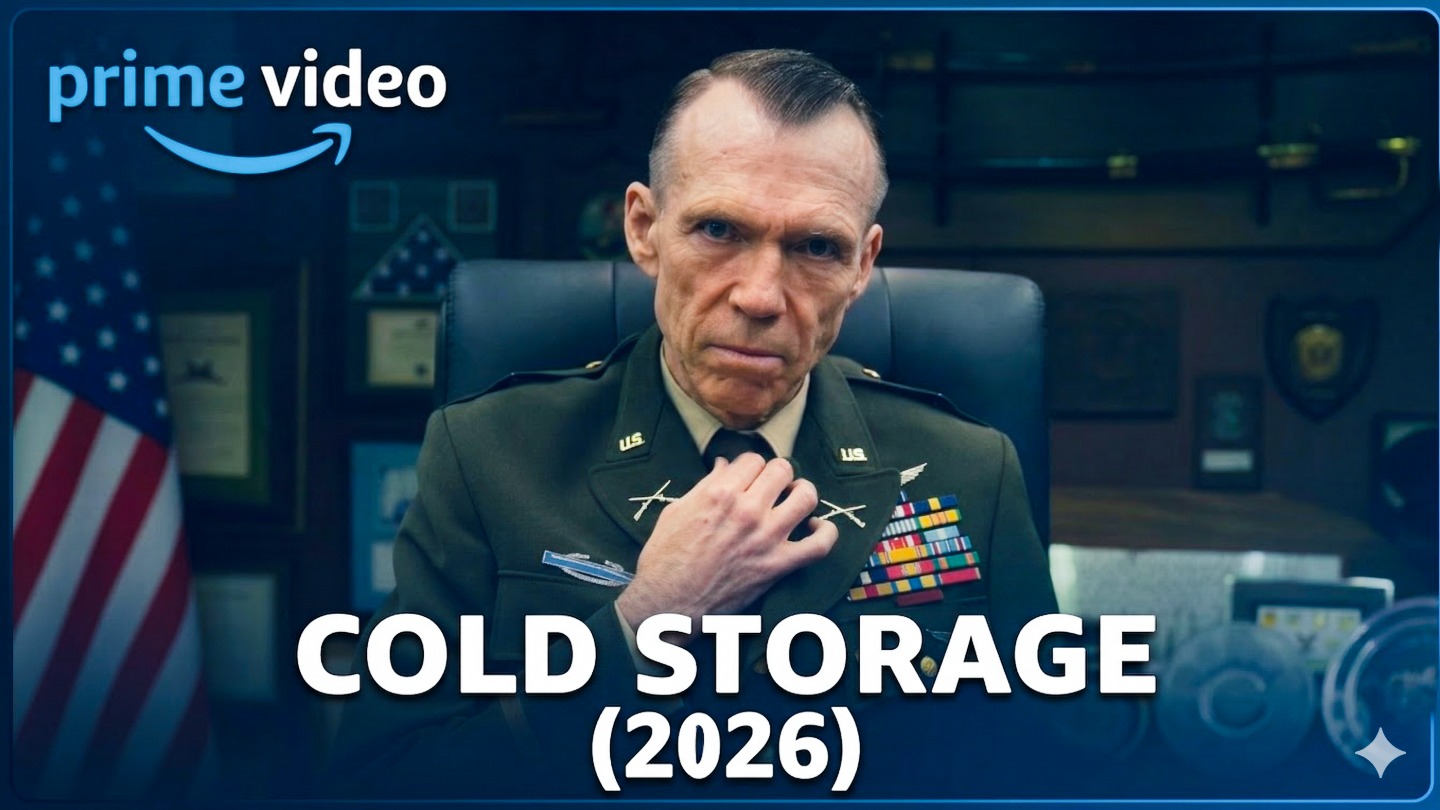
The “Old Guard” , Robert and Trini are grumpy and physically ailing (Robert’s back, Trini’s hacking up a lung from smoking), but they are the only ones capable of making the hard call to nuke the site.
Liam Neeson as Quinn operates in a register the actor has perfected over two decades of action-adjacent thrillers: the weary professional, the man who has been right about something dangerous for a very long time and has the bureaucratic scars to prove it. Paired with Lesley Manville’s dry wit, the two veteran actors add a strange credibility to the madness.
They’re the last remaining witnesses to the parasite’s original outbreak.
Manville, as Trini, is the film’s sharpest comedic instrument , a woman who has made peace with the moral weight of what she and Quinn did in Australia, and who carries that peace with a darkly pragmatic grace.
The bomb had been created 18 years earlier and put into a case as part of a contingency plan, but it had to be kept secret from the world since nobody had been told about the extraterrestrial fungus and its effects. Trini had carefully hidden the bomb in the basement of her son’s house, technically putting the lives of her grandchildren at risk, as she considered it to be the safest place.
That detail , the suitcase nuke in Grandma’s basement, next to the holiday decorations is one of Koepp’s most delicious dark comedy beats, and the film plays it completely straight.
Quinn reaches the facility, assesses the situation, and makes the decision that defines his character: his intention had only been to protect the rest of the country and the planet from contamination at any cost, and he was ready to sacrifice the lives of Teacake and Naomi, along with his own, to achieve this goal.
He sets the bomb’s timer without telling them. This is not portrayed as purely villainous , it is the calculus of a man who has been calculating these equations for eighteen years, a man who has learned that the fungus does not negotiate. He gives them “a solid hunch” they’ll make it.
In a better-funded film, this might have been explored with more moral complexity. In this one, it functions as a character beat that lands cleanly: Quinn is an operator, not a father figure, and the film is honest about the difference.
The Final Run
Travis and Naomi leave their hiding spot wanting to warn them to flee, but Mike arrives before and infects the gang members as Griffin runs away. As he turns towards the duo, they are saved by Ma Rooney. They get outside and find Robert, who gives them a backpack nuke to be put outside the vault door to destroy the whole facility from within and eliminate any trace of the fungus.
As the duo place the bomb, killing one of the infected along the way, Robert kills an escaping infected, making him fall on his back and find himself unable to get up. Griffin goes outside and tries to steal Robert’s car keys when an arriving Trini kills him. Travis and Naomi then appear and get along with Robert into Trini’s car, and they drive away right as the bomb explodes.
The explosion , a tactical nuclear detonation calibrated to irradiate deep underground without creating surface fallout swallows the Atchison facility whole, the ground caving inward as the car barely clears the blast radius. It is an enormous, gleefully executed practical-and-digital spectacle, and the film earns it.
Ma Rooney: The Film’s Unexpected Heart
Ma Rooney, who first seems detached from everything around her, unexpectedly helps Teacake and Naomi survive.
Vanessa Redgrave brings to Ma Rooney what only an actor of her calibre could , the suggestion of an entire life offscreen, decades of loss and love and disappointment compressed into a woman who has come to a storage unit on her anniversary to die beside a photograph of her dead husband.
Going down to her unit, she looks at a picture of her deceased husband (today was their anniversary) and pulls out a gun, intending to commit suicide.
After a moment of hesitation, she decides to take a short nap before she makes that final decision.
The nap saves her life, and eventually, she saves several others. When Mike , now fully infected and shambling , advances on Naomi and Teacake, it is Ma Rooney, awoken by the gunshots, who intervenes: “Something wasn’t right about that young man,” Mrs. Rooney deadpans after shooting him dead and watching his body explode in a shower of fungal green. It is the film’s best single line , delivered by one of the greatest actors alive as though she is commenting on someone’s parking.
The arc Ma Rooney completes is the film’s quietest emotional argument.
She arrived to end her life. The catastrophe around her , the chaos, the genuine possibility of mass extinction, the experience of action and consequence gives her something that her grief had taken away: a reason to see what happens next. She leaves the facility without fully understanding what she survived, but changed by having survived it.
The Ending Explained: Victory That Isn’t
The Aftermath: Heroes, Accountability, and a Whistleblower
Days later, Travis is spending time with Naomi and her daughter, while Robert is in the hospital, seeing news reports praising him for preventing a catastrophe.
The mechanism of his public vindication is one of the film’s smartest details. Ishani secretly leaks all the research papers and warning reports that Robert had once written to the American government to the media. Thus, in a matter of hours, Robert Quinn is hailed as a national hero who had tried to prevent the travesty, while Jerabeck faces flak for having ignored his warnings.
“Abigail” , the military officer who had been Robert’s voice on the phone throughout , turns out to have been acting under her own ethical compass all along: Abigail thanks him for reminding her that she does her job to be there and help when no one else will.
She is the film’s institutional conscience, the person inside the bureaucracy who chooses accountability over cover-up and who uses the only tool available to her (the press) to ensure that this particular basement monster cannot simply be replaced with another one.
The park scene between Travis and Naomi , his daughter Sarah on the grass nearby, Teacake finally explaining where his nickname came from , is the film’s emotional exhale.
Travis finally tells Naomi why his nickname is Teacake. Years before, he went to get some snacks with friends and teacakes were the only things left to buy so he took them, found out he enjoyed them, and thus was mocked by his friends by being given that nickname. He says he hadn’t heard his real name in years before she used it. Travis looks at her and she returns a glance, hinting at a future relationship between the two.
It is a lovely, understated conclusion to the film’s actual romance , a story not of supernatural fungus but of two people finding each other’s real names in a crisis and deciding they want to keep using them.
The Last Shot: The Deer That Ruins Everything
In a final scene, we see a herd of deer. One turns to the camera and violently vomits out the green fungus.
The ending makes it clear that survival and victory are not the same thing. Naomi gets back to her daughter. Quinn recovers in a hospital bed. But the last image of a deer vomiting green slime changes the meaning of everything that came before it. The blast stops one outbreak point. It does not prove the organism was erased.
The implications are carefully constructed. It seems like one of the deer from the herd that had first been infected by the cat has still survived, and it is still spreading the fungus among other life forms.
Since we know that the fungus is intelligent enough to modify itself to spread more easily and effectively, it might very well have come up with a means to stay alive for longer. Plus, we had seen the fungus travel up the tire of Mike’s car, raising the question as to whether the life form has now mastered the capability of traveling short distances through non-living objects.
By the end, Cold Storage is not saying humanity is safe. It is saying the clock may simply have been reset for the next outbreak.
This is the film’s most genuinely disturbing idea, delivered with the comic timing of a post-credits stinger: the nuclear explosion solved the immediate problem with finality and spectacle.
The systemic problem , the organism’s intelligence, its adaptability, the existence of other government vaults that nobody is checking remains entirely unaddressed. The deer is not a sequel tease. It is a thesis statement. The monster was never only in the basement.
The Performances
What distinguishes Cold Storage from the substantial body of B-movie genre exercises it resembles is that its cast has absorbed the tone with collective precision. You have a fun ensemble cast with Georgina Campbell, Joe Keery, Sosie Bacon, Vanessa Redgrave, Lesley Manville and Liam Neeson, who know exactly what movie they’re in.
Keery’s Teacake is disarming precisely because he never plays for laughs , he simply is the kind of person who processes existential horror through cheerful practicality, and the laughs arrive around him.
Campbell’s Naomi is the kind of horror-comedy lead the genre rarely produces: genuinely resourceful, emotionally present, and never defined by her fear. Neeson does Neeson , gruff authority in service of narrative momentum but with the specific grace note of a man who knows he is morally compromised and has decided not to hide it.
And Redgrave, in what is essentially a supporting turn, brings the whole enterprise a quality it would not otherwise have: the sense that human lives, even mundane ones, contain depths that deserve to be witnessed.
The Problems Worth Naming
Cold Storage is not without its failures. There is no consistent tone from character to character , sometimes Liam Neeson’s specialist is a wacky jokester, other times he is serious about the danger that could be unleashed on the world.
There is also the occasional throwaway plot point and janky editing, causing one to wonder if a prior version of the adaptation split time more evenly between the bioterror operatives and the security guards.
The CGI , particularly the animal sequences is, by critical consensus, not the film’s strongest suit. Anytime the film attempts to demonstrate how the fungal virus works on animals, the special effects are unforgivably poor.
The deer, in particular , the film’s most important symbolic image is rendered with effects that undercut its impact. A creature meant to represent the film’s darkest implication arrives looking like an early video game cutscene.
The film also rushes its finale. The movie feels a little uneven with the pacing as it doesn’t give you time to breathe as it wants to get to the ending faster.
The middle third, where the fungus’s escalating power and the facility’s expanding chaos could have been allowed to breathe, is compressed in favour of getting to the bomb. It works. It just works faster than it needs to.