Fallout Series Season 2 Episode 1 Explained | The Innovator
Intro
It has been a long trek across the radioactive sands since we last saw Lucy MacLean, The Ghoul, and the burning remains of the Griffith Observatory. While Amazon surprised us all by dropping the premiere a day early on December 16th, the wait for Fallout Season 2 has been excruciating.
Thankfully, the premiere, titled “The Innovator,” does not waste time re-treading old ground. Instead, it throws us headfirst into the sun-scorched brutality of the Mojave Wasteland. Written by showrunners Geneva Robertson-Dworet and Graham Wagner, the episode is a masterclass in tension, world-building, and that signature blend of dark humor and horrific violence.
Recap: The Innovator
The Cold Open: A Vision of Tomorrow
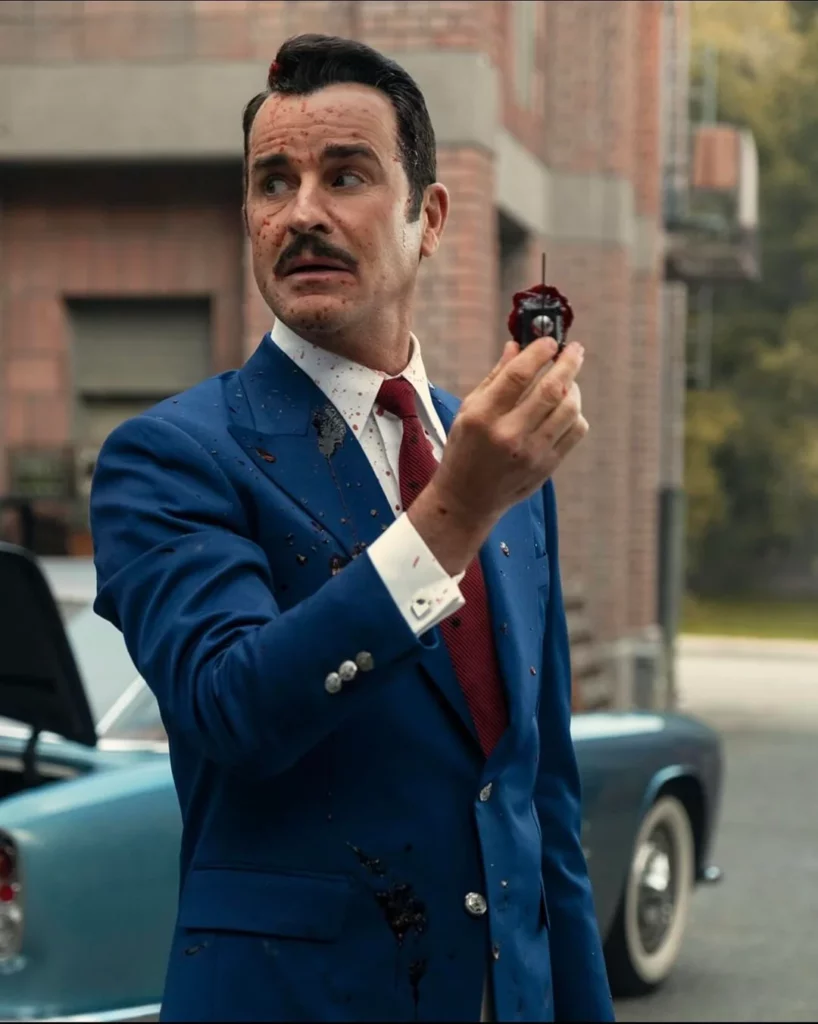
True to the show’s formula, we open in the Pre-War era. We are not in Los Angeles this time, but at a glittering gala in Las Vegas, hosted by none other than Robert House (a cameo that fans have been screaming for).
We see a younger, arrogant House: the titular Innovator pitching his vision of a city that can survive the end of the world. It’s a chilling juxtaposition to the decay we know is coming, anchoring the season’s thematic focus on the men who tried to save the world by owning it.
The Mojave Trek
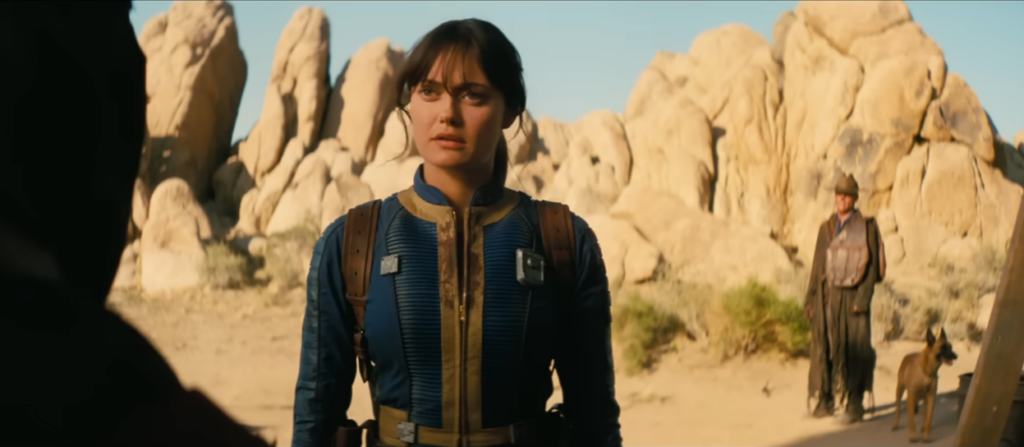
In the present (2297), the visual palette shifts from the Santa Monica gray-blues to the oppressive, irradiated oranges of the Mojave. Lucy (Ella Purnell) and The Ghoul (Walton Goggins) are deep in the desert. The dynamic has shifted; Lucy is no longer the naive Vault Dweller. She is hardened, begrimed, and following The Ghoul’s lead with grim efficiency.
Their journey is interrupted by a terrifying encounter with the Khans.
Vault 31: The Brain
The episode briefly checks in on Norm (Moisés Arias), still trapped in Vault 31. He is face-to-screen with Bud Askins (the brain on the Roomba). It’s a claustrophobic, psychological horror segment. Bud isn’t trying to kill Norm; he’s trying to recruit him, explaining the long game of management. It’s a dark, satirical look at corporate culture surviving the apocalypse.
New Vegas & The Lucky 38
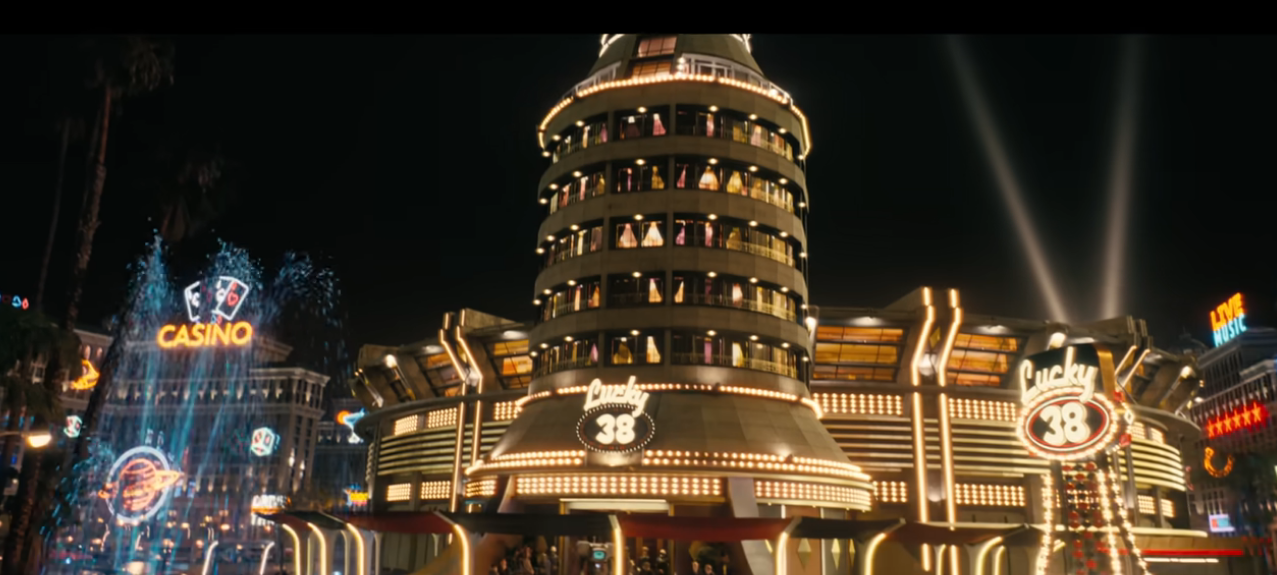
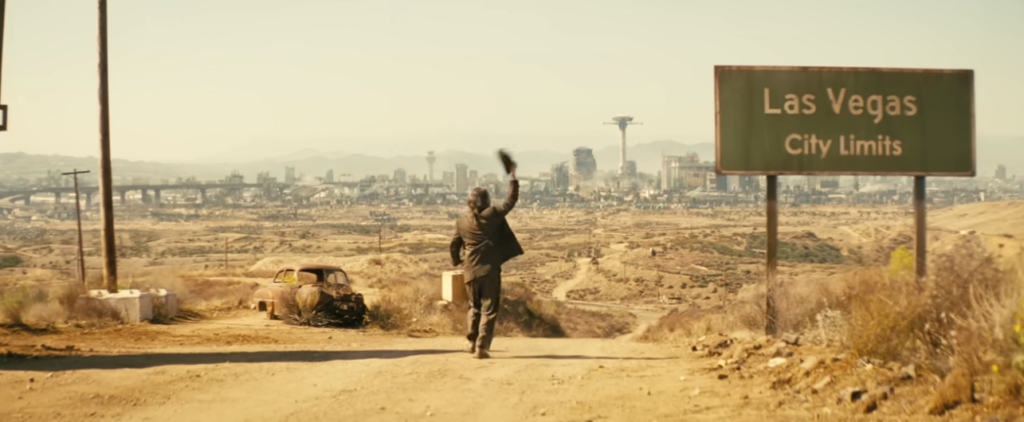
We catch up with Hank MacLean (Kyle MacLachlan), who has arrived at the outskirts of New Vegas. The city skyline is dominated by the Lucky 38 tower. Hank is not greeted as a hero. The episode does a fantastic job of portraying New Vegas not as the bustling hub from the game (yet), but as a silent, imposing fortress. Hank uses his Vault-Tec clearance codes to access the strip, only to be met by Securitrons, heavily armed robots with cheery faces on screens. He is escorted into the Lucky 38, ending his segment on a cliffhanger: an elevator ride up to meet the proprietor.
The Brotherhood’s Knight
Back in California, Maximus (Aaron Moten) is living a lie. The Brotherhood of Steel believes he killed Moldaver and secured the Cold Fusion technology single-handedly. He is being hailed as a hero, a status that makes him visibly nauseous. We see him struggling with the new power dynamics; the Brotherhood is now arguably the most powerful faction in the region thanks to the infinite energy source, but they are becoming increasingly fanatical. A brief interaction with a new scribe (played by the newly cast Macaulay Culkin in a scene-stealing, jittery performance) hints that some within the ranks suspect Maximus’s story doesn’t add up.
The Ending Explained
The episode concludes with Lucy and The Ghoul cresting a ridge at night. Below them, the lights of New Vegas flicker to life, powered up, presumably, by recent events or Hank’s arrival. It’s a hauntingly beautiful shot. The Ghoul checks his weapon, spits on the ground, and mutters, “House always wins.” Cut to black.
🔥Wasteland Propaganda Posters🖥️ Get your Faction Prints here:
Analysis
The Shift in Tone
The Innovator feels distinct from Season 1. If the first season was about discovery (Lucy discovering the surface), this season is about consequence. The setting of the Mojave adds a Western noir element that fits Walton Goggins perfectly. The cinematography captures the vast, lonely emptiness of the desert, making the eventual reveal of the neon-lit New Vegas even more striking.
2. The Theme of The Innovator”
The title works on multiple levels. It refers to Robert House, the pre-war genius who predicted the war. But it also refers to the Vault-Tec philosophy we learned about in the S1 finale: the idea that the only way to win the game of capitalism is to blow up the competition. Hank MacLean is an “innovator” in his own twisted mind, and seeing him approach the one man who might rival Vault-Tec’s power (House) sets up a fascinating conflict of ideologies.
3. Character Evolution
- Lucy: Ella Purnell continues to excel. Her optimism hasn’t vanished, but it has curdled into determination. She isn’t looking for her dad to hug him anymore; she’s looking for answers.
- The Ghoul: Goggins remains the MVP. We see cracks in his armor this episode. Returning to Vegas—a place he likely knew before the bombs, or at least knows the history of—clearly unsettles him.
- Maximus: His storyline is the ticking time bomb. The “imopster syndrome” is literal here. The introduction of Macaulay Culkin’s character as a suspicious, intelligent foil to Maximus’s brawn is a brilliant move.
4. The Weekly Release Format
Amazon’s decision to shift to a weekly release schedule (Wednesdays) rather than a binge drop is bold. “The Innovator” is a dense episode that benefits from digestion. It sets up multiple mysteries: Who is controlling Vegas now? What does Bud want with Norm? Will the Brotherhood march on the Mojave?—that will keep the community theorizing for the next seven weeks.
Verdict
The Innovator is a confident, visually stunning return to the Wasteland. It honors the New Vegas game lore while blazing a distinct path for the TV narrative. The stakes feel higher, the world feels bigger, and the moral compasses are more broken than ever.
The Series vs New Vegas Game
This is where the rubber meets the road or rather, where the Brahmin meets the butcher. The premiere, The Innovator, didn’t just drop Easter eggs; it backed a dump truck full of lore right up to the camera.
For fans of the 2010 Obsidian Entertainment masterpiece Fallout: New Vegas, seeing these elements realized in live action is a massive payoff.
Let’s break down the deep lore connections between the events of this episode and the established game canon.
1. Robert House: The Ghost in the Machine
In the Episode: We saw a pre-war flashback of House pitching his vision, and in the present, Hank MacLean entering the Lucky 38 to meet the proprietor.
The Game Lore:
Robert House was the CEO of RobCo Industries (the company that made the Pip-Boys, Protectrons, and Liberty Prime’s navigation systems). Unlike the Vault-Tec executives who hid underground, House predicted the Great War and spent billions fortifying Las Vegas to shoot down the nuclear missiles. He saved the city, but the strain put him into a coma for decades.
The State of Being
In New Vegas, House is technically alive in 2281 (and presumably 2297), kept alive by advanced life-support machinery deep within the Lucky 38. He is a shriveled, husk of a man who communicates solely through a giant supercomputer screen showing his youthful face.
Hank going to see him suggests a Corporate Alliance. In the lore, House was wary of Vault-Tec, considering them competition. If Hank is seeking him out, it implies Vault-Tec might need RobCo’s resources or that House has something Vault-Tec lost.
2. The Lucky 38 & The Strip
In the Episode: The tower dominates the skyline, dark and imposing until the lights flicker on. It is treated as a fortress.
The Game Lore:
The Lucky 38 is iconic because it is the only casino on the Strip that has been closed for centuries. No one enters, no one leaves. It is purely House’s base of operations.
Because of House’s laser defense grid, the Vegas “Strip” is one of the few places in the wasteland with intact buildings and electricity. The show capturing that contrast, the dead Mojave vs. the electric Strip, is pure New Vegas aesthetic.
3. The Securitrons
In the Episode: Hank is greeted by robots with “cheery faces on screens” that are heavily armed.
The Game Lore:
PDQ-88b Securitrons
These are House’s private army. They are distinct from the clumsy Protectrons or the military Assaultrons.
The face on the screen changes based on combat status. They have a friendly cowboy face (often called “Muggy” by fans, though that’s a different character) for policing, and an angry red soldier face for combat.
In the game, these bots are terrifying. They pack Gatling lasers and 9mm submachine guns. If House (or Hank) upgrades them with the “Platinum Chip” (a major game MacGuffin), they gain missile launchers and grenade launchers. Seeing them in the show confirms that whoever holds the Lucky 38 has serious firepower.
4. The Cazador
In the Episode: Lucy and The Ghoul are attacked by a frantic, mutated wasp.
The Game Lore:
Unlike the Radroaches (which are just irradiated bugs), Cazadores were genetically engineered bioweapons created at the Big MT (Big Mountain) research facility in the Old World Blues DLC.
In the game, they are widely considered the most annoying and deadly enemy for low-level players because they move erratically and inflict rapid poison.
Their presence in the show confirms we are deep in “Mojave rules” territory. It also subtly hints at the existence of Big MT, another potential location for future seasons.
5. The Power Vacuum (NCR vs. House)
In the Episode: The Brotherhood feels dominant in California, while Vegas feels isolated.
The Game Lore:
In the game (set in 2281), the New California Republic (NCR) was a massive army trying to annex Vegas. However, Season 1 of the show revealed the NCR capital, Shady Sands, was nuked.
This explains why the NCR wasn’t besieging the Strip in the premiere. With the NCR broken, the power balance has shifted. It leaves a vacuum that the Brotherhood of Steel (Maximus’s faction) and Mr. House are likely about to fight over. This mirrors the game’s central conflict but adapts it to the show’s new timeline (15 years after the game).
Summary of Connections
The showrunners are clearly treating New Vegas as a sacred text. They haven’t retconned House or the geography; they have advanced the timeline.
- Hank MacLean represents the Old World Blues: the refusal to let go of the past.
- Mr. House represents The House Always Wins: calculated, cold autocracy.
- The Brotherhood represents Hoarding Technology:religious zealotry.
We are setting up for a three-way war that mirrors the video game, but with Lucy and The Ghoul caught in the crossfire.
Rating: 4.5/5 Nuka-Colas